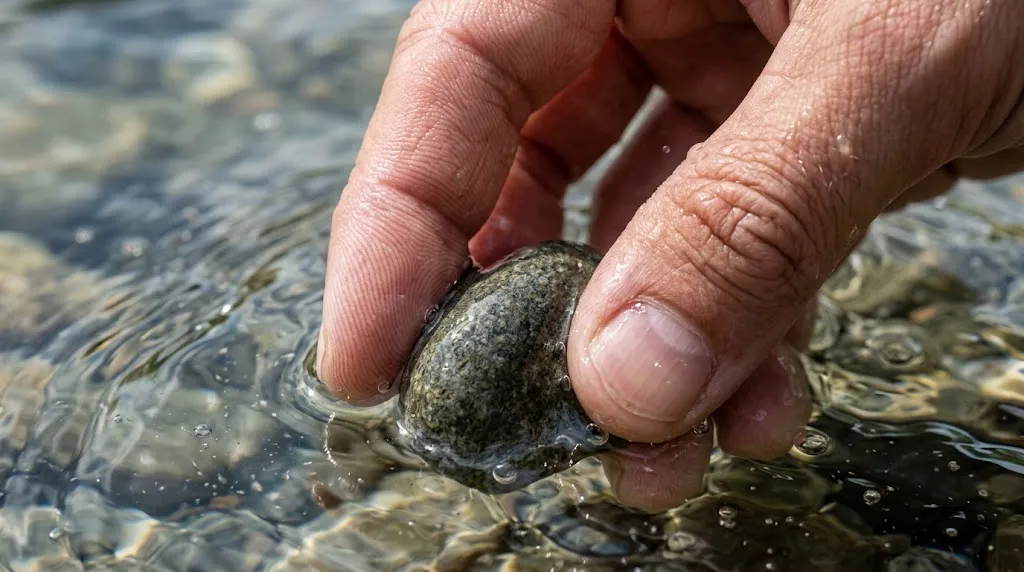
Put your hands in a bath for long enough and your fingertips eventually start looking as though someone has drawn a series of tiny valleys across them. The same thing happens to your toes after swimming. Leave the water and, after a while, your skin quietly goes back to normal.
For years, the explanation most people heard was simple: your skin absorbs water and swells.
It sounds reasonable. Your fingers have been sitting in water, so why wouldn't they become waterlogged?
The problem is that this doesn't explain what you're actually seeing. The skin on your fingertips doesn't simply puff up. It forms a very specific pattern of grooves and ridges, and the process depends on your nervous system. If certain nerves aren't working properly, the normal wrinkling response can be reduced or disappear altogether.
So why do your fingers wrinkle in water?
Your fingertips are actively changing their shape. Small blood vessels in the finger pulp constrict, reducing the volume underneath the skin. The skin above that smaller volume then folds inward, producing the familiar wrinkles. The response is controlled by the sympathetic nervous system, part of the system that automatically regulates things such as blood vessel diameter.
And there may be a practical reason for it.
Wrinkled fingertips appear to make it easier to handle wet objects. Several studies have found evidence that the grooves can improve grip efficiency or help move water away from the contact area. Scientists still debate exactly how much of the wrinkling exists for this purpose, but the idea is considerably more interesting than "your skin got wet."
Your skin isn't simply soaking up water
The old explanation wasn't completely unreasonable.
The outer layer of skin does interact with water, and water can move into the skin through structures such as sweat ducts. But simple water absorption doesn't explain the whole phenomenon.
If your fingertips merely swelled because they had absorbed water, you would expect the process to behave like ordinary swelling. Instead, the finger pulp loses volume as blood vessels constrict. That pulls the overlying skin into folds.
Researchers have been able to demonstrate the importance of blood flow by measuring circulation in the fingers during immersion. As the wrinkles developed, blood flow through the digital vessels decreased, consistent with vasoconstriction, meaning the vessels were narrowing.
That's a very different process from a sponge simply filling with water.
It also explains why the wrinkles tend to appear most strongly on the pads of the fingers and toes. These areas contain a type of hairless skin called glabrous skin, which has a dense supply of sweat glands, nerves and specialized blood vessels. The palms and soles have the same general type of skin, although the most obvious wrinkling usually occurs on the fingertips and toes.
What actually happens underneath a wrinkled fingertip?
The easiest way to understand it is to start underneath the skin.
When your fingers stay immersed, signals associated with the water exposure lead to activity in the sympathetic nervous system. Blood vessels in the fingertip constrict, reducing the amount of blood and therefore the volume of the soft tissue inside the fingertip.
The skin itself hasn't suddenly shrunk.
The support underneath it has changed.
As the volume of the finger pulp decreases, the skin has less surface area underneath it to stretch across. It buckles into grooves and ridges instead.
That's why the wrinkles have such a distinctive appearance. They aren't random creases caused by soggy skin. They're the visible result of a change happening beneath the surface.
There is still some uncertainty about exactly how water exposure starts the nervous-system response. One established explanation involves water entering through sweat ducts and changing the local environment around nerve endings and sweat glands, which then affects the blood vessels. Researchers continue to investigate the details.
The important point is that the nervous system is involved.
That becomes particularly clear when you look at people whose nerves have been damaged.
Why do fingers wrinkle if the nervous system is involved?
Because the response isn't purely mechanical.
If wrinkling were caused only by water entering the outer layer of the skin, damage to a nerve shouldn't necessarily prevent it. Yet studies have found that fingers with disrupted nerve supply can show little or no normal water-induced wrinkling. The response can return partially when nerve function is restored.
That's one reason doctors have used water-induced finger wrinkling as a simple test of sympathetic nerve function.
A clinician can immerse a person's hand and look at how the fingers wrinkle. Abnormally reduced or asymmetric wrinkling can sometimes provide information about autonomic nerve function. Recent medical reviews still describe the test as a possible screening tool for certain forms of small-fiber or autonomic nerve dysfunction.
That doesn't mean an ordinary person should inspect their fingers after a bath and try to diagnose a neurological disorder.
Finger wrinkling varies between people, and the circumstances of the test matter. The clinical use is much more controlled.
But it does give us a useful clue about what's happening.
Your nervous system is helping make the wrinkles.
Why do your toes wrinkle too?
Your toes have much of the same kind of hairless skin found on your fingertips, including the specialized structures involved in the response.
So when you spend a long time swimming, soaking in a bath or simply standing in water, the same basic process can occur in your feet.
That's why the skin on the balls of your toes and the bottoms of your feet can develop the same strange ridges that appear on your hands.
Your arms don't usually do it to the same extent because most of the skin covering your arms is different. It contains hair follicles and doesn't have the same combination of structures found in the thick, hairless skin of your fingertips, palms, soles and toes.
The response is therefore concentrated in particular parts of the body rather than being a general reaction in which all skin starts wrinkling after enough time underwater.
Why does it take several minutes?
The wrinkles don't appear the instant you put your hand in water because your body has to respond.
The process involves changes in blood vessel tone and tissue volume, so it takes time to develop. Studies of the wrinkling response commonly measure changes over several minutes rather than seconds.
The exact timing isn't fixed.
Water temperature, the condition of the skin, the individual person's physiology and other factors can affect how quickly and strongly the wrinkles develop. Temperature is particularly interesting because warm water can produce a strong wrinkling response, while extremely cold conditions don't simply make the process happen faster because they're colder. The relationship between temperature and wrinkling is more complicated than that.
So if your fingers wrinkle unusually quickly one day and take longer the next, that doesn't automatically mean something has changed in your health.
Why are the wrinkles arranged in lines?
This is one of the stranger parts.
The grooves aren't scattered randomly across your fingertips. They form recognizable patterns.
Part of that pattern comes from the structure of the fingertip itself and the way the skin folds as the underlying tissue volume changes. Researchers have also been interested in whether the arrangement of those grooves has a useful function, particularly when the finger is pressing against a wet object.
That leads to a much more interesting question.
What are the wrinkles actually for?
Do wrinkled fingers really help you grip wet things?
There is good evidence that they can.
One study compared people's ability to handle objects underwater with wrinkled and unwrinkled fingertips. Participants handled submerged objects more quickly when their fingers had developed water-induced wrinkles, while the wrinkles didn't provide the same advantage when objects were dry.
A later study looked at grip force more directly. It found that people with wrinkled fingers needed less grip force to hold wet objects than people with wet but unwrinkled fingers. In other words, the wrinkles appeared to make the grip more efficient.
The basic idea makes sense.
Water between your finger and an object can reduce friction. That's why a wet glass can be harder to hold than a dry one.
The grooves in wrinkled skin may provide channels for water to move away from parts of the contact surface, leaving more effective contact between the ridges of your fingertip and the object.
The comparison that has been used in research is similar to the tread on a tyre. The grooves aren't there simply to make the surface look different. They can give water somewhere to go while leaving parts of the surface in contact with the road.
The analogy isn't perfect, but it helps explain why a deliberately patterned fingertip could be useful around water.
But is the grip theory actually proven?
Not completely.
This is one area where it's worth being careful.
Several experiments support the idea that water-induced wrinkles improve handling of wet objects or make grip more efficient. But another study found no improvement in certain measures of manual dexterity and no meaningful change in touch sensitivity caused by wrinkling.
So scientists aren't simply saying, "Wrinkles exist because evolution designed them to grip things."
The evidence is more nuanced.
The nervous system clearly controls the response. Wrinkled fingers can improve performance with wet objects in some experimental situations. That makes an adaptive function plausible, and probably quite interesting from an evolutionary point of view. But the exact evolutionary story isn't something we can prove just by observing the wrinkles.
It could also be that the response has other effects that haven't been fully understood.
The safest description is that water-induced wrinkling appears to be an active physiological response, and improving interaction with wet objects is one strong explanation for why that response may be useful.
Why would evolution bother changing your fingertips in water?
If the grip explanation is correct, the advantage would have been fairly practical.
Humans have spent a very long time dealing with wet environments. Finding food in streams, handling wet plants, climbing around in rainy conditions and carrying objects in water all create the same basic problem: water makes surfaces slippery.
A temporary change to the fingertip could help with that.
And notice how little the body has to change.
Your fingers don't grow extra tissue. They don't produce a new substance. They don't need a permanent modification that would interfere with normal dry-land activities.
The body can simply alter blood flow in the fingertip for a while, change the shape of the skin, and then reverse the process when the stimulus is gone.
That would be an economical solution if the wrinkles provide a meaningful advantage.
But again, the adaptive explanation remains an interpretation of the evidence rather than something we can prove with certainty.
Why don't your fingers stay wrinkled after you get out?
Because the process is reversible.
Once the water exposure ends, the conditions that produced the vasoconstriction change. Blood flow and tissue volume return toward their usual state, and the skin gradually becomes smooth again.
The wrinkles aren't permanent folds carved into the skin.
They're the surface expression of a temporary change underneath it.
That's also why your fingers can go from completely normal to deeply wrinkled and back again without leaving damage behind.
The same basic principle explains why your fingertips don't become permanently wrinkled just because you take long baths every day.
Why do some people wrinkle faster than others?
There's no single timer that controls everyone's fingers.
The response can be affected by water temperature, the properties of the water, the duration of immersion and individual differences in autonomic and vascular function. Research has also shown that factors such as the chemical composition of the water can influence wrinkling.
That means "my fingers wrinkle after five minutes" versus "mine take fifteen minutes" isn't automatically a meaningful health difference.
The more useful distinction is whether there is a persistent, unusual change, particularly if one hand or a particular group of fingers behaves very differently from the other and there are other symptoms.
What if one hand doesn't wrinkle?
That can be more interesting than simply having fingers that wrinkle quickly or slowly.
Because the response depends partly on intact sympathetic nerve function and blood vessel responses, an absence of wrinkling can occur when those pathways are disrupted. This is one reason the water-wrinkling test has been used in neurological and autonomic assessments.
There are also medical conditions associated with abnormal wrinkling patterns.
But an unusual result on its own isn't a diagnosis. If one hand suddenly stops wrinkling when it always used to, especially alongside numbness, weakness, changes in sensation or other neurological symptoms, that's something to discuss with a clinician rather than trying to interpret from an internet article.
For most people, though, wrinkled fingers after swimming are exactly what they're supposed to be doing.
So why do your fingers wrinkle in water?
The old explanation makes the phenomenon sound passive.
Water gets into the skin, the skin swells, and wrinkles appear.
What's actually happening is much more active.
Water exposure triggers a response involving the sympathetic nervous system. Blood vessels in the fingertips constrict, reducing the volume of the tissue beneath the skin. The skin then folds into the grooves and ridges you see on your fingertips and toes.
And those wrinkles may do something useful.
Research suggests they can help people handle wet objects more efficiently, possibly by improving the way water moves between the fingertip and the object. The evidence isn't strong enough to say that this is the only reason the response exists, but it fits remarkably well with what the body is doing.
So the next time you get out of a bath and find your fingertips covered in tiny ridges, you're not looking at skin that has simply absorbed too much water.
You're looking at a temporary change in blood flow, nerve activity and skin shape that your body can switch on and off.
The strange part isn't that your fingers get wet and wrinkle.
It's that your nervous system appears to be changing the shape of your fingertips because you've been sitting in water.