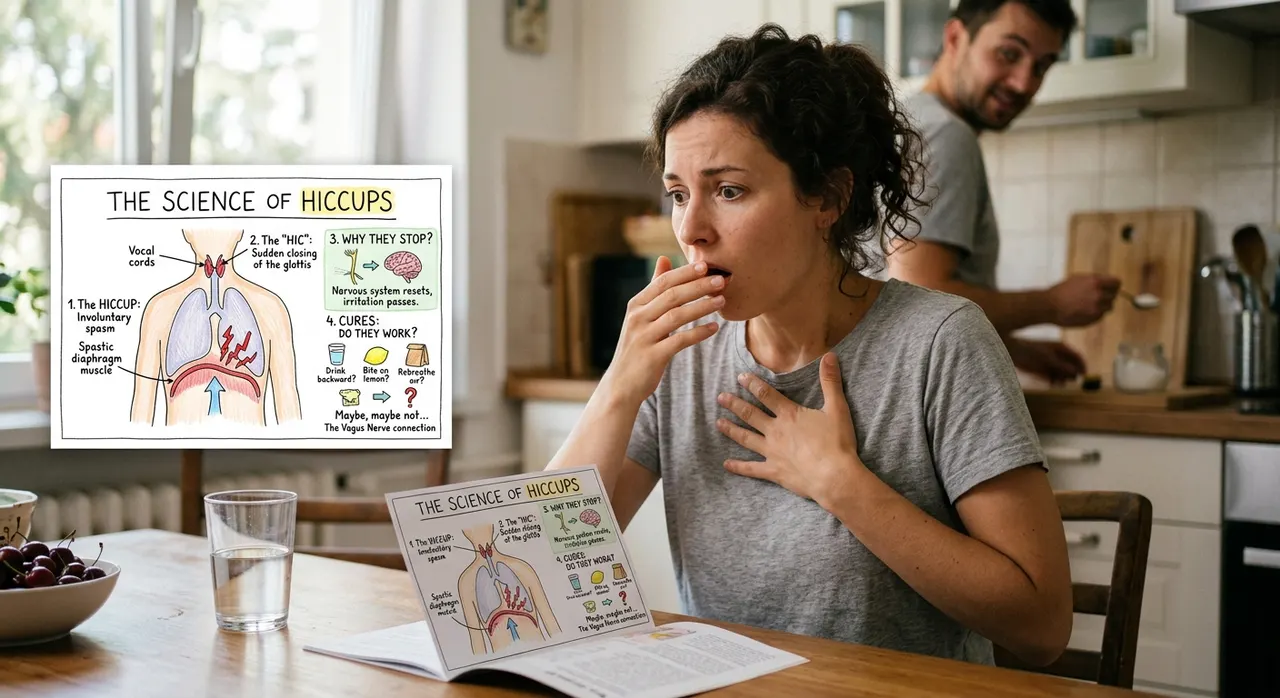
A hiccup can appear out of nowhere.
You're eating dinner, talking to someone, laughing, or doing absolutely nothing unusual, and suddenly your diaphragm jerks. Your vocal cords snap shut. That familiar little sound comes out.
Then it happens again.
And again.
Most of the time, hiccups disappear on their own. But the strange part is that nobody seems to agree on why some of the things we do to stop them actually work.
Hold your breath.
Drink water.
Swallow a spoonful of sugar.
Get startled.
Pull your knees toward your chest.
Some of these tricks have been passed around for generations. A few have a reasonable explanation behind them. Others have much less going for them.
To understand the difference, you first have to look at what a hiccup actually is.
A hiccup starts with a sudden contraction
Your diaphragm is a large sheet of muscle underneath your lungs. When you breathe in, it contracts and moves downward, giving your lungs room to expand. When it relaxes, you breathe out.
Normally, this happens without you having to think about it.
A hiccup is different.
For reasons that aren't always obvious, the nerves controlling the breathing muscles can trigger a sudden involuntary contraction of the diaphragm. Almost immediately afterward, your vocal cords close.
That combination produces the familiar "hic" sound.
The whole thing happens incredibly quickly.
There isn't a tiny creature inside your chest making a noise, obviously, but the mechanism is surprisingly mechanical. A signal triggers the diaphragm. The diaphragm contracts suddenly. Air rushes inward. The opening between your vocal cords closes, producing the sound.
That's one hiccup.
Then, if the reflex fires again, you get another.
So what sets the reflex off?
This is where things become less tidy.
There isn't one universal cause of hiccups.
Eating too much, eating quickly, drinking carbonated drinks, alcohol, sudden changes in temperature, laughing, excitement and swallowing air can all be associated with ordinary short-lived hiccups.
Sometimes there's no obvious trigger at all.
The nervous system involved in the hiccup reflex includes the nerves that carry signals from the diaphragm and nearby organs to the brain, along with pathways that send signals back to the muscles involved in breathing.
You don't consciously decide to start hiccuping. The reflex takes over.
That's also why telling yourself to "just stop" doesn't work very well.
Your diaphragm isn't waiting for permission.
Why can holding your breath sometimes stop hiccups?
This is one of the more sensible traditional tricks.
When you hold your breath, you're deliberately changing what's happening in your breathing system. Carbon dioxide gradually builds up in your blood, while the normal rhythm of breathing is interrupted.
That can influence the nervous signals involved in breathing and may interfere with the hiccup reflex.
It doesn't mean that holding your breath is a guaranteed cure. It isn't.
But there is at least a plausible physiological reason why it sometimes appears to work.
The same basic idea helps explain why some other breathing tricks can occasionally stop hiccups. You're changing the normal pattern of breathing and giving the reflex something different to respond to.
Just don't turn this into a competition to see how long you can hold your breath. There's no prize for that.
What about drinking water?
Drinking water is another common remedy, and it may work for some people.
Part of the reason could be swallowing itself.
Swallowing activates muscles and nerves in the throat and chest, which can interact with the reflex pathways involved in hiccups. Slow, controlled drinking also changes the rhythm of breathing and swallowing.
So if drinking water makes your hiccups disappear, that doesn't necessarily mean water itself is some special anti-hiccup substance.
The act of swallowing may be doing more of the work.
There's also a simple coincidence problem.
Hiccups naturally tend to stop on their own. If you drink a glass of water while they're happening and they disappear thirty seconds later, it's impossible to know with certainty whether the water stopped them or whether the reflex was already about to end.
That's one reason hiccup remedies can seem more reliable than they actually are.
Does swallowing sugar really work?
This one has a more interesting explanation.
The idea is usually to swallow a small amount of granulated sugar. The unusual sensation in the mouth and throat, followed by swallowing, may stimulate nerves involved in the hiccup reflex.
There have been reports and small studies suggesting that certain swallowing or sensory stimulation techniques can help stop hiccups, but the evidence isn't strong enough to say that sugar is a guaranteed treatment.
So I wouldn't describe sugar as a proven cure.
It makes more sense to think of it as one of several tricks that might interrupt the reflex in some people.
And if you're giving this a try, there's no reason to swallow a huge spoonful. More isn't better.
Can being scared actually cure hiccups?
This is where the traditional advice gets a little ridiculous.
The theory isn't completely impossible, though.
A sudden fright can cause a strong change in your breathing pattern and activate the body's stress response. That sudden shift could potentially interrupt the hiccup reflex.
But there's a big difference between "there's a plausible mechanism" and "this is a scientifically established treatment."
Being startled isn't a dependable medical treatment for hiccups.
So if somebody tells you they know a guaranteed way to scare your hiccups away, you can probably save yourself the trouble.
Why do hiccups sometimes stop as suddenly as they started?
This is probably the part that makes hiccups feel so strange.
You can hiccup ten times in a row and then suddenly... nothing.
The reflex has stopped.
That's because a normal bout of hiccups isn't necessarily being driven by an ongoing problem that has to be fixed. The nervous activity triggering the contractions can simply settle down.
Your breathing muscles return to their normal rhythm.
That's why a remedy can get credit for something that might have happened anyway.
You hold your breath.
You drink water.
You wait.
The hiccups disappear.
It feels as though the trick worked.
Maybe it did. Maybe the reflex was simply ready to stop at that moment.
Without controlled testing, you can't easily tell the difference.
Why do hiccups last for hours sometimes?
Most hiccups are brief.
Occasionally, though, they keep going for much longer.
Persistent hiccups can last for more than two days, and hiccups lasting longer than a month are classified as intractable hiccups.
That's a different situation from the ordinary hiccups you get after eating too quickly.
Long-lasting hiccups can sometimes be linked to irritation or problems affecting the nerves or parts of the brain involved in the reflex. Certain medications, metabolic problems and conditions affecting organs in the chest or abdomen can also be involved.
That doesn't mean a few hours of hiccups automatically means something is seriously wrong.
But if hiccups continue for a long time, repeatedly interfere with sleep or eating, or come with other concerning symptoms, it's worth getting medical advice rather than trying increasingly strange home remedies.
And yes, hiccups can be dangerous
Ordinary hiccups aren't dangerous for most people.
The problem with prolonged hiccups is what they can interfere with.
Someone who can't stop hiccuping may have difficulty eating, drinking, sleeping or speaking normally. Severe persistent hiccups can become exhausting and can sometimes contribute to other problems.
Very rarely, hiccups can be associated with a more serious underlying condition.
So the useful distinction isn't really "hiccups are harmless" versus "hiccups are dangerous."
It's duration and context.
A short bout after dinner is usually nothing to worry about.
Hiccups that keep going for days are a different story.
What about babies?
Babies hiccup a lot.
In fact, babies can hiccup before they're even born.
That might sound alarming if you haven't seen it before, but infant hiccups are generally normal. Their nervous systems and breathing patterns are still developing, and feeding can also trigger the reflex.
You may notice a baby hiccuping after feeding because the stomach has become distended or because the baby swallowed some air.
Most of the time, there's nothing that needs to be done.
They usually stop on their own.
And please don't try adult hiccup tricks on a baby. No breath holding, no startling, and definitely no forcing food or water as a "cure."
So which hiccup cures actually make sense?
If we separate the popular tricks from the biology, a pattern starts to emerge.
- Holding your breath: Plausible. Changing breathing and allowing carbon dioxide to rise may interfere with the reflex.
- Drinking water: Plausible. Swallowing stimulates nerves and muscles that may disrupt the reflex, while drinking also changes breathing patterns.
- Swallowing sugar: Possible, but evidence is limited. The sensory stimulation and swallowing may be more relevant than the sugar itself.
- Getting startled: Possible in theory because it can abruptly change breathing and nervous system activity, but there's little reason to treat it as a reliable cure.
- Waiting: Surprisingly effective. Hiccups commonly stop on their own, so sometimes the best explanation is simply that the reflex has run its course.
That's the awkward part about evaluating home remedies.
A hiccup episode is usually temporary. If you try something and the hiccups disappear, you don't automatically know that you caused the change.
What should you actually do when you get hiccups?
For an ordinary bout, you don't need anything complicated.
You can try slowly drinking water or briefly holding your breath if you're comfortable doing so. Avoid eating or drinking too quickly, especially if you've noticed that doing so triggers your hiccups.
If one method doesn't work, there's no need to keep escalating to increasingly bizarre tricks.
And don't use anything that could make you choke, faint or hurt yourself just to get rid of a hiccup.
Most bouts will end without any intervention.
That's probably why humans have accumulated so many supposed cures in the first place. We keep trying something, the hiccups stop, and the trick gets remembered.
Sometimes the trick probably helped.
Sometimes the hiccups were simply finished.
The next time your diaphragm suddenly decides to start making that little noise, there's a perfectly ordinary piece of biology behind it. A nerve signal triggers a sudden contraction, your vocal cords close, and you get the sound we call a hiccup.
The weird part isn't that it happens.
It's how quickly the whole reflex can start, stop, and disappear again without you ever consciously controlling it.