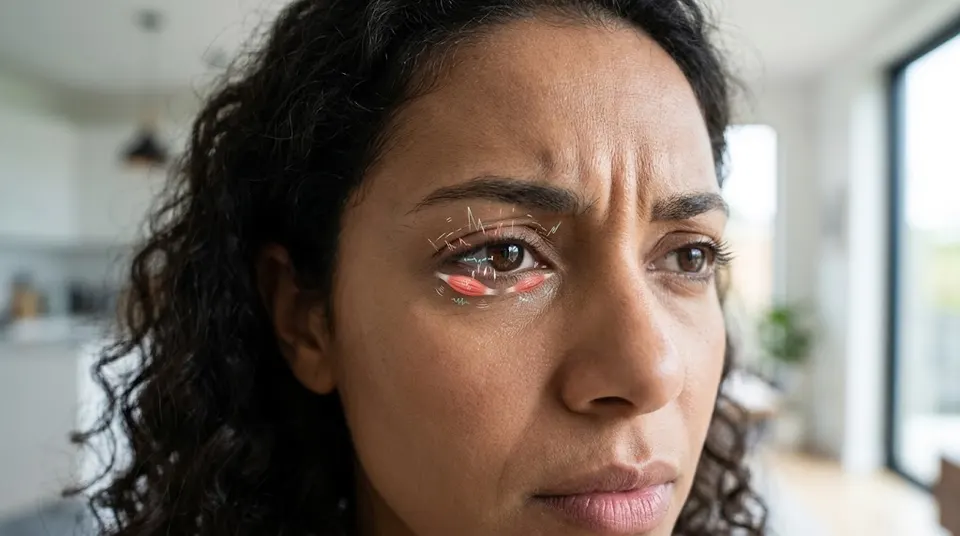
An eye twitch can be ridiculously small and still manage to annoy you all day.
You're sitting at your desk and your lower eyelid starts flickering. It stops. Ten minutes later, there it is again. You rub your eye, check the mirror, maybe blink a few times, and then start wondering whether something is wrong.
Most of the time, there isn't.
The common kind of eye twitch is called eyelid myokymia. It's an involuntary contraction of the tiny muscle that closes your eyelid. It usually affects one eye, often the lower eyelid, and the movement can look or feel like a little ripple under the skin.
The strange part is that you don't have to do anything deliberately to make it happen. The muscle is getting signals to contract when you didn't ask it to.
And several very ordinary things can make that more likely.
What is actually twitching?
Your eyeball usually isn't the thing jumping around when you say your eye is twitching.
It's generally the eyelid muscle.
One of the main muscles involved is called the orbicularis oculi. It sits around your eye and helps you blink and close your eyelids.
With myokymia, small groups of muscle fibers contract involuntarily. The contractions are usually gentle and repetitive, which is why the sensation can feel like something is moving underneath your eyelid.
Doctors describe the movement as fine or rippling rather than a strong, forceful blink. It's also usually limited to one eyelid at a time.
That's why you can sometimes feel the twitch much more clearly than another person can see it.
The muscle is moving. Just not very much.
Why does it happen?
There isn't always one single cause.
In many cases, several ordinary things seem to pile up at once. You've slept badly for a few nights, you've been drinking more coffee than usual, you're stressed, you've been staring at a screen for hours, and your eyes are irritated or dry.
Then your eyelid starts doing its little thing.
Common triggers associated with eyelid myokymia include fatigue, lack of sleep, stress, excess caffeine, nicotine, eye strain and irritation of the eye surface. Bright light, alcohol and environmental irritation can also play a role.
That doesn't mean every eye twitch has a neatly identifiable trigger. Sometimes it simply happens and you never find out exactly why.
Why is it usually just one eye?
Because the twitch is happening in a small group of muscles rather than your whole body.
Typical eyelid myokymia is localized. One lower eyelid might start fluttering while the other eye carries on completely normally.
It can affect an upper eyelid too, and occasionally both eyes can be involved, but one-sided lower-eyelid twitching is the classic pattern.
So if your left lower eyelid is twitching while your right eye feels perfectly normal, that pattern by itself isn't particularly unusual.
Why does my lower eyelid twitch more than my upper eyelid?
Lower eyelid twitching is more commonly reported with myokymia.
That doesn't mean an upper-eyelid twitch is abnormal. Both can happen. It's simply that the lower lid is the more typical location.
The important distinction isn't really "upper versus lower."
It's what the movement looks like, how long it lasts, and whether anything else is happening with it.
Can lack of sleep cause an eye twitch?
Yes, fatigue and sleep deprivation are among the common factors associated with eyelid twitching.
This is one reason people sometimes notice the twitch after several late nights.
You don't necessarily have to be severely sleep-deprived, either. A change in your normal sleep pattern can coincide with the twitch.
If you've been sleeping badly and suddenly notice your eyelid flickering, getting back to a decent sleep schedule is a sensible first thing to try.
Can stress cause it?
Yes.
Stress is another commonly reported trigger for eyelid myokymia.
And stress often comes with some of the other things that can encourage twitching, such as poor sleep and increased caffeine consumption.
So sometimes the question isn't simply, "Did stress cause my eye twitch?"
It may be more like, "What changed in my routine lately?"
A stressful week can change several things at once.
What about caffeine?
Caffeine can contribute too, particularly when you're consuming more than usual.
Coffee, energy drinks and other caffeinated products can all add to your overall caffeine intake. Medical sources list excess caffeine among the common triggers associated with eyelid myokymia.
If you've suddenly developed an annoying twitch and you've also gone from one cup of coffee to three or four, cutting back for a while is a reasonable experiment.
You don't need to assume caffeine is definitely the cause. You're simply removing one possible trigger and seeing what happens.
Can staring at a screen cause it?
Long periods of screen use can contribute to eye strain, and prolonged screen time is listed among possible risk factors for eyelid myokymia.
There's another practical issue here.
When you're concentrating on a screen, you may blink less often. That can leave your eyes feeling dry or irritated, which can add another source of discomfort around the eyelids.
So if you've spent half the day staring at a bright monitor and your eyelid starts twitching that evening, the screen isn't necessarily directly "causing" the muscle to fire. Eye strain, dryness, fatigue and the rest of your routine may all be contributing.
Can dry eyes cause an eye twitch?
They can be associated with eyelid twitching.
Irritation of the eye surface and dry eyes are both recognized factors that can accompany or contribute to twitching.
This can create an irritating little loop. Your eyes feel dry, you blink more or rub them, the area becomes more irritated, and the eyelid keeps misbehaving.
If your eyes are also gritty, burning or unusually uncomfortable, addressing the dryness may help.
Is dehydration the reason my eye is twitching?
People often blame dehydration for muscle twitching, but it isn't one of the best-established explanations for ordinary eyelid myokymia.
The better-supported everyday triggers include fatigue, stress, caffeine, nicotine, eye strain and eye irritation.
That doesn't mean hydration is irrelevant to how you feel. Drinking enough fluid is sensible for general health.
It just isn't a good idea to look at every eye twitch and immediately conclude that you're deficient in water or electrolytes.
What about magnesium?
This one gets repeated a lot online.
You'll see people recommending magnesium supplements whenever someone mentions muscle twitching, but an eye twitch by itself doesn't prove that you have a magnesium deficiency.
Nutrition can be involved in some forms of muscle twitching, but ordinary eyelid myokymia is more commonly associated with things such as stress, fatigue, caffeine and eye irritation.
So I wouldn't treat a random eyelid twitch as a diagnosis of magnesium deficiency.
If you're concerned about a nutritional deficiency or you're having frequent muscle symptoms elsewhere in your body, that's a different conversation worth having with a healthcare professional.
Why does it sometimes stop and start?
Because the contractions aren't necessarily continuous.
A twitch may happen for a few seconds or minutes, disappear, and then return later. Some episodes can continue intermittently for hours, and ordinary eyelid myokymia can sometimes hang around for days or even weeks before settling down.
That's why you might think you've finally gotten rid of it, only to feel that familiar flutter again while you're watching TV that night.
It doesn't automatically mean the condition is getting worse.
Why does it twitch more when I'm tired?
This is one of those situations where the trigger and the timing make sense together.
Fatigue is associated with eyelid myokymia, and people commonly notice the twitch during periods of poor sleep or heavy physical or mental strain.
If you've been exhausted, stressed and relying on caffeine to stay awake, you've basically collected several common triggers at once.
Getting enough sleep, easing back on caffeine and giving yourself some recovery time may be enough for the twitch to settle.
Why does my eye twitch when I'm trying to sleep?
It can feel especially noticeable at bedtime because there are fewer distractions.
During the day, you're talking, walking, working, looking at things and generally paying attention to dozens of other sensations. When you lie down in a quiet room, a tiny repetitive movement in your eyelid suddenly becomes impossible to ignore.
If you're also tired or have been under stress, those are known factors associated with myokymia.
So noticing the twitch more at night doesn't necessarily mean that lying down caused it.
You may simply have fewer things competing for your attention.
Why does rubbing my eye sometimes change the twitch?
The eyelid and the muscles around it are mechanically connected, so touching or rubbing the area can temporarily change what you're feeling.
But rubbing isn't a good treatment.
If your eye is already irritated, rubbing can make that irritation worse. Since eye irritation itself can be associated with twitching, repeatedly rubbing the eyelid may end up making an already annoying situation more uncomfortable.
If your eyes feel dry or irritated, it's better to address that problem rather than repeatedly attacking the twitch with your fingers.
How long should an eye twitch last?
There isn't one exact countdown.
Typical eyelid myokymia often disappears on its own within days or weeks. Individual twitching episodes can last seconds or minutes, although some people experience them intermittently for longer periods.
A twitch lasting a little while doesn't automatically mean something serious is happening.
What matters more is the overall pattern.
- Is it gradually settling down?
- Is it becoming more frequent?
- Is it spreading?
- Is it affecting your vision or making it difficult to open your eye?
Those details tell you much more than simply counting the number of days.
When is an eye twitch not just an ordinary eye twitch?
This is where the different types of eye movement matter.
Ordinary myokymia tends to be a small, localized, rippling movement, usually affecting one eyelid.
Other conditions can produce stronger or more widespread movements.
Benign essential blepharospasm, for example, can cause forceful involuntary eyelid closure and may affect both eyes. Hemifacial spasm can involve the eyelid and then other muscles on the same side of the face.
Those aren't simply different names for the same harmless little flutter.
That's why a twitch that starts behaving differently deserves more attention than an occasional lower-eyelid flicker.
When should you see a doctor?
Most ordinary eye twitching goes away without medical treatment.
But you should get it checked if the twitch persists for weeks, becomes increasingly disruptive, or comes with other concerning changes. Mayo Clinic recommends medical evaluation when the twitch doesn't go away within a few weeks, when the affected area feels weak or stiff, when the eyelid completely closes with each twitch, when you have difficulty opening the eye, or when twitching occurs in other parts of the face or body.
Changes in vision are another reason to seek medical advice.
And if the movement is spreading beyond the eyelid, becoming forceful, or happening alongside other neurological symptoms, don't try to diagnose the cause from a search result.
Get examined.
Serious neurological causes of eyelid twitching are rare, and ordinary myokymia is much more common. But when the pattern doesn't look like ordinary myokymia, that's exactly when an examination becomes useful.
What can you do to make an eye twitch stop?
There isn't a magic button.
The most sensible approach is to remove the common triggers you can control.
- Get some proper sleep.
- If you've been consuming a lot of caffeine, cut back.
- Give yourself some time away from whatever has been keeping you mentally wound up.
- If your eyes are dry or irritated, deal with that rather than constantly rubbing them.
- And pay attention to whether something in your routine changed around the time the twitch started.
These simple measures are recommended because most eyelid myokymia is temporary and settles when the contributing factors improve.
If a medication seems to coincide with the twitch, don't stop taking it on your own. Ask the healthcare professional who prescribed it whether it could be contributing.
Does an eye twitch mean something is wrong with your nerve?
Not necessarily.
The eyelid is controlled through the facial nerve, and abnormal nerve signaling can produce the small contractions seen in myokymia. But that doesn't mean an ordinary eyelid twitch means your facial nerve is damaged.
In common myokymia, the twitch is usually harmless and temporary.
The distinction matters because the word "nerve" can make a tiny eyelid flutter sound much more frightening than it usually is.
Why can an eye twitch spread to other parts of the face?
This is one of the situations where doctors may want to look more closely at what's happening.
Hemifacial spasm, for example, can begin around the eye and involve other muscles on the same side of the face. It's different from the small, localized twitching typical of eyelid myokymia.
So if your eyelid occasionally flutters by itself, that's one thing.
If you're getting repeated involuntary movements involving your cheek, mouth or other parts of one side of your face, that's a different pattern and worth having assessed.
So why is your eye twitching?
Usually, it's something much less dramatic than your brain sending out some mysterious warning signal.
Your eyelid contains a small muscle that can start contracting involuntarily, and everyday factors such as stress, fatigue, lack of sleep, caffeine, eye strain, nicotine and irritation can make that more likely.
Sometimes you can identify the trigger.
Sometimes you can't.
Either way, an occasional little flutter in one eyelid is usually more annoying than dangerous.
The useful thing is knowing what the ordinary version looks like. A small, localized twitch that comes and goes is very different from forceful eyelid closure, twitching that spreads across one side of the face, weakness, difficulty opening the eye, or changes in vision.
Your eyelid may be making a surprisingly big fuss over a surprisingly small muscle.
Most of the time, that's all it is.