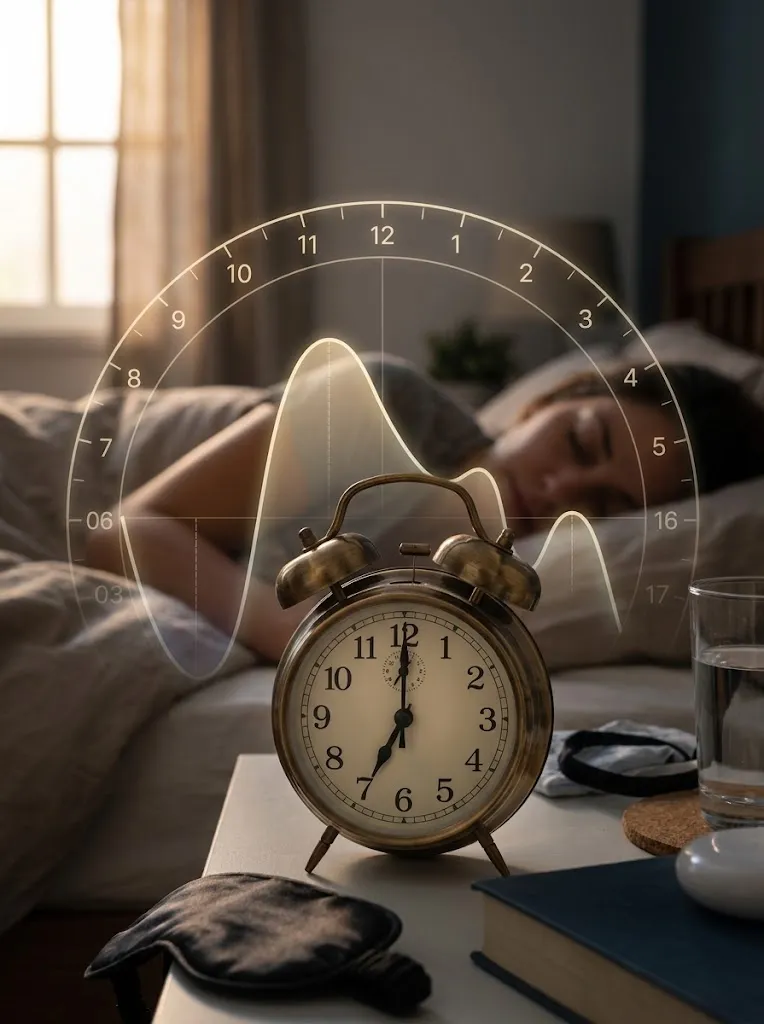
Waking up before your alarm is one of those little things most people don't think much about. Until it keeps happening.
You set the alarm for 6:30 and somehow you wake up at 6:27.
Then it happens again the next day.
And again.
After a while you start wondering whether your body actually knows what time it is.
It doesn't, at least not in the way your phone does. There isn't a little clock in your brain waiting for the numbers to reach 6:30. But your body does have a pretty good sense of when you're normally supposed to be awake, and if your sleep schedule is regular enough, it can start preparing for that time before you actually open your eyes.
That's why waking up a minute or two before an alarm isn't as strange as it sounds.
The slightly strange part is how accurate it can sometimes seem.
Your body has a clock, just not the kind you're thinking of
Your sleep isn't controlled entirely by whether you're tired enough to fall asleep.
There's also a roughly 24 hour timing system running in the background. Scientists call it the circadian system, and one of the main jobs it has is helping your body work out when it's time to sleep and when it's time to be awake.
Light is a huge part of this. Your brain gets information from the light entering your eyes and uses it to keep that internal timing system lined up with the outside world.
But your daily routine gives it information too.
If you go to bed around the same time every night and get up around the same time every morning, your body gets used to that pattern.
That's why you can sometimes wake up at your usual time without an alarm.
You haven't consciously decided to wake up. Your body has simply been doing the same thing often enough that the timing has become familiar.
And this is where the alarm clock gets interesting.
The alarm might not actually be the beginning of the waking process.
It might be the last thing that happens.
You're already getting closer to waking before the alarm rings
Waking up isn't really an instant switch from asleep to awake.
Your brain goes through changes as you move toward waking. Different parts of the brain become more active, your alertness changes, and your body starts moving out of the state it was in during sleep.
This can happen before you are consciously aware of it.
So if your alarm is set for 6:30, you might start becoming easier to wake at 6:20, 6:25 or 6:28.
Most of the time you won't notice any of that.
Then, occasionally, you open your eyes.
You look at the clock.
6:29.
That's the bit that makes it feel as though your body somehow knew.
It probably didn't know that the number on the clock was 6:29. It was responding to the timing of your sleep and your usual schedule.
There's actually research on this. Scientists have studied people who try to wake themselves at a particular time without using an alarm, a phenomenon known as self-awakening. The results aren't perfect, and the research is still fairly limited, but people have shown that they can sometimes wake around a time they've decided on beforehand.
So the idea that your brain can anticipate a waking time isn't made up.
It just isn't quite as precise or mysterious as it feels when you're lying there staring at the clock.
Why does it sometimes happen one minute before the alarm?
This is the part nobody seems to have a satisfying answer for.
If you wake up half an hour early, you can blame a noise or a dream or the fact that you weren't sleeping very deeply.
But one minute?
That's weird.
There probably isn't one single reason it happens. Your sleep stage matters, your schedule matters, and your body's timing system matters. If you've been waking at roughly the same time for weeks or months, your brain has had a lot of opportunities to learn that pattern.
Researchers have even found changes in brain activity before people successfully wake themselves at a chosen time.
That doesn't mean your brain is counting down to the alarm.
It's more that your body can get itself into the right general part of the day without needing somebody to tell it what time it is.
And there's another thing worth considering.
We notice the accurate ones.
If you wake at 6:29 and the alarm rings at 6:30, you remember it because it's oddly satisfying.
If you wake at 6:11, turn over and fall asleep again, you probably don't think about it at all.
So the really precise examples stand out.
What is cortisol doing in all this?
Cortisol gets dragged into almost every conversation about waking up because it follows a strong daily rhythm.
Levels tend to be higher in the morning than they are during much of the night, and the circadian system helps time that rhythm.
There's also a phenomenon called the cortisol awakening response, referring to changes in cortisol around the time of waking.
But it would be too simple to say, "Cortisol rises and wakes you up."
Human studies don't give us such a neat story.
The morning cortisol pattern is connected to the body's daily clock and expected waking time, but researchers have found considerable variation between people, and there is still debate about exactly how much of the cortisol change is caused by waking itself.
So cortisol is part of the morning picture, not an alarm clock hiding inside your bloodstream.
Your body is doing several things at once as it gets ready for the day.
Then why do I wake up before my alarm and still feel exhausted?
Because waking up and being well rested aren't the same thing.
You can have a very predictable body clock and still not be getting enough sleep.
Say you've been going to bed at midnight and getting up at 6:30 every morning. After doing that for long enough, your body may get very good at waking around 6:30.
That doesn't mean six and a half hours is necessarily enough sleep for you.
There's another system involved called sleep pressure. Basically, the longer you've been awake, the stronger the biological pressure to sleep becomes. Adenosine is one of the chemicals involved in that process.
So you can have a body clock that says it's time to get up while another part of your biology is basically saying, "I'd rather not."
That's why waking naturally isn't automatically a sign that you've had a good night's sleep.
You can wake up before the alarm and still desperately want another hour.
Why does it happen when you have something important to do?
This is where things get a little more complicated.
You might normally need an alarm to get up for work, but before an early flight you wake up on your own.
Or you have an exam the next morning and suddenly you're wide awake before the alarm.
Part of this probably comes down to anticipation.
When you know you have to be awake at a particular time, that time has more significance to you. Stress and anticipation can affect sleep, and your brain doesn't completely stop responding to what you expect just because you've gone to bed.
This can go the other way too.
If you're worried about missing something important, you might wake several times during the night.
That's not necessarily your body doing you a favour.
Sometimes it's simply a sign that your brain is more alert than usual because tomorrow matters.
Why do I wake up at the same time every night?
This is related, but it isn't exactly the same thing as waking before an alarm in the morning.
Your circadian rhythm affects the timing of sleep and wakefulness, but nighttime awakenings can happen for lots of reasons too.
Noise.
Temperature.
Light.
Stress.
Alcohol.
Your sleeping environment.
Sometimes there's no obvious reason at all.
If you briefly wake up, turn over and go back to sleep, you may not even remember it the next morning. In fact, most people have brief awakenings during the night without being aware of them.
But if you keep waking fully at the same time every night and struggle to get back to sleep, that's a different problem from simply waking naturally a few minutes before your alarm.
Why does my body do it on workdays but not weekends?
Because your body has no reason to treat Saturday exactly like Tuesday.
If you get up at 6:30 every weekday, that's a very strong repeated pattern.
Then Friday night comes along and you stay up later. Saturday morning arrives and there is no alarm, no work and no reason you have to be out of bed at 6:30.
Your schedule has changed.
So you might sleep longer.
That's also why a big difference between weekday and weekend sleep can make Monday morning feel rough. Your body has been following one schedule and then you've suddenly moved the goalposts.
So is your body actually predicting the alarm?
Not the alarm itself.
It isn't predicting that your phone is going to make a noise at 6:30.
It's predicting, in a much broader sense, when you're normally awake.
Your internal clock keeps a daily rhythm. Your sleep pressure changes throughout the day and night. Your routine gives your brain repeated information about when you normally go to bed and get up. As morning approaches, your body begins shifting toward wakefulness.
Put those things together and waking at 6:29 when your alarm is set for 6:30 isn't quite as mysterious anymore.
Your body didn't look at the clock.
It didn't hear the alarm early.
It didn't magically know that one minute remained.
It had simply been following the same schedule for long enough that, occasionally, it got there before the alarm did.
And when it happens, it does feel pretty strange.
Especially when you look at the clock and see 6:29 staring back at you.