You can be sitting in an air-conditioned room while everyone around you looks perfectly comfortable, yet your shirt is already starting to feel damp.
Or maybe your hands get sweaty whenever you're nervous. Your feet seem to sweat constantly. Your armpits can soak through a shirt even when you haven't done anything particularly strenuous.
And then there's the really confusing version: you're not hot, you're not exercising, and you can't even figure out why you're sweating.
So why do you sweat so much?
Usually, it's because your body's sweating system has been switched on by something. That something might be heat, exercise, stress, anxiety, spicy food, hormones, illness, medication or, in some people, an overactive sweating response called hyperhidrosis.
The interesting part is that your body doesn't have just one reason for making sweat.
It has several.
First, what is your body actually trying to do when you sweat?
Sweating is mostly a cooling system.
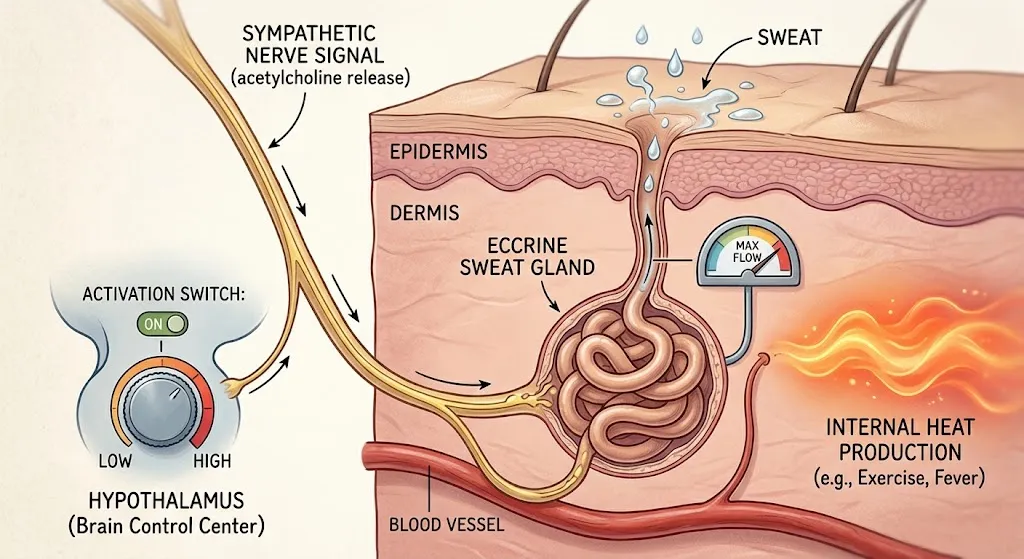
When your body gets too warm, the brain detects the change and sends signals through the autonomic nervous system to sweat glands in your skin. Those glands release sweat onto the surface of your body.
Then something very simple happens: some of that sweat evaporates.
That evaporation takes heat away from your skin, helping bring your body temperature back down.
Most of the sweating involved in cooling comes from eccrine sweat glands. You have millions of them spread across your skin, with particularly noticeable concentrations on areas such as your palms, soles and forehead.
So when you're running on a hot day and suddenly feel sweat running down your face, your body isn't malfunctioning.
It's doing its job.
The strange part is that the same system can respond to things that have little to do with body temperature.
That's why you can sweat when you're frightened, embarrassed or nervous.
Why do I sweat when I'm nervous or anxious?
This is one of the strangest things about sweating because you're not necessarily overheating.
Your brain can activate your body's stress response when you feel nervous, frightened or under pressure. That response changes things like heart rate, blood flow and activity in the autonomic nervous system.
Your sweat glands can get the message too.
That's why someone can walk into an interview room completely cool physically and still end up with sweaty palms.
Emotional sweating is particularly noticeable on the palms, soles and certain other areas of the body.
And there's a slightly annoying feedback loop here.
You notice your hands are sweating.
That makes you more self-conscious.
You become more anxious about the sweating.
Your stress response increases.
And you sweat more.
So sometimes the sweating you're worried about can become part of what keeps the sweating going.
Why do my hands sweat so much?
Your palms are one of the places where emotional sweating can be especially obvious.
That's because the sweat glands in your palms respond strongly to signals associated with the nervous system, not just increases in body temperature.
That's why sweaty hands can show up before a presentation, during an important conversation, while taking an exam or when you're about to do something that makes you nervous.
If your hands are frequently very sweaty even when you're relaxed and the sweating interferes with everyday life, that's different from simply having sweaty palms when you're anxious.
Persistent excessive sweating of the hands, feet, armpits or other specific areas can occur with primary focal hyperhidrosis.
Why do my feet and armpits sweat so much?
Part of the answer is simply that these areas contain many sweat glands.
Your feet can also spend hours trapped inside shoes, where heat and moisture don't have much opportunity to escape.
Your armpits are another place where sweating can become very noticeable because the area is warm and enclosed, and sweat can accumulate on clothing.
There's another thing worth clearing up here.
Fresh sweat itself usually isn't what creates the familiar body smell.
Sweat is mostly a clear, salty fluid. Odor develops when substances from sweat interact with bacteria living on your skin.
That's why sweating and smelling aren't exactly the same problem.
You can sweat heavily without producing a strong odor, and you can sometimes have noticeable odor without looking particularly sweaty.
Why do I sweat when I'm not hot?
This is where the answer gets more interesting.
Your body can activate sweating for reasons other than temperature.
Exercise is an obvious one. Anxiety and other strong emotions can do it too. Certain foods and drinks can increase sweating, and hormonal changes can alter the body's temperature-control system. Fever can also produce sweating as your body adjusts its temperature. Some medications and medical conditions can cause excessive sweating as well.
So the question isn't always:
"Why is my body hot?"
Sometimes it's:
"What signal is telling my nervous system to activate the sweat glands?"
That distinction explains a lot of otherwise confusing sweating.
Why does spicy food make me sweat?
You can eat something painfully hot without your actual body temperature rising very much.
Yet your forehead starts sweating anyway.
Spicy foods can trigger what's called gustatory sweating. Certain substances in spicy foods stimulate sensory pathways that can make your nervous system activate sweating, particularly around the face and head.
So that sweat isn't necessarily your body saying, "You're overheating."
It's responding to the sensation produced by the food.
Caffeine and alcohol can also increase sweating in some people.
Why do I sweat more than everyone else?
Two people can sit in exactly the same room and have completely different sweating responses.
There are several reasons for that.
Your number and distribution of sweat glands, genetics, fitness, acclimatization to heat, body size, hormones, clothing, environment and nervous-system responses can all affect how much you sweat.
Some people simply have a stronger sweating response.
And then there are people whose sweating is excessive enough to be considered hyperhidrosis.
Hyperhidrosis isn't simply "being a sweaty person." It's excessive sweating that happens beyond what the body needs for temperature regulation. It can occur even when you're sitting still or when the environment isn't warm.
So what exactly is hyperhidrosis?
Hyperhidrosis is the medical term for excessive sweating.
There are two broad forms.
Primary focal hyperhidrosis usually affects particular areas, commonly the palms, feet, underarms or face. It often begins relatively early in life and can run in families. The exact reason the sweating system becomes overactive isn't completely understood.
Secondary hyperhidrosis happens because something else is causing the increased sweating.
That could be a medication, a medical condition, hormonal changes or another underlying problem. Unlike primary focal hyperhidrosis, secondary sweating can affect much more of the body.
That distinction matters.
If someone has always had very sweaty palms, that's a different situation from someone who suddenly starts sweating heavily all over their body when they never used to.
The change itself can be useful information.
Why did I suddenly start sweating more than I used to?
A noticeable change in sweating deserves a little more attention than simply being someone who naturally sweats a lot.
Sometimes the explanation is harmless.
Maybe the weather has changed. Maybe you've started exercising more. Maybe you're drinking more caffeine or alcohol. Maybe you've changed your medication. Maybe you're under considerably more stress than usual.
Hormonal changes can also affect sweating. Menopause, for example, can cause hot flashes and sweating because changes in hormone levels affect the brain's temperature regulation.
But excessive sweating can also occur with certain medical conditions, including an overactive thyroid, diabetes, infections and some neurological conditions.
That's why a new and persistent change is worth discussing with a healthcare professional rather than automatically assuming you've just become "someone who sweats a lot."
Why do I sweat at night?
Night sweating can happen for ordinary reasons.
A hot room, heavy bedding, warm clothing or simply being too warm can obviously make you sweat while sleeping.
But persistent night sweats are different.
If you're regularly waking up drenched even though the room is reasonably cool, it's worth paying attention to, particularly if this is a new symptom or you're experiencing other symptoms at the same time.
Night sweating can occur with secondary hyperhidrosis and various medical conditions.
That doesn't mean night sweats automatically point to something serious. There are many possible explanations.
It just means they're worth mentioning to a healthcare professional if they keep happening.
Does sweating more mean I'm burning more calories?
Not necessarily.
Sweating tells you that your body is trying to lose heat. It doesn't directly tell you how many calories you've burned.
You can sweat heavily while sitting in a very hot, humid environment without doing much physical work at all.
And you can have a demanding workout in a cool environment without producing nearly as much visible sweat.
Exercise can increase both energy expenditure and sweating, but the sweat itself isn't a measurement of how many calories you've burned.
It's mainly a cooling response.
Does sweating mean I'm dehydrated?
Not automatically.
You lose fluid when you sweat, so heavy sweating can contribute to dehydration if you're not replacing enough fluid.
But sweating itself doesn't prove that you're already dehydrated.
Think of it as a fluid balance problem. The more fluid you're losing through sweat, especially during prolonged exercise or heat exposure, the more attention you need to pay to replacing fluids.
MedlinePlus recommends replacing fluids after heavy sweating, with water or fluids containing electrolytes when appropriate.
And there's another misconception worth clearing up.
Does sweating remove toxins from your body?
Sweat does contain small amounts of substances besides water and salt, but sweating isn't a special detox system that cleans your body of unwanted substances.
Its main job is cooling.
Your body has other systems responsible for processing and eliminating waste, particularly the liver and kidneys.
So sweating during exercise is useful because it helps regulate temperature, not because you're somehow "sweating toxins out."
Why does exercise make some people sweat much more?
When you exercise, your muscles produce heat.
Your body needs to get rid of that heat, and sweating is one of its most effective tools for doing so.
But the amount you sweat isn't a perfect measure of how hard you're working.
Two people can perform the same workout and produce noticeably different amounts of sweat.
Heat, humidity, fitness, clothing, body size, hydration and individual differences in sweating all affect the response.
And once the air becomes very humid, something else happens: sweat doesn't evaporate as easily.
That means you can feel much sweatier without necessarily getting proportionally more cooling from all that moisture.
Why do I sweat even when everyone else is comfortable?
This is where the individual differences become really obvious.
Your body's temperature regulation isn't identical to somebody else's.
You may start sweating sooner. You may produce more sweat once you start. You may have a stronger response to anxiety. You may simply have more noticeable sweating in certain areas.
None of that automatically means something is wrong.
The better question is whether your sweating is appropriate for the situation and whether it's interfering with your life.
If you're constantly changing clothes, avoiding handshakes, struggling to use a keyboard because your hands are wet, worrying about visible sweat marks, or avoiding activities because of sweating, that's worth taking seriously.
Hyperhidrosis can have a real effect on everyday life, and treatments are available.
How can you tell normal sweating from excessive sweating?
There's no single number of milliliters of sweat that suddenly turns normal sweating into abnormal sweating.
Instead, look at the situation.
| What you're experiencing | What it may suggest |
|---|---|
| Sweating during exercise | Normal cooling response |
| Sweating in hot or humid weather | Normal temperature regulation |
| Sweaty palms during stressful situations | Emotional sweating |
| Sweating after spicy food | Gustatory sweating |
| Frequent sweating while resting for no obvious reason | Possible excessive sweating |
| Sweating that regularly soaks clothes or interferes with daily life | Worth discussing with a healthcare professional |
| New widespread sweating | Possible secondary cause worth investigating |
| Repeated night sweats | Worth discussing with a healthcare professional |
Hyperhidrosis becomes more likely when sweating is excessive, happens when your body doesn't appear to need cooling, or significantly interferes with normal activities.
What can you actually do if you sweat too much?
Start by figuring out what seems to trigger it.
Does it happen mainly in heat?
During exercise?
When you're nervous?
After coffee?
After spicy food?
At night?
After starting a medication?
Or does it happen randomly, even when you're sitting comfortably?
That pattern can tell you more than simply saying, "I sweat a lot."
For ordinary excessive sweating, practical measures can help. Loose-fitting clothing can reduce the discomfort and visibility of sweating, and moisture-absorbing socks can help with sweaty feet. Stronger antiperspirants are also available, including products that a pharmacist can recommend.
If those measures aren't enough, medical treatments exist. Depending on the type and location of sweating, treatment can include prescription medicines, topical treatments, iontophoresis and injections such as botulinum toxin.
The right treatment depends on why you're sweating and where it's happening.
When should excessive sweating be checked?
If you've been sweating excessively for a long time and it's affecting your everyday life, that's already a good reason to talk to a healthcare professional.
The NHS suggests seeking medical advice when excessive sweating has lasted for months, happens regularly, interferes with daily activities, occurs at night, or isn't improving with self-care.
A new change is also worth mentioning, especially if you can't explain it.
And heavy sweating accompanied by symptoms such as chest pain, shortness of breath, a rapid pounding heartbeat, fever or unexplained weight loss deserves medical attention.
Don't assume every episode of heavy sweating means something serious. It usually doesn't.
The point is to notice when your normal pattern has changed.
So why do you sweat so much?
Because sweating isn't controlled by a simple "hot equals sweat" switch.
Your brain and nervous system are constantly responding to your body's temperature, your surroundings, physical activity and emotional state. Food, hormones, medications and health conditions can influence the same system.
Most of the time, sweating is your body's very ordinary way of getting rid of heat.
But if you're sweating when you don't seem to need cooling, or you're sweating so much that it's changing how you live, there's a different question to ask.
Not just:
"Why am I so sweaty?"
But:
"What is triggering my sweating system, and has that pattern changed?"
That shift in thinking makes the symptom much easier to understand.
Sometimes the answer is simply heat.
Sometimes it's nerves.
Sometimes it's the food you just ate.
And sometimes your sweat glands really are working harder than they need to. That's when excessive sweating becomes something worth investigating rather than something you just have to put up with.