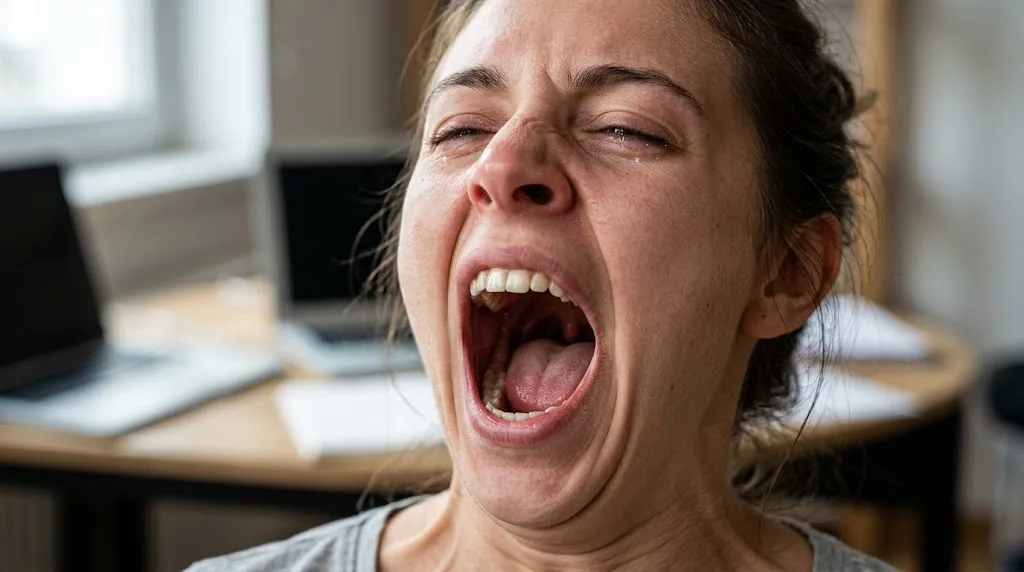
A yawn can start almost anywhere.
You might yawn when you're tired, halfway through a boring conversation, just after waking up, or while sitting quietly doing absolutely nothing. Then someone nearby yawns and, somehow, you find yourself doing the same thing a few seconds later.
Even reading about yawning can be enough to set one off.
Yawning looks like a very simple action, but quite a lot is happening when it occurs. Your jaw drops, your throat opens wide, you take a deep breath, several muscles around your face and neck stretch, your heart rate can change, and then you exhale.
The strange part is that scientists still don't have one universally accepted answer for why humans yawn.
What we do know is that yawning is much more than a response to not getting enough oxygen. Research has largely ruled out the old idea that we yawn simply because the brain needs more oxygen. Several other explanations have been investigated, including changes in alertness, thermoregulation and social communication.
One of the better-supported ideas is that yawning helps regulate the brain's temperature and state of alertness. But even that isn't the whole story.
So what is actually happening when you yawn?
What happens inside your body during a yawn?
A yawn is a coordinated reflex involving your brain, breathing muscles, jaw, throat, face and other parts of the body.
It usually begins without you consciously deciding to do it.
Your mouth opens and your lower jaw drops. Your tongue moves, your throat and airway expand, and you take a relatively deep breath. Muscles around your jaw, face and throat stretch strongly. You may also stretch your neck, arms or the rest of your body at the same time.
Then you exhale and the muscles relax.
A typical yawn lasts only a few seconds, but during that short period your airway can expand dramatically.
That large mouth opening isn't just for show.
Yawning produces a much more substantial mechanical movement than an ordinary breath. The muscles involved in the jaw and throat contract and stretch, blood flow around the head and neck changes, and the respiratory system behaves differently from a normal quiet breath.
That's why a yawn feels like a whole-body event rather than simply taking a deep breath.
Why do we yawn when we're tired?
This is the part everyone notices.
Yawning is strongly associated with changes in alertness. It commonly appears when we're sleepy, when we're becoming tired, and around transitions between sleeping and waking.
But a yawn probably isn't simply your body's way of saying:
“You need oxygen.”
Your breathing system already does a very good job of regulating oxygen and carbon dioxide without requiring a giant mouthful of air every few minutes.
Experiments have found that changing oxygen and carbon dioxide levels doesn't produce the kind of yawning response that the old oxygen theory predicted. Even exercise that substantially increases breathing doesn't simply produce more yawning.
Yawning is therefore connected to tiredness, but tiredness probably isn't the entire purpose of the behavior.
It may be better to think of a yawn as something associated with a change in your level of alertness.
That helps explain why you can yawn when you're falling asleep, but also when you're waking up.
Those are opposite directions on the sleep-wake scale, yet both involve a major change in your brain's state.
Why do we yawn after waking up?
The first few yawns of the morning make sense once you stop thinking of yawning as something that only happens when you're sleepy.
Waking up involves a rapid change in brain and body state.
Your nervous system is moving from sleep toward full alertness, your muscles are becoming active again, and your breathing and circulation are changing.
Yawning often appears alongside stretching during this transition.
That's why the giant stretch and yawn combination feels so natural after waking.
The two behaviors are closely associated with changes in arousal and muscle activity.
And yawning isn't something humans invented after birth.
Fetuses can yawn before they're born, with fetal yawning observed during development long before a newborn ever experiences boredom or a long day at work.
That alone makes the idea that yawning is simply a reaction to boredom or tiredness hard to explain.
Why do I yawn when I'm bored?
Boredom is another common trigger.
When you're sitting through something that isn't demanding much of your attention, your level of alertness can drift downward. Yawning frequently appears during these low-stimulation situations.
That doesn't necessarily mean your brain is saying, “This is boring.”
It may be that boredom creates the internal conditions associated with reduced alertness, and yawning is part of the body's response to that changing state.
This is also why you can suddenly yawn during a lecture, meeting or long car journey even if you weren't particularly tired beforehand.
Your body isn't necessarily running out of oxygen.
Your brain may simply be shifting into a less stimulated state.
Does yawning cool the brain?
This is where things get much more interesting.
One leading scientific hypothesis is that yawning contributes to thermoregulation, meaning the regulation of body temperature, particularly temperature around the brain.
The idea is that the combination of a deep inhalation, changes in blood flow and powerful movements of the jaw and surrounding muscles can help move heat away from the head.
Research has found that yawning frequency can change with ambient temperature, which is one piece of evidence supporting this theory.
The proposed mechanism is fairly complicated.
During a yawn, the jaw and facial muscles produce changes in blood flow around the head. The deep inhalation also changes circulation and air movement through the mouth and upper airway.
Together, these effects could help alter heat exchange around the brain.
There is also evidence that yawning changes blood and cerebrospinal-fluid flow. A 2026 study using real-time imaging found that yawns and forceful open-mouth breaths increased cerebrospinal-fluid and internal-jugular flow compared with normal breathing. The researchers found that yawning produced a distinct pattern of fluid movement, although that doesn't by itself prove that cooling is the ultimate purpose of yawning.
That's an important distinction.
There is evidence that yawning can affect the body's heat and fluid dynamics.
That is not the same thing as proving:
“We yawn specifically to cool the brain.”
The broader function of yawning is still being investigated.
So is the brain-cooling theory true?
It may be part of the answer, and it has more experimental support than many of the older explanations.
But scientists haven't reached a final verdict that explains every yawn.
The brain-cooling hypothesis makes some interesting predictions, including that yawning should depend on environmental temperature. Some experiments have found exactly that kind of relationship.
Other researchers have argued that yawning may have roles in arousal and social communication as well.
The safest conclusion is therefore:
Yawning appears to be involved in changes in brain and body state, and thermoregulation is one of the leading explanations for its physiological function. But there probably isn't a single simple reason behind every yawn.
That's a much more accurate answer than either “nobody knows anything” or “yawning definitely cools your brain.”
Then why doesn't yawning just mean you're sleepy?
Because yawning happens in situations that don't fit simple sleepiness.
People yawn when waking up.
They yawn when bored.
They can yawn during stressful situations.
Athletes have even been observed yawning before competition, when they are obviously not preparing to fall asleep.
This makes sense if yawning is connected to changes in alertness rather than sleepiness alone.
A stressful event can produce a major shift in your nervous system.
So can anticipation.
So can waking.
So can becoming sleepy.
The common factor may be the changing state of the brain and body rather than the particular emotion involved.
Why does seeing someone yawn make you yawn?
This is the part that makes yawning feel almost ridiculous.
Someone across the room yawns.
You see it.
A few seconds later, your jaw starts dropping.
That's called contagious yawning, and it is a real phenomenon.
Humans can respond to another person's yawn by yawning themselves, and the response can also be triggered by hearing a yawn. Research has even shown that thinking about yawning can sometimes be enough.
The exact reason is still debated.
One possibility is that contagious yawning is connected to social processing and the brain's tendency to automatically respond to other people's actions.
Another possibility is that it has something to do with coordinating alertness or behavior within social groups.
The popular explanation that contagious yawning simply proves you're highly empathetic is much less secure than social media often makes it sound.
Research has found relationships between contagious yawning and social cognition, but findings are not perfectly consistent, and the mechanism remains under investigation.
So if someone doesn't yawn when you do, don't immediately conclude that they have no empathy.
Their brain may simply not be particularly susceptible to contagious yawning at that moment.
Why is yawning contagious even when you aren't tired?
Because contagious yawning doesn't require you to be genuinely sleepy.
The visual or auditory cue can trigger the behavior.
Brain-imaging research has found that watching yawning activates regions involved in processing social information and biological actions.
There's an interesting twist here.
Contagious yawning may itself make you feel slightly more tired. One study found that people who yawned contagiously reported increased tiredness after watching yawning stimuli.
So sometimes the sequence may look something like this:
You see someone yawn → your brain responds to the social cue → you yawn → your state of alertness changes.
That doesn't mean the process has been fully explained.
It just shows that contagious yawning is more complicated than copying someone's facial expression.
Why can talking about yawning make you yawn?
Because your brain doesn't need a direct visual yawn to activate the same kind of response.
Yawning can be triggered by seeing it, hearing it and even thinking about it.
Which creates a rather unfair situation for anyone reading this article.
If you have already yawned once while reading it, you've just demonstrated the phenomenon.
And if you haven't yet, there's still time.
Why do we open our mouths so wide?
Because the yawn is a large coordinated movement of the jaw and upper airway.
During a full yawn, the lower jaw drops substantially, the tongue moves, the throat opens and the muscles surrounding the airway stretch.
The pharynx can become several times wider than it is during normal breathing.
The huge mouth opening may also contribute to the physiological effects researchers are interested in, particularly changes in circulation and airflow.
A yawn isn't simply a bigger version of an ordinary breath.
The muscular stretching is part of the behavior.
Why do my eyes water when I yawn?
Your eyes can water because of what happens to the muscles and tissues around your face.
A strong yawn stretches and compresses several facial structures. That can stimulate the tear-producing system around the eyes.
There can also be another reason.
If you're tired, your eyes may already be dry or irritated, and your eyes may produce tears as part of their normal response.
So watery eyes during a yawn don't necessarily mean you're crying because the yawn was emotionally overwhelming.
Your face is just doing a lot of mechanical work.
Why does my jaw sometimes click when I yawn?
A yawn takes the jaw through a much larger movement than ordinary talking or chewing.
If the joint connecting your lower jaw to your skull is already prone to clicking, opening your mouth very wide can make the sound more noticeable.
A single painless click isn't automatically a sign that something is seriously wrong.
But persistent jaw pain, locking, difficulty opening the mouth or repeated painful clicking is a different matter and is worth discussing with a dentist or healthcare professional.
Yawning itself isn't necessarily damaging the joint.
It's simply asking the jaw to move through a large range.
Why do I sometimes yawn several times in a row?
Yawning often occurs in clusters.
One yawn may not completely shift your state of alertness, or the conditions that triggered the first yawn may still be present.
You may therefore yawn again shortly afterward.
Cleveland Clinic notes that yawning commonly occurs in fits of two or three, although individual patterns vary considerably.
And once another person joins in, contagious yawning can add another layer to the chain.
One person's yawn can become several people's yawns surprisingly quickly.
Do animals yawn for the same reason?
Yawning isn't unique to humans.
It occurs across a wide range of vertebrate animals, including mammals, birds and fish.
That tells us something important.
Whatever yawning does, it is probably an old biological behavior rather than a specifically human response to modern life.
Animals also show contagious yawning.
Research has found contagious responses in several social species, and studies have even investigated responses between humans and other animals. One study found evidence that people could respond with yawns to yawning stimuli from a range of other animals, including cats and dogs.
The evolutionary purpose is still debated, but the behavior clearly goes far beyond humans sitting in boring meetings.
Does a bigger brain mean a longer yawn?
Oddly enough, there is evidence for a relationship between brain size and yawn duration across species.
A comparative study looking at 109 individuals from 19 mammal species found that average yawn duration was associated with brain weight and the number of cortical neurons.
That doesn't mean a person with a larger brain automatically needs a longer yawn.
It's a comparison across species, not a test of individual humans.
But it is another clue that yawning may be doing something more interesting physiologically than simply filling your lungs with air.
Does yawning mean your brain needs more oxygen?
No.
This is one of the most persistent myths about yawning.
The old idea was straightforward: you're tired, oxygen levels fall, the brain notices, and you yawn to bring in a large breath of fresh air.
The problem is that experiments don't support that explanation.
Changing oxygen and carbon dioxide concentrations doesn't produce the expected changes in yawning, and yawning isn't simply an oxygen-delivery mechanism.
Your lungs are already exchanging gases continuously.
You don't need to yawn every few minutes to keep your brain supplied with oxygen.
So if someone says:
“You're yawning because you aren't getting enough oxygen.”
That's not a good explanation for ordinary yawning.
Can stress make you yawn?
Yes.
Stress is one of the situations in which increased yawning has been observed.
That may sound strange until you remember that yawning isn't exclusively associated with relaxation or sleepiness.
Stress changes your body's arousal state.
Yawning may occur during those transitions, possibly as part of the body's attempt to regulate alertness and other physiological processes.
This is one reason someone can yawn before an important event even though they're perfectly awake.
Can you stop a yawn once it starts?
Sometimes.
A yawn is largely involuntary, but you can interfere with it to some extent.
You can close your mouth, change your breathing or deliberately contract the muscles involved in resisting the movement.
But anyone who has tried to suppress a huge yawn knows that it can feel strangely difficult.
That's because the behavior is being coordinated automatically by the nervous system rather than waiting for you to consciously decide whether to perform each individual movement.
And suppressing a yawn can leave you with the peculiar feeling that the yawn never quite finished.
Why does yawning feel satisfying?
Part of the answer may simply be mechanical.
Your jaw, face, throat and other muscles have undergone a large stretch, followed by relaxation.
Your breathing has changed.
Blood flow and other physiological variables have shifted.
And the nervous system has completed a coordinated reflex.
Researchers have also found that yawning produces physiological changes that are not identical to an ordinary deep breath. Heart rate and other measures can change around the event.
That may help explain why a proper yawn feels different from deliberately taking one giant breath.
Your body isn't just inhaling.
It's performing the entire yawn sequence.
So why do we yawn?
The honest answer is that we don't have one final explanation yet.
Yawning is strongly associated with changes in alertness, including sleepiness and waking. It can occur with boredom and stress. It involves a coordinated sequence of breathing, jaw and throat movements. There is substantial evidence supporting the idea that yawning may contribute to thermoregulation, including brain cooling, although the precise role of this mechanism in humans remains under investigation.
And then there's contagious yawning, which introduces an entirely different social dimension.
So the old explanation:
“You yawn because you're tired and need more oxygen.”
is much too simple.
A better description is:
Yawning is an ancient, involuntary brain-body reflex associated with changes in alertness and possibly temperature regulation, while contagious yawning adds a social component that scientists are still trying to fully understand.
That's why you can yawn when you're exhausted, when you're waking up, when you're bored, before something stressful, after seeing another person yawn, or even while reading an article about yawning.
The behavior looks simple because it lasts only a few seconds.
Underneath it, your brain, breathing system, jaw, muscles, circulation and social-processing systems are all getting involved.
And somehow, after millions of years of evolution, the whole thing can still be triggered by watching somebody else open their mouth.