A sneeze can start with almost nothing.
A little tickle somewhere inside your nose. A bit of dust. Pepper drifting up from a plate. Pollen on a windy day. Then your nose feels suddenly irritated, your face tightens, your eyes close, you take a breath and, before you have much time to think about it, the sneeze is already happening.
Sneezing feels simple because it happens so quickly. It isn't.
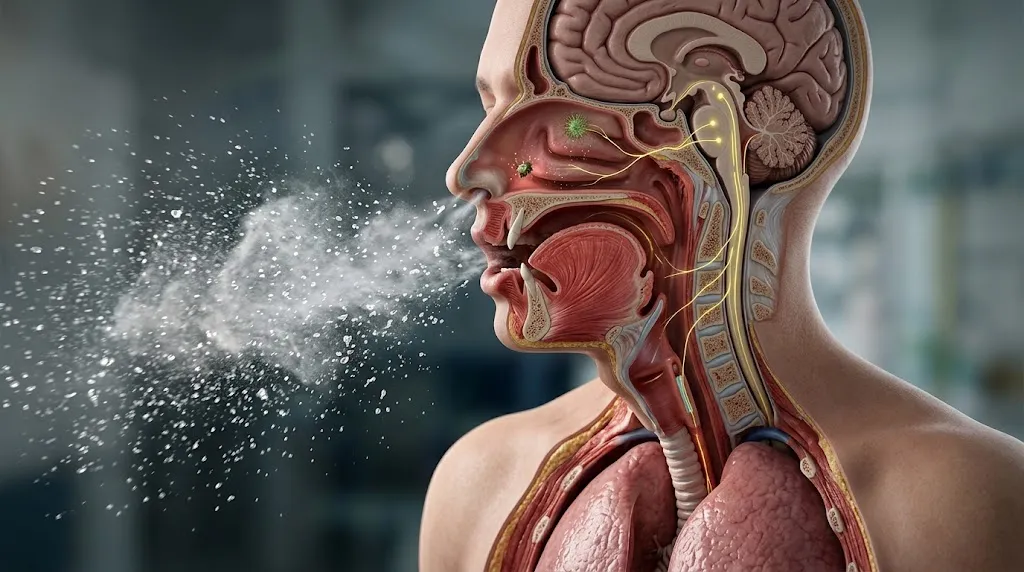
A sneeze is a coordinated reflex involving sensory nerves in the nose, the brainstem, breathing muscles, the muscles of the throat and face, and a sudden burst of air through the nose and mouth. Its main job is to respond to irritation in the upper airway and help clear the nasal passages. Recent research has filled in more of the neural circuitry behind the reflex, although some parts of the process are still being worked out.
So why do we sneeze?
Because your nervous system has detected something it considers irritating and has a very fast way of trying to get rid of it.
The interesting part is everything that happens between the first tickle in your nose and the actual sneeze.
What actually triggers a sneeze?
Most sneezes begin when sensory nerve endings in the lining of your nose detect something they don't like.
That could be dust, pollen, smoke, pepper, chemical irritants, mucus, an infection, or other particles. Temperature changes can do it too. Cold air, for example, can irritate the nasal lining in some people, particularly those with sensitive or nonallergic nasal reactions.
Allergies add another layer.
When someone with allergic rhinitis encounters something such as pollen, the immune system releases inflammatory chemicals, including histamine. Those chemicals can stimulate sensory nerves in the nasal lining, producing the familiar combination of itching, irritation, runny nose and sneezing.
A cold works differently. A respiratory infection can irritate the nasal tissues and activate the same protective reflex.
The important point is that your nose doesn't have to contain a visible piece of dust for a sneeze to happen. The sensory system is responding to irritation and chemical or physical changes in the nasal tissue.
What happens inside your body during a sneeze?
The process happens in roughly two stages.
First comes the sensory phase.
Nerve endings in the nasal lining detect the irritating stimulus. Much of this information travels through branches of the trigeminal nerve, which carries sensory information from the face and nasal region into the brainstem. Researchers now know that this pathway is more specialized than the old idea of a simple "sneeze center" suggests. Recent work has identified particular sensory neurons and signaling molecules involved in carrying the signal from the nose toward the brainstem.
Then comes the motor phase.
The brainstem coordinates a rapid sequence involving breathing and facial muscles. You inhale, your airway briefly closes, pressure builds, and then the airway opens while respiratory muscles contract forcefully. Air is driven out through the nose and mouth.
Your eyelids close as part of the same coordinated response. The muscles around your face and nose move too, which is why a sneeze can make your entire expression look temporarily distorted.
It all happens in a fraction of a second.
One recent study measuring sneeze airflow found that the sneeze lasted roughly 430 milliseconds in the participants studied, with peak airflow occurring very early in the event. Another experiment measuring droplets from sneezes found that their average velocities varied considerably between people, with measured mean droplet speeds of about 2 to 5.4 meters per second.
So the familiar "ACHOO" is really the audible end of a much larger reflex.
Why does your nose feel itchy before you sneeze?
That itchy, prickly feeling is part of the sensory phase.
The nasal lining contains sensory nerve endings that detect irritation. When those nerves become activated, the brain receives information that something is happening inside the nose.
You experience part of that signal as an urge to sneeze.
This is why you can sometimes feel a sneeze building for several seconds. The nervous system has detected enough irritation to start the process, but the reflex hasn't quite reached the point where the full motor response occurs.
It also explains why the sensation can disappear.
If the stimulus is weak, moves away, or the sensory signal drops below the level needed to complete the reflex, the sneeze may simply never happen.
That familiar experience of "losing" a sneeze isn't your body changing its mind for no reason. The reflex depends on a chain of signals reaching the point where the motor response is triggered.
Why does pepper make you sneeze?
Pepper is a good example because it can trigger sneezing without causing an infection or an allergy.
The particles can irritate the nasal lining, activating sensory pathways involved in the sneeze reflex. Other strong chemical irritants can do something similar.
Some substances primarily affect smell, while irritating substances can activate the trigeminal sensory system, which detects sensations such as burning, stinging and irritation. Sneezing can follow when those nasal sensory pathways are strongly activated.
That's why a little pepper can produce a surprisingly large reaction.
Your nose isn't trying to determine whether the irritant is dangerous. It is responding to the sensory signal it receives.
Why do allergies make you sneeze so much?
Allergies can essentially turn the sensitivity of the nasal system up.
With allergic rhinitis, an allergen such as pollen triggers an immune response in the nasal tissues. Histamine and other inflammatory substances are released, and these can activate sensory nerves.
The result can be repeated sneezing, itching, congestion and a runny nose.
This also explains why allergic sneezing can come in bursts. The nasal tissue may remain irritated even after the first sneeze, so the sensory system continues receiving signals.
A cold can produce repeated sneezing for a similar practical reason, although the underlying cause is different. Instead of an allergic immune response, the nasal lining is being irritated as part of an infection.
Why do some people sneeze when they look at the sun?
This one is genuinely unusual.
Some people sneeze when they suddenly move from a darker environment into bright sunlight. It is called the photic sneeze reflex, sometimes known by the acronym ACHOO.
The phenomenon isn't rare. Studies have estimated that roughly a quarter of people can experience light-induced sneezing, although estimates vary depending on how the condition is defined and measured.
The strange part is that sunlight isn't entering your nose.
The leading explanations involve interaction between visual and sensory pathways. Bright light strongly stimulates the visual system, and in susceptible people that activity appears to interact with pathways involved in nasal sensation and the sneeze reflex.
Exactly how this happens isn't settled. Recent reviews have considered several possibilities, including interaction between optic and trigeminal pathways and changes in parasympathetic activity. Researchers have not established one definitive mechanism.
There also appears to be a genetic component. Genetic studies have identified variants associated with the tendency to sneeze in response to bright light.
So if someone steps outside into bright sunlight and immediately sneezes, they aren't imagining a connection. Their nervous system really can link the two.
Why do we close our eyes when we sneeze?
Closing your eyes is another part of the reflex.
The muscles that control your eyelids are activated during sneezing, so your eyes usually shut automatically. The same general coordination links the nasal and facial parts of the reflex.
But the idea that your eyes must close is not quite right.
People can sneeze with their eyes open. It is simply difficult because the automatic eyelid response is strong. Cleveland Clinic notes that keeping the eyes open is possible, but it requires consciously overriding the normal response.
And no, your eyes aren't going to pop out if you sneeze with them open.
That's an old myth.
The eye-closing response is better understood as part of the coordinated facial reflex rather than a safety mechanism that prevents your eyeballs from flying across the room.
Why does your whole face move during a sneeze?
Because a sneeze isn't controlled by your nose alone.
Once the sensory signal reaches the brainstem, the reflex recruits several groups of muscles at once. Your eyelids close. Muscles around the nose and mouth contract. Your throat and airway change position. Your diaphragm and chest and abdominal muscles help generate the forceful expiration.
The result is a brief, highly coordinated movement involving much more of your body than you might expect from something that started with a tickle in your nose.
That coordination is part of what makes sneezing so effective as a respiratory reflex. The goal isn't simply to move air. It is to produce a rapid change in airflow and pressure that helps clear material from the upper airway.
How fast does a sneeze actually travel?
There's no single number because a sneeze isn't a perfectly consistent jet of air.
Different studies have measured very different speeds depending on whether they are measuring the airflow, individual droplets, or the visible sneeze plume.
One experiment found maximum sneeze airflow of about 15.9 meters per second, while another study measuring droplets from 35 sneezes found mean droplet velocities between 2 and 5.4 meters per second. Other experiments have produced different values.
That's why claims that every sneeze travels at some exact speed, such as 100 miles per hour, are misleading.
The sneeze is a rapidly changing mixture of air, droplets and particles. Some components move faster than others, and the speed falls quickly as the plume spreads into surrounding air.
The important thing isn't one impressive speed figure. It's that sneezing can propel respiratory material outward very quickly.
Why do some people sneeze three times in a row?
There isn't a universal rule that says a person should sneeze once.
If the original irritation remains, the sensory system can trigger another sneeze. A second or third sneeze may also help clear material that wasn't removed by the first one.
People also appear to differ in how strongly their sneeze reflex responds to a given stimulus. Some people sneeze once and stop. Others go through a short series.
Research into photic sneezing, for example, has found considerable variation in the number of sneezes people produce in response to light.
So the person who always sneezes three times isn't necessarily experiencing three completely separate problems. It may simply be the way their reflex responds to the stimulus.
Why does one sneeze sometimes trigger another?
The same basic principle applies.
If the nasal lining is still irritated after the first sneeze, the sensory signal hasn't necessarily disappeared. The first sneeze may clear some material without completely removing the irritation.
There can also be a short period in which the nasal tissues remain sensitive.
This is particularly noticeable with allergies and respiratory infections, where the underlying inflammation doesn't disappear after one sneeze. The nose can keep sending the brain the same message, and the reflex can fire again.
Can you stop a sneeze?
Sometimes you can interrupt the urge before the reflex fully develops.
People may do this by changing their breathing, moving away from the irritant or simply waiting for the sensation to pass.
But once the reflex is fully underway, trying to violently clamp the nose and mouth shut is a different matter.
That can sharply increase pressure inside the airways. A review of reported sneeze injuries found that forcibly suppressing a sneeze against a closed airway has been associated with injuries including damage to blood vessels, the throat and ears. These injuries are uncommon, but they are a good reason not to treat a sneeze like something that has to be physically trapped.
If you need to sneeze, it is generally safer to let it happen while covering your nose and mouth appropriately.
Is sneezing actually meant to clean your nose?
Yes, but "blow everything out of your nose" is a little too simple.
Sneezing is considered a protective airway reflex. Irritating material on the nasal lining activates sensory pathways, and the resulting respiratory response helps move air and secretions through the upper airway.
It isn't a precision cleaning system. It doesn't guarantee that every particle is removed, and it certainly doesn't mean every sneeze contains something dangerous that needed to be expelled.
Sometimes the trigger is an allergen. Sometimes it is a virus. Sometimes it is dust. Sometimes it is a sudden change in temperature.
And sometimes it is sunlight.
The reflex doesn't care very much which one started the process.
Can cold air make you sneeze?
It can.
Cold or rapidly changing air can stimulate sensitive nasal tissue, and some people are particularly responsive to temperature changes. Cold air is also a recognized trigger in nonallergic rhinitis, a condition in which nasal symptoms occur without the usual allergic cause.
This is why walking into cold outdoor air can sometimes produce a sudden sneeze or several sneezes.
It doesn't necessarily mean you're getting sick.
Your nasal nerves can respond to temperature and environmental changes just as they respond to chemical irritation.
Do animals sneeze too?
Yes.
Sneezing isn't unique to humans. Many animals have nasal sensory systems and protective respiratory reflexes that serve similar purposes.
Dogs, cats and other mammals can sneeze when their nasal passages are irritated by dust, allergens, foreign material or infection.
The exact neural circuitry differs between species, but the basic idea is familiar: detect irritation, send the signal through sensory pathways, coordinate a respiratory response, and expel air.
In that sense, the sneeze is a very old piece of biological equipment.
So what is your body actually doing when you sneeze?
A sneeze begins with detection.
Something irritates the nasal lining, and sensory nerves carry that information toward the brainstem. The brain then coordinates a rapid sequence of inhalation, airway closure, muscle contraction and explosive exhalation. At the same time, facial muscles close the eyes and help coordinate the movement of the nose, mouth and upper airway.
That is why such a small sensation can produce such a large physical reaction.
It also explains why sneezing can have so many different triggers. Dust, pollen, pepper, infections, cold air and even bright sunlight can all reach the nervous system through different routes and end up producing the same basic reflex.
And the more researchers study it, the less the sneeze looks like a simple blast of air.
It is a fast piece of neural coordination that starts with a sensation in your nose and ends with almost your entire upper respiratory system joining in. The next time you feel that little itch building, there is already a lot happening before the sneeze ever makes a sound.