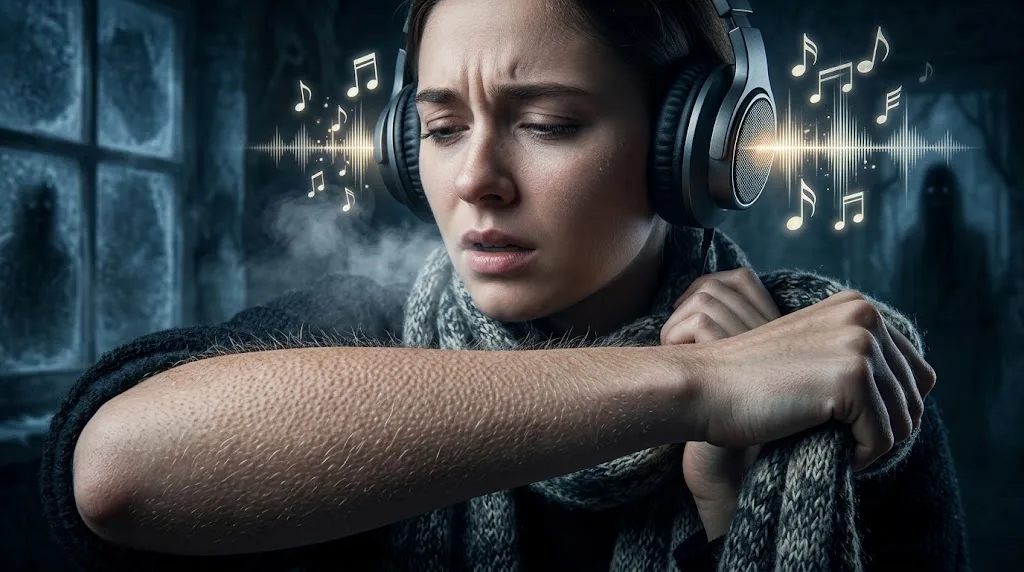
Your skin can change in a matter of seconds.
A cold breeze runs across your arms and the hairs stand up. You get frightened and suddenly your skin is covered in tiny bumps. Then, at a completely different moment, a piece of music reaches a certain note or chorus and you get the same reaction.
Nothing has made the room colder. Nothing has touched your skin. Yet there they are again.
Goosebumps are the visible result of tiny muscles attached to your hair follicles contracting. The muscles pull the hairs upright and slightly change the shape of the skin around them. The response is controlled automatically by the autonomic nervous system, particularly the sympathetic nervous system, which is involved in regulating the body's response to things such as cold, danger and intense emotional arousal.
That explains how goosebumps happen.
The more interesting question is why cold, fear, music and emotional memories can all switch on essentially the same response.
What actually causes goosebumps?
Every hair on your body grows from a structure called a hair follicle. Attached to many of those follicles is a tiny smooth muscle called the arrector pili muscle.
When that muscle contracts, it pulls the hair follicle upward. The skin around the follicle gets slightly puckered, producing the little raised bumps you see.
The scientific name for this is piloerection.
You don't have to consciously tell those muscles to contract. In fact, you can't normally decide to give yourself goosebumps in the same way you can decide to raise your hand. The response is controlled by the autonomic nervous system, which handles many body functions that operate without conscious effort.
So when you suddenly get goosebumps, there is a real physical chain happening:
cold, fear, excitement or another trigger → autonomic nervous system activation → sympathetic nerves signal the skin → arrector pili muscles contract → hairs rise → skin develops bumps.
The bumps themselves aren't the cause of the sensation. They're the visible evidence that this nervous system response has happened.
Why do you get goosebumps when you're cold?
Cold is probably the easiest version to understand.
When your body senses a drop in temperature, the nervous system begins making adjustments to limit heat loss and maintain body temperature. One of the responses is piloerection.
For a furry mammal, raising the hairs can be useful. Erect hairs can increase the thickness of the layer of air held close to the skin, providing additional insulation.
A cat in the cold isn't doing anything particularly mysterious when its fur puffs up.
The hairs are being raised by the same basic kind of muscle response.
Humans inherited the machinery, but we lost most of the fur that made the response especially useful. We have far less body hair than our furry ancestors, so raising the hairs on your arms doesn't create much insulation.
You can still see the old system working, though.
The bumps are essentially a small leftover from a response that made considerably more sense on a much hairier body.
There is another interesting detail here. Research in mice has shown that the sympathetic nerves and arrector pili muscles around hair follicles are connected to hair follicle stem cells. Cold-induced sympathetic activity can influence hair growth in these animals. That doesn't mean your goosebumps are secretly making your hair grow, but it shows that the system around the hair follicle is more biologically active than simply being a mechanism for producing bumps.
Why do you get goosebumps when you're scared?
This is where the same physical response starts to make more sense.
Fear activates the body's sympathetic nervous system. Your heart rate can increase, your attention becomes more focused, your muscles become more prepared for action and other automatic changes occur.
Piloerection can happen as part of that broader response.
In animals covered with fur, standing the hair upright can also make the animal appear larger. A frightened cat with its tail and fur puffed up is a good example. The raised coat can make the animal look more imposing to a potential threat. Researchers studying human piloerection have therefore linked emotional hair raising to defensive responses that are much more obvious in other mammals.
For humans, the visual effect is much less useful.
Someone who is frightened doesn't suddenly become twice the size because the hairs on their arms stand up.
But the nervous system doesn't need to invent a completely new response every time the trigger changes. Different situations can activate overlapping parts of the same autonomic system.
That's why cold and fear can produce such a similar physical reaction.
So why can music give you goosebumps?
This is probably the strangest version.
You're sitting comfortably in a warm room. There's no predator. You're not freezing. Then a singer hits a particular note, a choir enters, a familiar melody returns, or the music builds toward a moment you've been anticipating.
Your skin suddenly prickles.
Researchers call these experiences music-induced chills, frisson, or emotional piloerection.
Studies have found that music-induced chills are associated with increased physiological arousal, including changes in skin conductance and heart rate, while people report the experience as pleasurable.
The response isn't simply caused by hearing a particular frequency.
Music can create anticipation. You may know that a certain part of a song is coming. The arrangement builds tension, holds something back, changes harmony, introduces a voice or instrument, and then reaches the expected or unexpected musical moment.
Those changes can produce a strong emotional response.
The brain processes the music, your emotional and reward systems respond, and the autonomic nervous system can become more active. Goosebumps are one of the physical signs that can appear during that heightened state.
Research on musical chills has found that particular musical structures, including changes such as crescendos and unexpected musical events, can be associated with these peak emotional responses.
That doesn't mean every person will react to the same song.
Your response to music is shaped by familiarity, personal taste, memories, expectations and emotional associations. A song that gives one person chills might leave another person completely unaffected.
Why can a memory give you goosebumps?
Your body doesn't need the original event to be physically happening again.
A powerful memory can produce a strong emotional response in the present.
Think about remembering a funeral, a major achievement, a frightening event, a first meeting with someone important, or a moment when something suddenly changed in your life.
The event is over. You're sitting somewhere else. But remembering it can still change your heart rate, breathing, facial expression and other physical responses.
Goosebumps can be part of that response.
Research on emotional piloerection has found that goosebumps can occur during highly emotional moments, including responses to emotionally powerful films. One study found that piloerection was associated with periods of increasing physiological arousal and could occur alongside emotional tears during particularly intense moments.
This helps explain why a memory can sometimes produce the same skin reaction as something happening directly around you.
Your nervous system responds to what your brain is experiencing, not just to what your skin is physically touching.
Why does the same reaction happen for cold and emotion?
Because goosebumps aren't really a response to one particular thing.
They're a response produced by a particular part of the nervous system.
Cold is one trigger. Fear is another. Excitement can be another. Music and emotionally powerful memories can produce enough arousal to activate the same physical machinery.
The underlying situations are completely different, but the body has a limited number of ways to respond to a sudden change in its internal state.
Your sympathetic nervous system is involved in many of those responses.
This is why you might notice several things happening together. Your heart may beat faster. Your palms may sweat. Your breathing may change. Your attention may sharpen. Your skin may develop goosebumps.
The bumps are just one visible part of a much larger response.
Why do the hairs on your arms stand up?
Each hair follicle has its own tiny piece of muscle.
When the arrector pili muscle contracts, it pulls the follicle into a more upright position. Because the follicle is attached to the surrounding skin, that movement also creates the little mound that we recognize as a goosebump.
You can think of each bump as a tiny mechanical consequence of a hair follicle being pulled.
That's why goosebumps usually appear around individual hairs rather than as a completely smooth sheet of raised skin.
The muscles are microscopic, but there are a lot of them working at once.
Why do goosebumps sometimes spread across your body?
Because the sympathetic nervous system can affect large areas of skin at the same time.
You might first notice bumps on your arms and then feel them on your legs, neck or torso. The exact pattern depends partly on where you have hair follicles and which areas are responding to the nervous system signal.
The sensation can also feel as though it is spreading even when the visible response is concentrated in certain areas.
A strong emotional event can activate the body's arousal systems quickly, so the physical response may seem to arrive all at once.
Why do goosebumps disappear after a few minutes?
The response doesn't stay switched on forever.
Once the trigger disappears or the nervous system returns toward its normal state, the arrector pili muscles relax. The hairs fall back down and the skin returns to its usual appearance.
If you're cold, the bumps may remain while your body continues responding to the temperature.
If you're listening to music, they may appear for only a few seconds during a particular part of a song.
That timing is one reason researchers can study musical chills. People can report when a chill occurs, while researchers measure accompanying changes in physiological arousal.
Can you get goosebumps when you're hot?
Yes.
Goosebumps don't prove that you're cold.
Strong emotions can produce them even when the surrounding temperature is comfortable or warm. Fear, excitement, shock, sexual arousal and emotionally powerful experiences can all be associated with piloerection.
There's also an important distinction between goosebumps and chills.
People often use the words interchangeably, but they're not exactly the same thing. You can experience chills without visible goosebumps, and goosebumps can occur as part of an emotional reaction rather than because you're physically cold.
So if you suddenly get goosebumps while listening to a song in a warm room, your skin isn't necessarily telling you that the temperature has dropped.
Your nervous system may simply be highly aroused.
Why can't you give yourself goosebumps whenever you want?
Because piloerection is largely an automatic response.
You can deliberately expose yourself to something cold, frighten yourself with a thought, or listen to music that you know gives you chills. But you can't normally command the arrector pili muscles to contract directly.
That's different from muscles that you control voluntarily, such as the muscles in your hands and legs.
The autonomic nervous system operates largely outside conscious control. The same general principle applies to many things your body does automatically, such as changing heart rate or sweating in response to a stressful situation.
You can influence the circumstances that trigger the response, but you generally can't just decide, "goosebumps now," and switch it on.
Why do cats get goosebumps when they're frightened?
The basic mechanism is useful to look at in animals because the original function is easier to see.
A frightened cat may arch its back, puff up its fur and raise the hair on its tail. The animal suddenly appears larger.
That can be part of a defensive display.
In a furry animal, raised hair can also create a thicker layer of trapped air, which helps with insulation. In humans, the same hair-raising response has far less practical effect because we don't have anything close to the same coat.
This is why saying "goosebumps keep humans warm" is a little too simple.
They are part of an ancient thermoregulatory system, but the effect is much more useful in furry mammals than it is in us.
Why do some songs give you goosebumps while others don't?
The music itself isn't the whole story.
People differ in which musical passages produce chills, and the same person may react strongly to one song but not another.
Personal meaning matters. So does familiarity. So does anticipation.
A song you've heard hundreds of times may have a particular moment that your brain has learned to expect. A change in harmony, an unexpected chord, a voice entering after silence, or a gradual build can create a strong emotional peak.
Research on music-induced chills has found that these moments can involve both pleasure and physiological arousal. In other words, the body isn't simply becoming "relaxed by beautiful music." Some of the most pleasurable musical experiences can involve a genuine increase in arousal.
That helps explain the strange feeling of being simultaneously comfortable and physically charged while listening to a song you love.
Why do I sometimes get goosebumps for no obvious reason?
Usually, there's a fairly ordinary explanation.
You may have experienced a small temperature change without paying attention to it. You may have heard or remembered something emotionally significant. You may have had a brief change in arousal that you didn't consciously identify.
The autonomic nervous system is constantly adjusting the body, and you aren't aware of every signal it produces.
Occasional goosebumps by themselves generally aren't a cause for concern.
Persistent or unexplained episodes accompanied by other symptoms are different. Goosebumps can rarely occur alongside certain medical conditions, including some seizures and autonomic disorders. For example, autonomic dysreflexia can cause goosebumps along with a sudden severe rise in blood pressure, particularly in people with spinal cord injuries.
The goosebumps themselves aren't what makes those situations serious. It's the accompanying symptoms and the underlying condition that matter.
So why do we get goosebumps?
Goosebumps are what happens when tiny muscles at the base of your hair follicles contract.
Cold can trigger the response because the system is part of an ancient temperature-control mechanism. Fear and other strong emotions can trigger it because they activate the sympathetic nervous system. Music and memories can sometimes produce the same reaction because intense emotional experiences can also increase autonomic arousal.
The physical response is the same even though the reason for switching it on can be completely different.
That's the odd part about goosebumps. The bumps aren't really telling you one specific thing.
They're telling you that your nervous system has responded strongly to something.