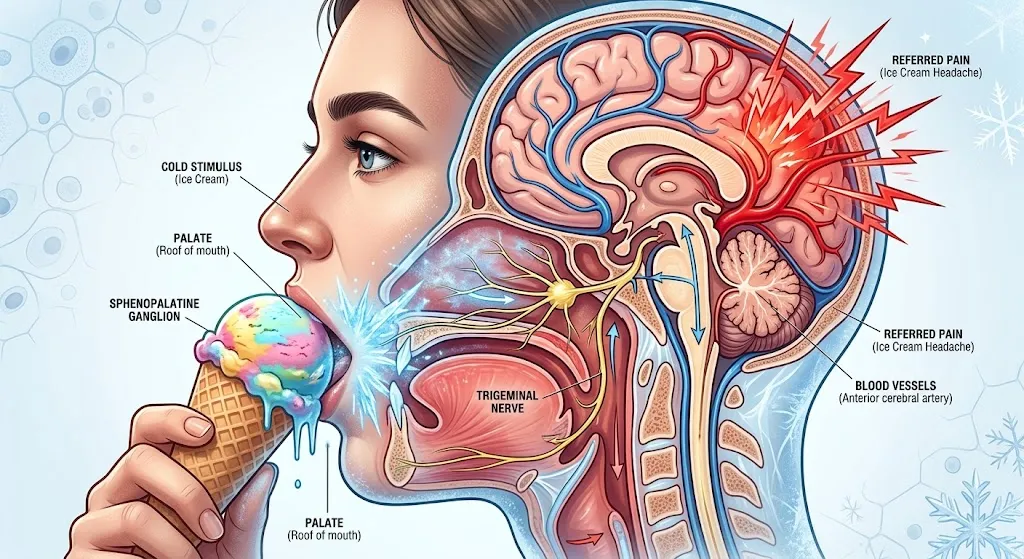
There you are, eating ice cream normally, and then one spoonful hits the roof of your mouth just right.
A few seconds later, there's a sudden stab of pain across your forehead.
Sometimes it reaches your temples or seems to sit behind your eyes. Then, almost as quickly as it arrived, it disappears.
It's called brain freeze, although your brain isn't actually freezing.
The medical name is cold-stimulus headache, and it's a real type of headache recognized by the International Headache Society. It can happen when something very cold touches the roof of your mouth or the back of your throat, and it usually disappears shortly after the cold stimulus is gone.
So why does cold food in your mouth end up hurting somewhere inside your head?
The answer has a lot to do with the nerves and blood vessels around your mouth, face and head.
Your brain isn't freezing
This is probably the first thing worth clearing up.
Despite the name, brain freeze doesn't mean the temperature of your brain suddenly drops to freezing.
The cold is hitting tissues in your mouth and throat, particularly around the roof of the mouth and the back of the throat. Those tissues contain nerves and blood vessels that respond to sudden temperature changes.
Your brain is simply where you feel the resulting pain.
That's why the experience can be so confusing. You bite into something cold in one part of your body and the pain appears somewhere completely different.
Researchers call this kind of pain a referred pain response. The nerves carrying information from the mouth and face are connected to pathways that also carry pain sensations from parts of the head.
So your forehead isn't necessarily being injured by the ice cream.
Your nervous system is interpreting signals from the cold-sensitive tissues in your mouth as pain in the head.
Why does ice cream cause it in the first place?
The roof of your mouth is a particularly sensitive place.
When you eat ice cream quickly, or take a big gulp of an icy drink, very cold material can press against the palate, which is the roof of your mouth. The colder the material and the faster it reaches the area, the more likely it is to trigger the headache.
The International Headache Society specifically describes this type of headache as being caused by cold material passing over the palate or the back of the throat. Rapidly eating crushed ice is particularly likely to trigger it, although ice cream can cause it too.
And it doesn't have to be ice cream.
Ice-cold drinks, frozen desserts, ice cubes, slushies and even inhaling very cold air can produce similar headaches.
The common factor is the sudden cold exposure.
So what actually causes the pain?
This is where things get interesting from a biology point of view.
When very cold food hits the roof of your mouth, the blood vessels in the area respond to the sudden temperature change. They constrict, meaning they become narrower, and then change size again as the tissue responds to the cold.
That rapid vascular response can activate nearby pain-sensitive nerves. Mayo Clinic describes this rapid change in blood-vessel size as one of the reasons the pain receptors become activated.
The nervous system then sends the pain signal through pathways associated with the trigeminal nerve, one of the major nerves responsible for sensation in the face and head.
And this helps explain the strangest part of brain freeze.
The cold is in your mouth.
The pain is in your head.
Why does brain freeze hurt in your forehead?
Your brain isn't very good at giving you a little map showing exactly where every pain signal originated.
The trigeminal nerve carries sensory information from the face, mouth and head. Because different areas share parts of the same pain-processing system, the brain can interpret a signal originating around the palate as pain somewhere else.
That's why brain freeze often feels like it's sitting in the forehead or temples rather than on the roof of your mouth.
A study of 414 people who were exposed to a cold stimulus on the palate found that the forehead and temples were among the most common locations for the resulting pain. Most participants who developed the headache experienced it on both sides of the head.
Some people also feel it around or behind the eyes.
That doesn't mean the cold has somehow travelled through your skull to your eyes.
It's the way the connected nerve pathways are reporting the sensation.
Why does it sometimes feel like the pain is inside your brain?
Because that's exactly where your nervous system tells you the pain is.
Pain isn't a simple temperature sensor saying, "Cold detected here."
It's an experience created by the nervous system after it receives signals from tissues throughout the body.
In a brain freeze, cold-sensitive structures in the mouth are stimulated intensely and quickly. The resulting signals travel through the facial pain pathways, and your brain interprets them as a headache.
That's why the name is slightly misleading.
Nothing is actually freezing inside your skull.
The sensation is real. The location is real. The cause is just somewhere other than where the pain seems to be.
Why does eating ice cream quickly make it worse?
Speed matters.
If you slowly eat a spoonful of ice cream, the cold exposure to your palate may be relatively brief or mild.
If you shovel several spoonfuls into your mouth in quick succession, the same area can be exposed to intense cold repeatedly.
The temperature changes more quickly, and a larger amount of cold material may contact the sensitive area.
Research on cold-stimulus headaches has found that the type of cold stimulus, how quickly it is applied and the size of the exposed area can affect how often the headache occurs, how quickly it begins and how painful it becomes.
That explains why you can eat ice cream one day without a problem and then get a nasty brain freeze the next time.
The conditions aren't necessarily identical.
Why don't I get brain freeze every time?
Because people don't all respond to cold stimulation in exactly the same way.
Even in people who can get brain freeze, the likelihood depends on things such as the temperature of the food, how quickly it's eaten, where it touches the mouth and how much cold exposure occurs.
Your own history of headaches may matter too.
In one study, people with a history of primary headaches were more likely to develop an ice-induced headache during the experiment than people without such a history. The International Headache Society also notes that cold-stimulus headache is especially common among people with migraine.
That doesn't mean everyone who gets brain freeze has migraine.
It simply suggests that some nervous systems may be more susceptible to this kind of cold-triggered pain.
Why does the pain disappear so quickly?
This is one of the clues that tells us brain freeze isn't the same thing as an ordinary headache.
The cold stimulus goes away.
The tissues in your mouth warm back up.
The abnormal stimulation of the nerves stops.
The vascular response settles down.
And the pain disappears.
The International Headache Society says a headache caused by eating or inhaling a cold stimulus should resolve within 10 minutes after the cold stimulus is removed. In practice, many brain freezes last only seconds or a couple of minutes.
That's why you can be completely fine one moment, suddenly grab your forehead the next, and then be eating ice cream again shortly afterward.
Your nervous system isn't dealing with an ongoing injury.
The trigger has simply disappeared.
Why does pressing your tongue against the roof of your mouth sometimes help?
This one makes sense once you know where the trigger is.
If the cold stimulus is cooling the roof of your mouth, warming that area can help bring the tissue back toward its normal temperature.
Pressing your tongue against the roof of your mouth can transfer warmth from your tongue to the palate. Drinking something at room temperature can do something similar.
Cleveland Clinic recommends stopping the cold food or drink and warming the mouth and throat. It also suggests pressing the tongue against the roof of the mouth as one way to help.
You don't need to do anything dramatic.
You're basically removing the thing that started the reaction and helping the affected area warm up.
Can cold water cause brain freeze?
Yes.
In fact, very cold water can be particularly effective at triggering a cold-stimulus headache when it rapidly contacts the palate.
You don't need ice cream.
A very cold drink can do it.
A slushy can do it.
An ice cube can do it.
And cold air can trigger a related form of cold-stimulus headache when the head or airway is exposed to sufficiently low temperatures.
The important distinction is that different types of cold exposure can produce slightly different versions of the same general phenomenon.
Why does the pain sometimes reach behind the eyes?
Again, the trigeminal nerve helps explain this.
The trigeminal system carries sensory information from much of the face and head, including areas around the eyes, forehead, nose, mouth and jaw.
Because those regions are connected through overlapping pain pathways, stimulation in the mouth can sometimes be experienced elsewhere in the head.
That's also why the exact location isn't identical for everyone.
Some people get a sharp pain in the forehead.
Others feel it around the temples.
Others describe pressure or pain behind the eyes.
These aren't necessarily different conditions. They're different ways the same cold-triggered sensory response can be experienced.
Does brain freeze mean something is wrong with your brain?
Usually, no.
Brain freeze is generally harmless and short-lived. It's classified as a cold-stimulus headache, meaning the headache is directly triggered by a physical cold stimulus rather than by some hidden disease inside the brain.
The fact that it hurts badly for a few seconds can make it feel more serious than it is.
But intensity isn't the same thing as danger.
If the pain follows the familiar pattern of eating or drinking something very cold, starts shortly afterward and disappears quickly when the cold exposure stops, that's the typical pattern.
A headache that happens for no obvious reason, lasts much longer than expected, keeps becoming more frequent or severe, or comes with symptoms such as weakness, confusion, fainting, vision problems, trouble speaking or a sudden extremely severe headache is different and deserves medical attention.
That's no longer something to casually label "brain freeze."
Is brain freeze related to migraine?
There does appear to be a connection.
People who experience migraine seem to be more susceptible to cold-stimulus headaches, although having brain freeze doesn't mean you have migraine. The International Headache Society specifically notes that cold-stimulus headaches are common in the general population and particularly common among people with migraine.
One study found that people with a previous history of primary headaches were more likely to develop an ice-induced headache when their palate was exposed to cold.
This makes sense when you consider that both involve the nervous system's handling of pain signals around the head.
But brain freeze is much more straightforward.
There is a very obvious trigger.
Cold touches the relevant tissue, the headache appears, the cold disappears and the headache goes away.
Can you stop brain freeze once it starts?
Usually, you don't need to do much.
Stop eating or drinking the cold thing.
Let the cold food move away from the roof of your mouth.
Warm the area with your tongue or drink something that's around room temperature.
And wait.
The headache normally settles on its own fairly quickly.
The better strategy, though, is prevention.
Eat frozen foods more slowly.
Take smaller bites.
Don't hold ice cream against the roof of your mouth.
Sip very cold drinks instead of swallowing large amounts quickly.
You don't have to give up ice cream. You just have to stop treating it like a speed-eating competition.
Why does slowing down actually help?
Because the problem isn't simply that something is cold.
It's the rapid cold stimulation.
If the cold reaches the palate quickly and intensely, you're more likely to trigger the nerve and blood-vessel response associated with the headache.
Slowing down reduces the intensity and speed of that exposure.
That's also why the International Headache Society specifically identifies rapid ingestion of crushed ice as particularly likely to provoke cold-stimulus headache.
So when someone tells you to eat ice cream slowly because they keep getting brain freeze, they're not just being cautious.
They're changing the conditions that trigger the headache.
The strange part isn't that ice cream can cause a headache
It's that the body can take a cold sensation in your mouth and turn it into pain that feels as though it's coming from your forehead.
That's the part that makes brain freeze seem so ridiculous.
But the nervous system isn't trying to fool you. It's processing signals from a network of nerves that serve the mouth, face and head, while nearby blood vessels respond to the sudden cold.
The result is a very short-lived headache that feels much farther away from the ice cream than you'd expect.
So no, your brain isn't freezing.
Your palate got cold, your nerves reacted, your blood vessels responded, and your brain interpreted the resulting signals as pain in your head.
And the next time you get that familiar stab halfway through a bowl of ice cream, you'll know what's actually happening.
The easiest fix is also the simplest one: slow down.