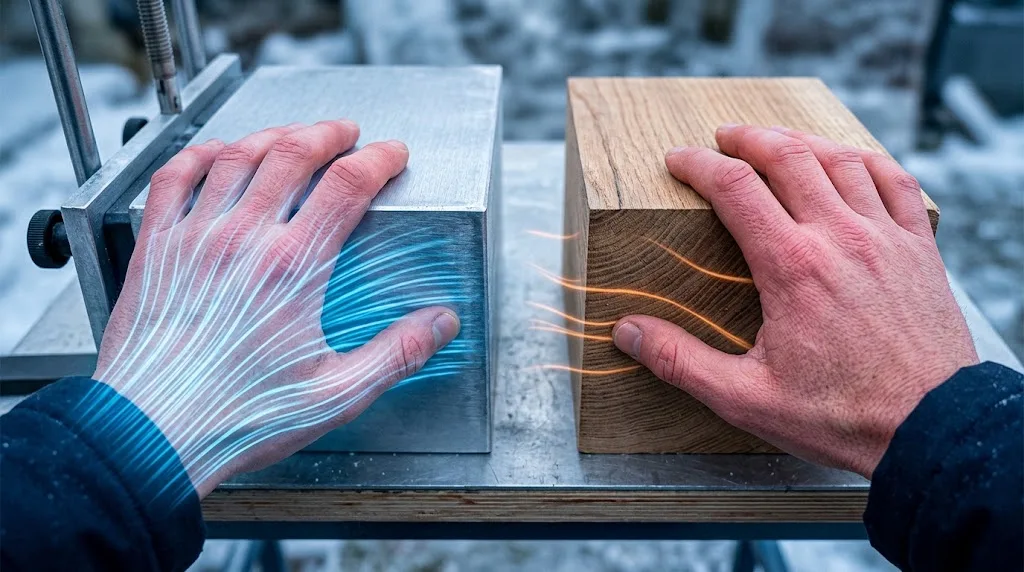
Put a metal spoon and a wooden spoon on the same kitchen counter and leave them there for a while. They eventually settle to roughly the same temperature as the room.
Touch them, though, and they don't feel the same at all.
The metal feels colder.
That isn't because the metal secretly stayed colder while the wood warmed up. If both objects have been sitting in the same room long enough, a thermometer can show that they're at essentially the same temperature.
What you're noticing is the rate at which heat moves between your skin and the material.
Metal conducts heat very efficiently. When your warmer hand touches room-temperature metal, heat moves out of your skin quickly and spreads through the metal. Your skin cools rapidly, and your nervous system interprets that change as a strong sensation of cold.
Wood conducts heat much more slowly. The small area of wood touching your hand warms up relatively quickly, so the flow of heat out of your skin slows down. The wood therefore feels warmer, even though its starting temperature can be the same as the metal's.
Your hand isn't a thermometer
A thermometer gives you a measurement of an object's temperature.
Your sense of touch does something different.
Temperature-sensitive nerve endings in your skin respond to changes in skin temperature. When you touch a cooler object, heat leaves your skin and your skin temperature falls. The size and speed of that change affect how cold the object feels.
This is why two objects at the same temperature can produce very different sensations.
Suppose your hand is warmer than both a wooden table and a metal table. In both cases, heat flows from your hand into the table.
The difference is what happens to that heat after it enters the material.
With wood, heat moves slowly through the material. The surface directly under your finger warms, reducing the temperature difference between your skin and that small area.
With metal, heat is carried away from the contact area much more efficiently. The metal surface touching your finger can continue receiving heat from your hand because the material rapidly spreads that energy away.
So your skin keeps losing heat.
That is what makes the metal feel colder.
What thermal conductivity actually means
The property behind this is called thermal conductivity.
It describes how readily heat moves through a material.
A material with high thermal conductivity can transfer heat through itself efficiently. A material with low thermal conductivity resists that movement.
Metals generally have high thermal conductivity. Wood has relatively low thermal conductivity.
That difference is why metal is useful for things such as cooking pans and heat sinks. Heat can move through the metal efficiently.
Wood behaves more like an insulator. Its structure contains lots of tiny spaces and relatively poor pathways for heat movement, which slows conduction.
The important part is that conductivity affects the rate of heat transfer. It doesn't mean that the metal starts out at a lower temperature.
That's the part that is easy to miss.
Two objects can have the same temperature and feel completely different
Imagine a metal chair and a wooden chair sitting outside overnight.
By morning, both have been exchanging heat with the surrounding air. Given enough time, their temperatures can become very close to the air temperature.
Touch the metal.
It feels cold.
Touch the wood.
It feels noticeably warmer.
A thermometer isn't confused. Your touch isn't necessarily giving you the object's temperature either. The two objects simply produce different rates of heat loss from your skin.
This same effect explains why a metal doorknob can feel colder than a wooden door even when both have been inside the same house for hours.
The metal isn't necessarily colder.
It is just much better at moving your heat away from the contact point.
Why the wood seems to warm up
There is a small but useful detail here.
When you touch a wooden surface, the wood immediately next to your skin begins to warm.
It doesn't mean the entire piece of wood suddenly becomes warm. The warming is concentrated near the contact area.
Because wood doesn't conduct heat very well, that warmth doesn't spread away quickly. The surface therefore approaches your skin temperature more readily, reducing the heat flow from your hand.
Metal behaves differently.
Heat entering the metal spreads away from the contact region much more efficiently. The metal can therefore keep accepting heat from your hand at a higher rate.
Research on human thermal perception describes this as a transient process. Skin temperature typically drops rapidly when contact begins, then changes more slowly as the interaction continues. Materials with stronger thermal contact properties tend to produce a larger initial cooling response.
That's why the first moment of contact can be particularly noticeable.
There's more to it than conductivity
Thermal conductivity gets most of the attention in simple explanations, and it's a good starting point.
But the physics of touch is a little richer.
Another property called thermal effusivity describes how readily a material can exchange thermal energy with another material at its surface. It depends on properties including thermal conductivity, density and heat capacity.
This helps explain why materials with very different physical properties can produce different sensations even when they start at the same temperature.
Research into thermal perception has found that the cooling response of the skin depends on several factors, including the material's thermal properties, the size and condition of the contact area, the pressure applied and the surface itself.
A study of different tabletop materials also found that wood-based materials, which generally had lower thermal effusivity, produced different surface-temperature changes after contact than higher-effusivity materials.
So "metal conducts heat better" is correct, but it is really the beginning of the explanation rather than the whole story.
Why does tile feel colder than carpet?
The same physics shows up under your feet.
Walk barefoot across a room and step from a carpet onto a tile floor.
The tile can feel much colder even if both surfaces have been sitting in the same room and are at roughly the same temperature.
Tile allows heat to leave your feet more quickly than carpet does. Carpet contains fibres and air pockets that slow heat transfer.
OpenStax uses this exact comparison to explain why a carpet and tile floor at the same temperature can produce different sensations. The greater heat loss from skin touching the tile produces the stronger feeling of cold.
This is also why a wooden floor usually feels more comfortable than a stone or tile floor on a cool morning.
Your feet aren't detecting some secret temperature difference.
They're responding to how quickly they're losing heat.
Then why does room-temperature water feel colder than air?
There's another everyday example that makes the same point.
Imagine air and water at approximately the same temperature. Put your hand into the water.
The water feels colder.
Again, the temperature alone doesn't explain the sensation.
Water transfers heat away from your skin much more effectively than still air. So your hand loses heat faster when it is surrounded by water.
The American Chemical Society uses this comparison in its heat-transfer teaching materials: room-temperature water and air can be at approximately the same temperature while the water produces a colder sensation because heat is transferred from the hand more effectively.
The same basic idea keeps appearing.
Metal versus wood.
Tile versus carpet.
Water versus air.
The thermometer can give similar temperature readings while your skin experiences very different rates of heat loss.
Why does metal also feel hotter in hot conditions?
This is one of the easiest ways to see that the effect isn't really about "metal being cold."
High thermal conductivity works in both directions.
If the object is colder than your skin, heat moves from your skin into the object. A good conductor can move that heat away quickly, making the object feel colder.
If the object is hotter than your skin, the direction reverses.
Heat moves from the hot object into your skin.
A metal object can transfer that heat rapidly, so it can feel extremely hot.
This is why a metal bench sitting in strong sunlight can become uncomfortable to touch. A wooden surface under similar conditions may feel different, depending on its actual temperature and thermal properties.
The material hasn't changed its definition of hot or cold.
The direction of heat transfer has changed.
The same physical property that makes metal feel especially cold below your skin temperature can make it feel especially hot above it. Research on thermal perception also finds that when materials are heated above skin temperature, the usual colder-warmer ordering can reverse, with metals moving toward the warm end of the scale.
Why does a blanket feel warm if it isn't producing heat?
A blanket is another version of the same idea, although there is an extra factor involved.
The blanket doesn't normally create enough heat to warm you by itself.
Your body does.
A blanket slows the rate at which your body loses heat to the surrounding environment. Materials such as wool, fleece and other insulating fabrics trap air and reduce heat transfer.
So when you get under a blanket, the material helps keep your body heat close to you.
That's why a blanket can feel warm even though the blanket itself isn't a heater.
It is reducing heat loss.
The same principle explains why wood can feel warmer than metal. Wood isn't necessarily warmer. It simply doesn't carry heat away from your skin as efficiently.
Why does pressing harder sometimes make something feel colder?
The contact between your skin and an object matters too.
Real surfaces aren't perfectly flat. Even something that looks smooth has microscopic irregularities.
When you press your finger against a surface, you generally increase the amount of actual contact between the skin and the material. That can reduce thermal contact resistance and allow more heat to move between them.
Research on thermal touch perception has found that cooling sensations can become stronger with increased contact force, while surface roughness and other properties of the skin-object interface also affect heat transfer.
So the sensation isn't determined only by the material.
It's also affected by how you're touching it.
Why does metal feel colder after sitting in a cold room?
Now consider a winter morning.
A metal railing outside may actually be much colder than your hand. If the metal and wood beside it have both been outside long enough, they may be at similar temperatures.
The metal still feels colder.
The difference in thermal conductivity makes the sensation stronger because the metal can continue transferring heat away from your hand quickly.
Wood slows the process.
The same thing happens with objects inside a cold garage. A metal toolbox, concrete floor and wooden workbench may all be cold, but they don't necessarily feel equally cold when touched.
The material changes how quickly your skin responds.
Is metal actually colder than wood?
Not necessarily.
If the metal and wood have been sitting in the same environment long enough to reach thermal equilibrium, they can be at essentially the same temperature.
A thermometer measures that temperature.
Your hand is responding to what happens when your skin and the object exchange heat.
There are situations where the metal really is colder, of course. If the two objects have been exposed to different conditions, or one has a different surface temperature, then they can genuinely have different temperatures.
But when two materials have been sitting together in the same environment and have reached the same temperature, the familiar metal-versus-wood difference is mainly a heat-transfer effect.
So what is your skin actually detecting?
It's detecting changes in itself.
Your skin contains thermoreceptors that respond to temperature changes. When you touch a room-temperature metal object with warmer skin, the contact causes your skin temperature to fall.
The faster and more strongly that cooling happens, the stronger the cold sensation can be.
This is why humans can use thermal sensations to distinguish materials. A study reviewing the field found that people can identify and discriminate materials partly from the cooling patterns produced when they touch them. Metal, wood and fabric tend to produce different thermal responses even when their physical temperatures are similar.
In other words, your sense of touch is doing more than asking:
"How cold is this object?"
It's also responding to:
"What is this object doing to my skin?"
That distinction explains the whole metal-and-wood puzzle.
The simple answer
Metal feels colder than wood when they're at the same temperature because metal moves heat away from your skin much faster.
Your hand is usually warmer than a room-temperature object. When you touch either material, heat flows from your hand into it.
Wood slows that transfer, so the skin near the contact point warms relatively quickly.
Metal carries the heat away from the contact area efficiently, keeping the heat transfer going and causing a faster drop in skin temperature.
Your brain interprets that faster cooling as a stronger sensation of cold.
So the next time a metal spoon feels ice-cold while the wooden spoon beside it feels almost warm, the metal isn't necessarily colder.
It's just much better at taking your heat.