You take a plate out of the microwave and find that one part is almost too hot to touch while another part is still cold. The food has been sitting in the same oven for the same amount of time, yet somehow it has come out with several different temperatures.
That's normal microwave behavior more often than it is a sign that the oven is broken.
Microwave heating is uneven because the electromagnetic field inside the oven isn't perfectly uniform, and the food itself doesn't absorb that energy evenly. Its shape, thickness, moisture, density and composition all matter. Heat then has to move through the food after the microwave energy has been absorbed, which creates another opportunity for temperature differences to remain.
The turntable, stirring, covering and resting instructions you see on microwave meals are all ways of dealing with this problem.
A microwave doesn't heat every part of the oven equally
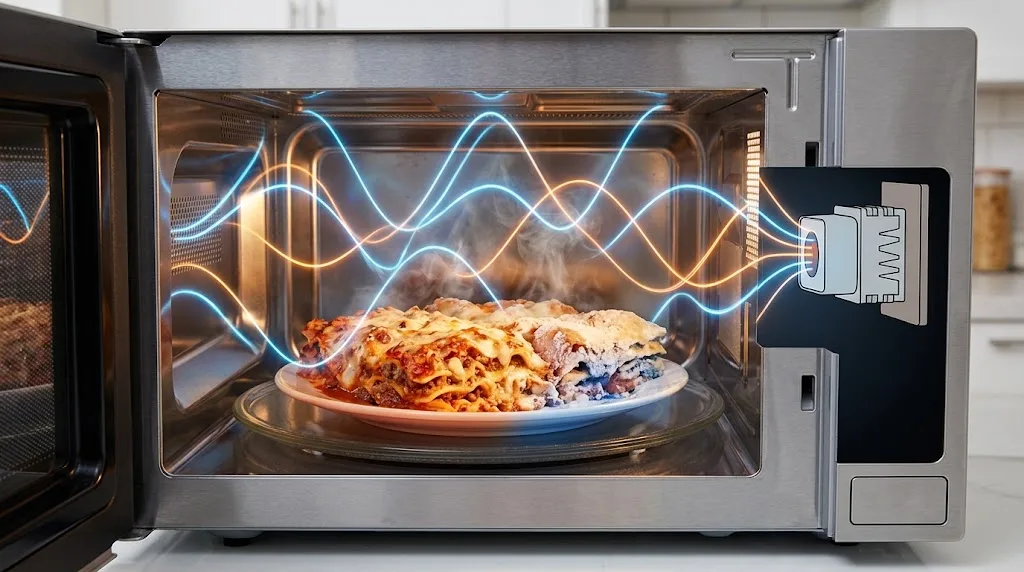
Inside a microwave is a metal cavity. The microwave energy enters that cavity and reflects from its walls. Those reflected waves interact with the incoming waves, producing a complicated pattern of stronger and weaker electromagnetic fields.
In some places, the waves reinforce one another. In others, they partially cancel one another.
The result is a three-dimensional pattern of hot and cold zones inside the oven. Physicists describe these as standing-wave patterns.
So imagine putting a plate of food into the oven and leaving it completely still. Different parts of that plate would sit in different parts of the electromagnetic field. One section might receive much more microwave energy than another.
That's one reason two pieces of food sitting a few inches apart can end up with noticeably different temperatures.
It isn't that the microwave decides to heat one side and ignore the other. The field inside the cavity simply isn't uniform.
This is why the turntable exists
The glass plate isn't there just to make the microwave look busy.
Its job is to move the food through different parts of the electromagnetic field.
As the food rotates, a particular piece of food doesn't remain in exactly the same hot or cold zone for the entire cooking cycle. It moves through the pattern and receives a changing amount of energy over time.
That averages things out.
It doesn't make the heating perfectly uniform, though.
The food is still changing position relative to the field, and its own shape and composition still affect how much energy it absorbs.
Some microwave ovens also use a metal component called a mode stirrer. Instead of relying only on the food moving around, the stirrer changes the pattern of the reflected microwave field itself.
So there are two basic approaches to the same problem:
Move the food through the field, or move the field around the food.
Many ovens use one or both methods.
Why is the middle of your food often cold?
This is where microwave cooking gets misunderstood.
People sometimes say that microwaves cook food “from the inside out.” That's not really what happens.
Microwave energy can penetrate into food, but it doesn't penetrate indefinitely. USDA guidance puts typical penetration at roughly 1 to 1½ inches, depending on the food and conditions. In thicker foods, the center increasingly depends on heat moving inward from warmer surrounding areas.
That creates a familiar situation.
The outside of a thick piece of food may already be very hot while the center is still cool.
Once the outer part has absorbed energy, heat begins moving through the food by ordinary conduction. The hot material transfers some of its thermal energy to the cooler material next to it.
That process is much slower than microwave energy being absorbed directly.
So a thick mound of food can develop a hot outer region and a cooler center even though the microwave is operating normally.
This is also why spreading food out can help. A shallow, evenly distributed layer gives heat less distance to travel before the colder parts catch up.
Food isn't made of one uniform material
A plate of food may look like one meal, but from the microwave's point of view it can be several very different materials sitting together.
Water, fat, sugar, salt, starch and other components interact with microwave fields differently. Moisture content and food composition affect how energy is absorbed, while density and geometry affect how that energy is distributed through the food.
Think about a frozen meal containing meat, sauce, vegetables and pasta.
The vegetables may contain plenty of water.
The meat has a different structure and density.
The frozen portions contain ice rather than liquid water.
The sauce may contain a mixture of water, fat, salt and sugar.
These aren't going to respond to microwave energy in exactly the same way.
That's why a meal can have a bubbling patch of sauce next to a piece of food that is still barely warm.
Frozen food makes the problem worse
Frozen food has another complication: ice doesn't absorb microwave energy in the same way liquid water does.
The USDA's National Agricultural Library notes that uneven heating can be particularly severe in frozen microwaveable foods because thawed portions warm more readily while frozen sections can remain cold.
This can create a feedback effect during heating.
A section that has thawed can begin absorbing energy more effectively, while another section is still frozen and remains comparatively cold.
That's one reason frozen meals often have instructions telling you to pause, stir, rotate, rearrange or let the food stand before eating.
The instructions aren't just there because food manufacturers like making you wait.
They're compensating for the physics of the heating process.
Why does stirring work so well?
Stirring does something the turntable cannot.
The turntable moves the entire plate through the microwave's field. Stirring physically mixes hotter and colder parts of the food together.
Now heat has a chance to move between them.
Suppose one part of a sauce is very hot and another part is barely warm. If you leave both parts where they are, conduction will eventually move some heat from the hotter region into the colder one.
Stirring does that mixing much more aggressively.
It also changes the position and orientation of different pieces of food relative to the microwave field.
That's why instructions for microwave cooking often recommend stirring or rearranging food halfway through heating. USDA specifically recommends stirring, rotating or turning food over where possible to reduce cold spots.
Why covering food helps
Covering food changes the heat transfer inside the container.
As water in the food turns into steam, a cover helps retain moisture and creates a warmer, more humid environment around the food. USDA recommends covering microwave food, while allowing steam to vent, as one way to promote more uniform heating.
This matters because the microwave isn't only dealing with electromagnetic energy. Once food gets hot, ordinary heat transfer and moisture movement become part of the process too.
A covered dish can therefore behave differently from an uncovered one.
The cover doesn't magically make the microwave field uniform. It helps the heat and moisture already being produced spread through the food more effectively.
Why lower power can produce more even food
Microwave power settings are also easy to misunderstand.
On many conventional microwave ovens, selecting a lower power level doesn't mean the oven suddenly produces a weaker microwave continuously. Instead, the magnetron cycles on and off to produce a lower average power level. USDA describes 50% power, for example, as microwave energy being produced for part of the cycle and switched off for the rest.
That pause matters.
During the periods when microwave energy isn't being added, heat can continue moving from hotter parts of the food toward cooler parts.
So a longer heating period at reduced power can sometimes produce a more even result than blasting the food at full power for a shorter time.
This is particularly useful for dense foods that need time for heat to move toward the center.
Why does the plate stay cooler than the food?
This one seems strange until you remember what the microwave energy is interacting with.
The microwave field doesn't simply heat everything inside the oven equally.
Glass, many ceramics and some microwave-safe plastics allow much of the microwave energy to pass through rather than absorbing it strongly. The food, particularly its water-rich components, absorbs much more of the energy and heats up.
That means a ceramic plate can remain relatively cool while the food sitting on it is hot.
But there is an important second step.
The plate can become hot from the food.
If hot soup sits in a ceramic bowl for several minutes, heat can conduct from the soup into the bowl. So when you pick up the container afterward, it may feel surprisingly warm even though the microwave didn't directly heat it very much.
The same thing explains why some plastic containers become hot even when the plastic itself doesn't absorb much microwave energy. The food inside can heat the container.
Why do microwave ovens have metal walls?
The metal walls are part of what makes the oven work.
Microwaves reflect from conductive metal surfaces, allowing the electromagnetic energy to remain inside the cooking cavity rather than simply passing through the walls. Those reflections are also responsible for the standing-wave pattern that creates uneven field strength inside the oven.
That creates an interesting trade-off.
The reflections help keep the microwave energy where you want it, but they also produce the hot and cold regions that make perfectly uniform heating difficult.
The oven's design has to manage that pattern rather than simply eliminate it.
That's why turntables and mode stirrers exist.
Why does food keep cooking after the microwave stops?
The microwave stops producing energy when the timer reaches zero, but the food doesn't instantly become the same temperature everywhere.
A hot region can still contain more thermal energy than a cooler region beside it.
Heat continues moving from warmer areas toward cooler ones.
This is called standing time or carryover cooking.
USDA specifically recommends allowing food to stand after microwave cooking because the temperature can continue rising and heat can redistribute during that period.
It's especially relevant for dense foods.
A few minutes can make a noticeable difference between a meal with a hot exterior and cool center and one that has reached a more even temperature.
In other words, the microwave timer stopping isn't necessarily the end of the heating process.
It's the end of the microwave part of it.
Why does rotating the food help if the microwave already has a turntable?
Because a turntable can only do so much.
Research on microwave heating has found that rotating the food improves temperature uniformity, but the underlying electromagnetic field remains non-uniform. Food geometry also matters. One 2024 study found that changing the geometry of microwaveable food improved heating uniformity and that rotational heating further improved temperature uniformity.
So if the microwave tells you to rotate the dish halfway through, that's not necessarily redundant.
You're changing which part of the food occupies which position in the field.
And if the food itself is rearranged, you're changing the geometry at the same time.
What about the classic hot edge and cold center?
That's a combination of several effects rather than one single microwave rule.
The electromagnetic field isn't uniform.
The food has finite penetration depth.
The food may have different densities and moisture levels.
The outer regions can heat before the center catches up.
And the shape of the food determines how much surface and interior volume are exposed to the field.
Researchers studying microwave heating have repeatedly found that food shape and the electromagnetic field distribution both affect temperature patterns.
This is why a thin layer of food can heat quite differently from a thick pile of the same food.
It also explains why spreading food around a dish rather than leaving it in one large mound can help.
Does uneven heating mean the microwave is broken?
Usually, no.
Some degree of uneven heating is built into the physics of microwave cooking.
A working oven can produce hot and cold spots because of the electromagnetic field inside its cavity and because different foods absorb and conduct heat differently.
There are cases where an appliance problem can make heating worse, though.
If the turntable has stopped rotating, food may remain in the same part of the field for the entire cooking cycle. A damaged or malfunctioning system that distributes microwave energy can also affect heating performance.
A sudden major change is more interesting than ordinary unevenness.
If food that used to heat normally now takes dramatically longer to warm, or one area consistently stays cold while other areas become extremely hot, the appliance may deserve inspection.
Don't open the microwave yourself to investigate internal high-voltage components. Microwave ovens contain components that can be hazardous even after the appliance has been unplugged.
So what actually makes microwave food heat more evenly?
The practical answer is a combination of several small things.
Spread food into a relatively even layer rather than leaving it in one thick mound.
Stir or rearrange it partway through heating when possible.
Rotate solid pieces or turn them over.
Use the power level recommended for the particular food instead of automatically using maximum power.
Cover food when the instructions call for it, while allowing steam to vent safely.
Let the food stand for the recommended time after heating.
For foods where safety matters, don't assume that a hot surface means the entire food has reached a safe temperature. USDA recommends checking food in several places because microwave heating can leave cold spots.
The microwave itself isn't necessarily doing anything wrong.
It's dealing with a complicated electromagnetic field inside a metal box, and then trying to heat food that may contain several different materials, shapes, densities and moisture levels at once.
The hot edge, cold middle and random warm patches are the visible result of all those things happening together.
The turntable helps average the field out. Stirring helps mix the temperatures. Standing time lets heat continue moving.
None of them changes the basic physics.
They just give the heat a better chance to end up where you actually want it.