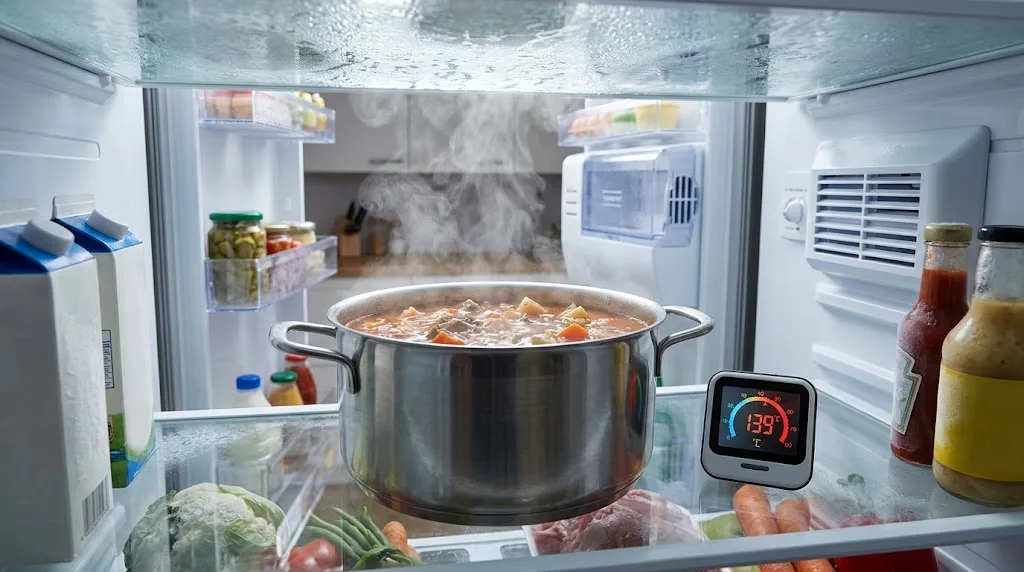
You have just finished cooking a pot of rice, soup, stew, pasta or something else that is still steaming. There is usually a moment when you have to decide what to do with it.
Put it in the refrigerator now?
Or leave it on the counter until it cools down?
The old advice says that putting hot food in the fridge makes the refrigerator work too hard. There is some truth behind that idea. Hot food does add heat to the refrigerator, and the cooling system has to remove that extra heat.
But that doesn't mean you should leave cooked food sitting on the counter for hours.
The FDA and USDA both say hot food can be placed directly in the refrigerator, and they recommend refrigerating perishable leftovers promptly rather than leaving them at room temperature for an extended period. The FDA specifically says hot food won't harm the refrigerator and recommends dividing large amounts into shallow containers so they cool faster.
So what actually happens when you put a hot meal in the fridge?
Yes, the refrigerator has to remove extra heat
A refrigerator doesn't create cold in the way an air conditioner creates cold air. Its cooling system removes heat from inside the compartment and releases that heat into the room.
When you put a hot container of food inside, you're adding another source of heat.
The food begins transferring heat to the colder air and surfaces around it. The refrigerator then has to remove that heat along with the heat that was already inside the compartment.
That can cause the refrigerator's cooling system to run for longer than it otherwise would.
So, in that narrow sense, the answer is yes. Hot food can make the refrigerator work harder for a while.
The important question is how much it matters.
A small container of warm leftovers is very different from putting a large, steaming pot of soup into an already-full refrigerator.
The amount of food, its temperature, its container, how much cold air can circulate around it, and the refrigerator's existing temperature all affect what happens.
Where does the heat actually go?
This is the part that often gets left out of the argument.
Suppose you put a hot pot of stew into the refrigerator.
The heat doesn't simply disappear.
It moves from the stew into the surrounding refrigerator compartment. The refrigerator's cooling system then removes that heat and eventually releases it into the room.
In other words, the refrigerator is taking heat from your food and moving it outside the refrigerator.
That's what the cooling system is designed to do.
The extra work is real, but it isn't the same thing as the refrigerator being damaged.
A refrigerator that runs longer after you add a large quantity of warm food is responding to a larger cooling load. Once the food has cooled and the compartment returns to its normal temperature, the refrigerator can return to its normal operating cycle.
Does hot food raise the refrigerator's temperature?
It can.
The effect depends heavily on how much hot food you put inside.
A large pot of freshly cooked food contains a lot of thermal energy. A small bowl of slightly warm leftovers contains much less.
If you place a large amount of hot food into the refrigerator, the air around it can become warmer temporarily. Food sitting directly beside it may also experience a temperature increase.
That doesn't mean the entire refrigerator suddenly becomes warm enough to spoil everything inside. Modern refrigerators continuously control their temperature, and the cooling system is designed to respond to changes.
But the effect is still worth understanding.
The FDA recommends keeping a refrigerator at 40°F (4°C) or below and specifically recommends using shallow containers when storing large amounts of leftovers.
That advice solves two problems at once.
The food cools faster, and the refrigerator doesn't have to deal with one enormous concentrated mass of heat.
A huge pot is different from several shallow containers
Imagine you have just cooked a large pot of soup.
You could put the entire pot into the refrigerator.
Or you could divide the soup into several smaller, shallow containers.
The second arrangement allows much more of the food's surface area to contact the colder surroundings.
Heat can leave the food more easily.
The center of a deep pot is surrounded by other hot food, so it takes much longer for that heat to reach the outside. A shallow container gives the heat a shorter distance to travel.
This is one reason the USDA recommends dividing large quantities of leftovers into shallow containers for rapid cooling.
It isn't just an energy-saving trick.
It's a food-safety technique.
So should you let hot food cool before putting it away?
Not for hours.
This is where the traditional advice can become misleading.
Cooked food passes through temperatures where bacteria can multiply rapidly. The USDA describes the danger zone as 40°F to 140°F (4°C to 60°C), and recommends refrigerating leftovers within two hours. If the surrounding temperature is above 90°F (about 32°C), the limit is one hour.
That means the goal isn't:
“Wait until the food reaches room temperature.”
The goal is:
“Cool it quickly and get it refrigerated within the safe time.”
The FDA makes the same point. It says hot food won't harm the refrigerator and recommends dividing large amounts of leftovers into shallow containers for quicker cooling.
That's a significant difference from the old idea that food should sit on the counter until it is completely cool.
Why does the old advice exist, then?
Because the concern isn't completely imaginary.
Putting a large amount of hot food into a refrigerator does add heat to the compartment. Some appliance manufacturers still advise allowing food to cool before refrigeration because of the temporary temperature increase and the additional cooling load.
Samsung, for example, currently advises allowing food to cool to room temperature before putting it into the refrigerator, saying hot food can raise the compartment temperature.
Electrolux gives similar advice about avoiding very hot food because the refrigerator has to remove the additional heat.
Food-safety authorities take a different practical approach.
The FDA and USDA place more emphasis on getting perishable food out of the temperature range where bacteria can multiply rapidly. They explicitly say hot food can be refrigerated.
So the disagreement isn't really about whether hot food contains heat.
Of course it does.
The disagreement is about how that heat should be managed while also keeping the food safe.
Does putting hot food in the fridge increase electricity use?
It can, because the refrigerator has to remove the additional heat.
But there's an important distinction between using more energy during that cooling event and causing a dramatic increase in your electricity bill.
The refrigerator is already using electricity to maintain its temperature. Adding a large amount of hot food increases the cooling load, so the compressor may need to operate for longer.
How much extra electricity that represents depends on the amount and temperature of the food, the refrigerator, the surrounding room temperature, how full the refrigerator is, and how efficiently the appliance operates.
I wouldn't put a universal number on the extra electricity without measuring a particular refrigerator under controlled conditions.
That is one place where a genuine HIAW experiment could add something useful.
Can hot food warm the other food in the fridge?
Potentially, yes.
But again, the size of the effect matters.
A large hot container placed next to other food can temporarily raise the temperature around it. That's one reason shallow containers and sensible spacing are useful.
A refrigerator also has a cooling system working to bring the temperature back down.
The FDA warns against packing refrigerators too tightly because cold air needs to circulate properly.
So if you have a large amount of freshly cooked food, putting it into several shallow containers is a better setup than cramming one enormous steaming pot into an already packed refrigerator.
Can hot food damage the refrigerator?
For a modern household refrigerator, ordinary hot leftovers are not generally considered a reason to worry about damaging the appliance.
The refrigerator is designed to remove heat.
Adding heat gives it more work to do, but that is different from asking it to perform some task it wasn't designed for.
The Center for Science in the Public Interest notes that the idea that hot food will damage a modern refrigerator comes partly from older refrigeration systems, which operated differently. Modern refrigerators are designed to maintain temperature much more consistently.
That doesn't mean every refrigerator manual will tell you to put steaming food straight inside. Manufacturers can have specific instructions for particular models.
If your refrigerator's manual gives specific storage instructions, those instructions are worth following.
Why shallow containers are such a big deal
There are two separate things happening when you cool food.
The refrigerator needs to cool the food.
And the food needs to cool internally.
The second part is easy to overlook.
A deep container can stay hot in the middle long after its surface has cooled. The outside may feel cold while the center remains much warmer.
A shallow container reduces the distance between the center of the food and the cold surroundings.
That's why USDA guidance repeatedly recommends shallow containers for leftovers.
For a large batch of soup, stew, rice or another dense food, dividing it into smaller portions is therefore useful for more than convenience.
It speeds up the cooling process.
Is it safer to cool food quickly?
Yes.
For perishable cooked food, rapid cooling is generally safer than leaving it sitting around for several hours.
Bacteria can multiply rapidly when food remains in the 40°F to 140°F (4°C to 60°C) range. The USDA therefore recommends getting leftovers into refrigeration within two hours, or within one hour when the surrounding temperature is above 90°F (32°C).
This is why “I'll wait until it cools completely” isn't a particularly good rule.
A better approach is to manage the heat without unnecessarily leaving the food out.
Divide large quantities.
Use shallow containers.
Refrigerate promptly.
Keep the refrigerator at 40°F (4°C) or below.
What about a giant pot of boiling soup?
That's the situation where the difference matters most.
A huge, extremely hot pot contains a lot of heat and cools slowly because of its size and depth.
Instead of leaving it on the counter for hours, divide the food into smaller shallow containers.
The USDA also says hot food can be placed directly in the refrigerator or rapidly chilled using an ice or cold-water bath before refrigeration.
That gives you a way to remove heat quickly without relying on a long period of room-temperature cooling.
Does putting hot food in the fridge make it work harder?
Yes, in the literal sense that the refrigerator has more heat to remove.
But the common version of the claim leaves out the more important part.
Hot food doesn't automatically mean you're doing something unsafe or damaging your refrigerator.
The refrigerator will have to deal with the extra heat, and a large amount of very hot food can temporarily raise the compartment temperature and increase the cooling load.
At the same time, leaving perishable food sitting on the counter for hours can create a much more serious problem: bacterial growth.
That's why the safest practical approach isn't to wait for a large pot of food to reach room temperature.
It's to cool it efficiently.
For large amounts, divide the food into shallow containers. Refrigerate perishable leftovers within two hours, or within one hour when the surrounding temperature is above 90°F (32°C).
The refrigerator may have to work a little harder.
That's a real physical effect.
But the idea that you need to leave food sitting out for hours to protect the refrigerator is a different matter, and current food-safety guidance does not support it.