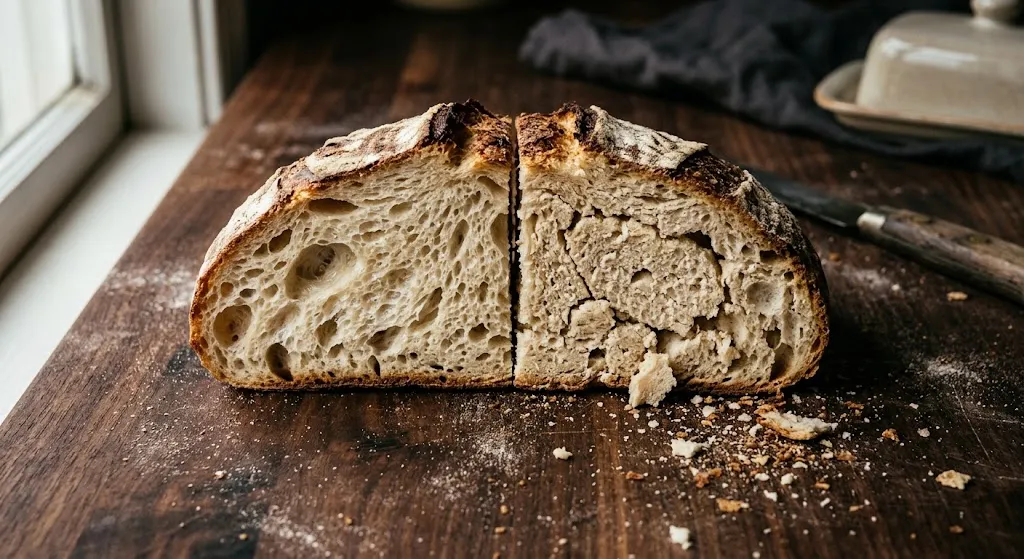
Fresh bread has a short window in which everything about it seems right. The crust is crisp, the middle is soft, and the crumb has that springy texture that disappears surprisingly quickly.
Leave the same loaf on the counter for a day or two and it can become firm, dry-looking and strangely chewy. The crust may lose its crispness at the same time.
It's tempting to say the bread has simply dried out.
That's part of what happens, but it isn't the whole story.
Bread staling is a combination of water movement and changes in the structure of starch. Some water moves from the soft crumb toward the crust and eventually into the surrounding air. At the same time, starch molecules that were disrupted during baking gradually rearrange themselves into a more ordered structure.
That second process is one of the main reasons bread can become firm even when it hasn't lost all that much of its original moisture.
And that leads to one of the stranger things about stale bread:
A loaf can become hard without simply becoming bone-dry.
What happens to bread when it bakes?
To understand staling, it helps to start with what happens inside the dough in the oven.
Flour contains a lot of starch. Wheat starch is mainly made up of two types of large molecules called amylose and amylopectin.
Before baking, these molecules are arranged in relatively organized structures inside starch granules.
Then the dough is heated in the presence of water.
The starch granules absorb water, swell and lose much of their original internal organization. This process is called gelatinization. The starch becomes part of the soft structure that gives freshly baked bread its characteristic crumb.
The result is not a permanently fixed structure.
Once the bread comes out of the oven and begins to cool, the starch starts changing again.
Some of those starch molecules begin to reassociate and form more ordered structures. This process is called retrogradation.
And it continues during storage.
So what actually makes bread stale?
There isn't one single event that turns fresh bread into stale bread.
Several things happen at the same time.
The crumb loses some moisture.
Water moves from the crumb toward the crust.
Some moisture eventually escapes from the bread altogether.
And starch molecules gradually reorganize, with amylopectin retrogradation playing a major role in the longer-term firming of bread.
Researchers have studied bread staling for decades, and the process is still considered complex rather than something that can be explained by one mechanism alone.
So “the bread dried out” isn't exactly wrong.
It's just incomplete.
The surprising part: the water doesn't simply disappear
This is where bread staling gets interesting.
Imagine cutting a loaf in half and measuring the moisture in different parts of it as it ages.
The crumb and crust don't behave in the same way.
During storage, moisture can move from the crumb toward the crust. Some of that moisture remains in the crust, while some eventually escapes into the surrounding air. Studies have directly observed this redistribution of water during staling.
That's why an older loaf can have a crust that is no longer crisp while its crumb has become firmer.
The water hasn't necessarily vanished from the loaf immediately.
It has been redistributed.
And where that water ends up matters because water affects the physical state of the starch and other components in the bread.
The same amount of water can behave differently depending on what it is interacting with.
Why does the soft crumb become hard?
This is mainly where starch enters the picture.
During baking, starch becomes swollen and disordered. After baking, some of its molecules begin moving back toward more ordered arrangements.
Amylose tends to participate in earlier changes after baking, while the slower recrystallization of amylopectin is strongly associated with the longer-term firming of bread.
As these starch structures become more ordered, the crumb gradually loses some of the soft, flexible character it had when fresh.
Researchers have observed increasing amylopectin retrogradation alongside increasing firmness during bread storage.
So when you bite into a slice of bread that has been sitting around for a couple of days, you aren't just biting into bread that has lost water.
You're biting into a structure that has been changing at the molecular level since it left the oven.
Why can bread become hard even when it still contains water?
Because water content and water behavior aren't the same thing.
Some of the water in bread is associated with starch, gluten and other components of the crumb.
As the bread ages, the distribution and mobility of that water change. Research using techniques such as nuclear magnetic resonance has observed changes in the mobility of water within the bread matrix during storage.
At the same time, starch is reorganizing.
So you can have a loaf that still contains a considerable amount of moisture but has a much firmer texture.
This is one reason the simple explanation of “it dried out” doesn't quite work.
Then why does bread eventually dry out too?
Because it really does lose water.
Bread is not a sealed system unless you've put it in some kind of barrier.
Water can move through the crumb and crust, and water vapor can eventually leave the surface and enter the surrounding air. Temperature and humidity affect how this happens.
So there are really two related things happening:
Inside the loaf: water is being redistributed and its interaction with starch and other components is changing.
At the surface: some of that water eventually escapes into the environment.
The first helps change the structure and texture.
The second contributes to actual drying.
That's why saying “bread goes stale because it dries out” captures only part of the process.
Why does the crust go soft while the middle gets hard?
This is one of the better clues that something more complicated than simple drying is happening.
Fresh bread has a moisture difference between its crumb and crust.
The interior contains much more moisture, while the crust is relatively dry and crisp because of what happened during baking.
During storage, moisture moves outward from the crumb.
That can make the crumb progressively firmer while the crust gains moisture and loses some of its crispness.
So the bread can effectively trade textures.
The middle becomes less soft.
The crust becomes less crisp.
The loaf ends up with neither of the textures you wanted when it was fresh.
Why does bread sometimes go stale faster in the fridge?
This is one of the strangest parts.
You'd expect refrigeration to preserve bread because cold temperatures slow down many chemical and biological processes.
And refrigeration does help with some forms of food spoilage.
But bread staling is different.
The starch changes involved in staling can actually proceed efficiently at cool temperatures above freezing. Research on bread staling has found that lowering storage temperature can increase the rate of crumb firming in the relevant temperature range, consistent with starch crystallization behavior.
That's why putting ordinary bread in the refrigerator isn't necessarily the best way to keep it soft.
You may slow some other forms of deterioration, but you can make the texture worse.
The freezer is a different story.
Why does freezing bread work better than refrigerating it?
Freezing greatly slows the molecular processes responsible for staling because the water becomes ice and molecular movement is drastically reduced.
It doesn't mean absolutely nothing changes. Frozen bread can still undergo changes during storage, particularly depending on temperature, packaging and how long it remains frozen.
But freezing is generally much better at preserving the texture of bread than keeping it in the refrigerator.
The important distinction is therefore not simply:
cold = good
It's closer to:
cool temperatures can encourage starch retrogradation, while freezing greatly slows the molecular movement involved in it.
That's a much better explanation for the refrigerator/freezer difference.
Does putting bread in a plastic bag stop it from going stale?
No.
But it can slow part of the process.
A good moisture barrier reduces the amount of water that escapes from the bread into the surrounding environment. Packaging studies have shown that controlling moisture loss can help maintain bread quality during storage.
But sealing the bread doesn't freeze the starch molecules in place.
The starch can still retrograde inside the loaf.
So a sealed bag can help prevent excessive drying while the bread continues to undergo the internal changes associated with staling.
This is another reason why “stale = dry” is too simple.
Why can you make stale bread soft again?
Because some of the structural changes are reversible, at least temporarily.
Heating stale bread can soften the crumb because heat changes the physical state of the retrograded starch structures.
At sufficiently high temperatures, some of the ordered starch structures can melt or become disrupted again. The bread becomes softer and more like it was when fresh.
But this doesn't permanently restore the original loaf.
Some moisture may have already escaped.
The bread's internal structure has changed.
And once the bread cools again, the staling process begins again.
That's why reheated bread can seem wonderfully fresh for a short time and then become firm again.
You haven't turned back the clock.
You've temporarily changed the physical state of the bread.
What about microwaving stale bread?
The same basic principle applies.
A microwave heats the water already present in the bread. That can temporarily soften the crumb by increasing molecular mobility and disrupting some of the rigid starch structure.
The effect doesn't last forever.
If the bread is heated too long, more water can be driven out, leaving you with bread that becomes tough once it cools.
So there is a narrow window between “soft again” and “why did I just create a bread brick?”
The exact result depends on the bread, how stale it is, how much moisture it contains and how it is heated.
Why does sourdough sometimes stay fresh longer?
Sourdough can behave differently from conventional bread because fermentation changes the chemistry of the dough.
Organic acids and other compounds produced during fermentation can affect starch, gluten and water retention. Studies have found that certain sourdough formulations can slow the rate of staling and reduce starch crystallinity during storage.
But this isn't a universal rule that says “sourdough never goes stale.”
The effect depends on the recipe, fermentation conditions, acidity, ingredients and storage.
Different breads can therefore age at noticeably different rates even when they're sitting next to each other on the same kitchen counter.
Is stale bread the same thing as spoiled bread?
No.
Staling is mainly a quality problem.
Spoilage is a food safety problem.
Stale bread may be hard, dry, chewy or unpleasant to eat while still being free from visible microbial spoilage.
Mold is different.
If bread develops visible mold, unusual growth or other signs of spoilage, don't treat heating or toasting as a way of making it safe. Mold can extend beyond the part you can see.
So “stale” doesn't mean “moldy,” and “not moldy” doesn't necessarily mean the bread will still taste good.
They're separate problems.
Why does toast behave differently?
Toast gives us another useful clue.
When you toast bread, you're deliberately heating the surface and driving off moisture.
That creates a dry, crisp structure along with browning reactions that produce the characteristic flavor and color of toast.
That's different from ordinary staling.
Staling happens gradually during storage through a combination of starch restructuring, moisture redistribution and moisture loss.
Toasting is an intentional high-temperature transformation.
The result happens to be hard and crisp, but the route there is completely different.
What actually happens from fresh bread to stale bread?
It helps to think about the process as a sequence.
Freshly baked
The starch has been transformed by heat and water, and the crumb is soft and flexible.
As the bread cools
Starch molecules begin reorganizing. Early starch changes happen relatively quickly.
During the next hours and days
Amylopectin gradually retrogrades and the crumb becomes firmer. Water also moves through the bread, particularly from the crumb toward the crust.
As storage continues
More water may escape into the surrounding air. The crust loses its original crispness and the crumb becomes increasingly firm.
If you heat it again
Some of the starch structure can be disrupted temporarily, making the bread softer.
After it cools
The process starts again.
That's bread staling in a nutshell.
So, does bread go stale because it dries out?
Partly, but that's not the whole answer.
Bread loses moisture during storage, and that absolutely matters.
But bread can also become firm because its starch structure is changing. Water is redistributed between the crumb, crust and starch, and the molecular organization of the starch changes over time. Amylopectin retrogradation is one of the major mechanisms associated with longer-term bread firming.
That's why a better description is:
Bread goes stale because its structure changes while its water moves around and, eventually, leaves the loaf.
The funny part is that the thing that starts this whole process is what made the bread good in the first place.
Baking takes flour, water and heat and turns starch into the soft structure of fresh bread.
Then, almost as soon as the loaf starts cooling, that structure begins trying to reorganize itself.
Fresh bread is therefore less like a finished object and more like a structure that is slowly changing from the moment it leaves the oven.
And that's why yesterday's loaf can still contain plenty of water and somehow feel like a completely different food.