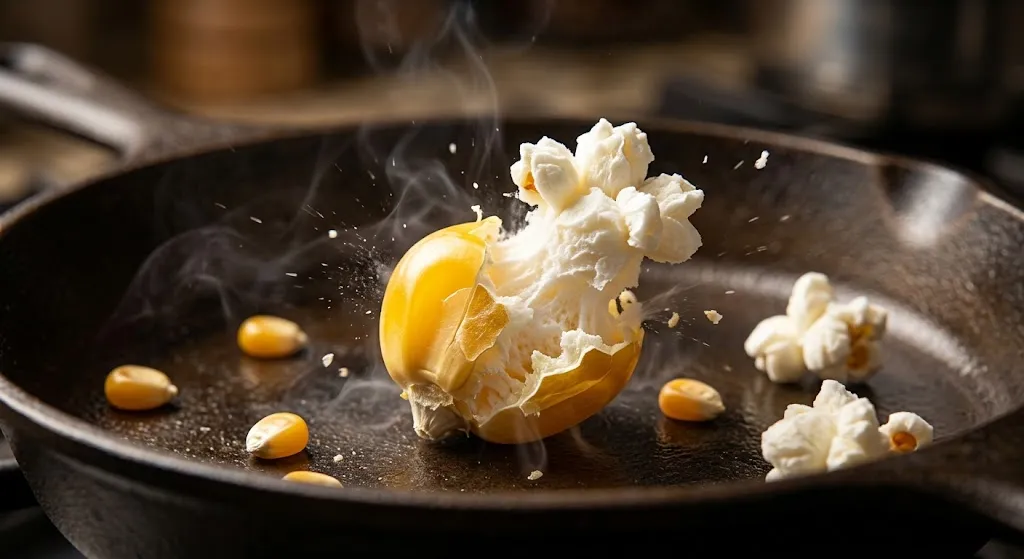
There are few foods that change as dramatically as popcorn. A hard, dry kernel sits in a hot pan looking much like it did when it came out of the bag. Then, seemingly all at once, it splits open and becomes a soft white puff several times its original size.
The reason is simple: a popcorn kernel contains a small amount of water sealed inside a hard outer shell. When the kernel is heated, that water turns into steam and raises the pressure inside. Once the shell can no longer contain the pressure, it ruptures, and the hot starch inside rapidly expands into the popcorn you eat.
That explains the basic idea. But it doesn't quite explain the transformation.
Why does the kernel hold pressure in the first place? Why does it expand so much? Why does the inside turn into something light and fluffy instead of simply becoming a soggy mass of cooked corn? And why do some kernels stubbornly sit at the bottom of the pan while everything around them has already popped?
The details are what make popcorn interesting.
What's inside a popcorn kernel?
A popcorn kernel is a seed, and most of it is made up of a starchy interior surrounded by a tough outer covering.
Inside are three main parts: the germ, the starchy endosperm, and the outer hull, also called the pericarp. The germ is the part that can grow into a new corn plant. The endosperm contains most of the starch. The hull forms the relatively tough outside of the kernel.
There is also a small amount of water trapped inside.
That water is the part that sets the whole process in motion.
A popcorn kernel typically contains around 13% to 14% moisture when it pops well, although the exact ideal moisture level depends on the variety and conditions. Researchers have found that moisture content has a major effect on how much popcorn expands and how many kernels successfully pop.
So although the kernel looks dry, it isn't completely dry.
That little bit of trapped water is doing a lot of work.
Where does the pressure come from?
Put the kernel in a hot pan and its temperature begins to rise.
The water inside heats up too. As it gets hotter, some of it changes into water vapor. Because the outer hull is relatively resistant to steam escaping, the vapor remains trapped inside the kernel.
As more water turns into vapor, the pressure inside increases.
This is similar to what happens in a sealed container being heated, except the popcorn kernel isn't an ordinary container. Its walls are made from the natural materials of a seed, and its inside contains starch that is changing as the temperature rises.
The pressure keeps building until the hull can no longer contain it.
At that point, the kernel ruptures.
That's the pop.
Does popcorn actually explode?
In a small sense, yes.
The word “explode” can make it sound as though the kernel is undergoing some kind of chemical explosion. It isn't. There's no combustion and no explosive chemical reaction responsible for the pop.
The energy comes from heat.
The kernel is essentially storing pressure as it heats. When the hull breaks, the pressure inside drops very quickly. That sudden change allows the hot, softened contents of the kernel to expand rapidly.
So the pop is a physical rupture caused by pressure, not an explosion in the way a firework or explosive material works.
The difference matters because it explains why the process is so fast while still being perfectly ordinary food physics.
What happens to the water inside?
The water doesn't simply disappear.
As the kernel heats, the trapped water becomes increasingly important because water vapor takes up much more space than liquid water. Inside the sealed kernel, that creates pressure.
The temperature continues rising until the kernel reaches the conditions needed for popping. Measurements vary with the particular kernel and the way it is heated, but popcorn generally pops at roughly 180°C, or around 350°F, under common popping conditions.
By this point, the starch has also changed.
Heat and moisture soften the starch inside the kernel, turning what began as a hard, compact material into a hot, plastic-like mass that can expand when the hull breaks.
Then the shell gives way.
The pressure drops.
The water vapor expands.
And the starch goes with it.
Why does the kernel expand so much?
This is the part that's easy to miss.
The popcorn doesn't simply become a bigger version of the original kernel. Its internal structure changes.
Before popping, the starch is densely packed inside the kernel. After the hull ruptures, the sudden pressure drop allows the hot starch to expand. Water vapor forms and escapes through the expanding starch, leaving behind countless tiny air spaces.
The result is a kind of natural foam.
The starch stretches around these spaces, creating the familiar irregular structure of popcorn. As the expanded material cools, it becomes rigid again and holds that new shape.
That's why a kernel that was once small and dense can become a large, lightweight piece of popcorn.
The volume has increased dramatically because the starch has been transformed into a structure containing lots of tiny spaces.
Why is popcorn fluffy?
The fluffiness comes from those tiny spaces.
Think about the difference between a solid block and a sponge. A sponge contains a lot of empty space within its structure, so it can occupy a surprisingly large volume without containing a huge amount of material.
Popcorn has a similar idea.
During popping, the softened starch expands around bubbles formed by rapidly expanding water vapor. Once the material cools, those bubbles become part of the rigid structure.
That's what gives popcorn its light, porous texture.
So when you bite into popcorn, you're not eating a giant piece of expanded corn in the same solid form it had before.
You're eating a foamed starch structure.
Why is popped popcorn mostly white?
The white part is largely the expanded starch from inside the kernel.
Popcorn varieties can have kernels of different colors, including yellow, white, red, blue, and other shades. But once many of them pop, the expanded interior becomes pale or white.
That's because the starch inside the kernel is light in color, and after it expands into a porous structure, it dominates what you see.
The outside hull doesn't disappear completely. Bits of it often remain attached to the popped popcorn, which is why you sometimes see small brown or yellow pieces mixed into the white portion.
Why doesn't every kernel pop?
This is one of the most familiar popcorn mysteries.
You put a handful of kernels into a pan, heat them, and eventually you're left with several hard little kernels sitting underneath a pile of popcorn.
Those kernels didn't necessarily fail because they weren't heated enough.
Successful popping depends on several things, particularly the kernel's moisture content and the condition of its hull.
If a kernel has lost too much moisture during storage, there may not be enough water available to create the pressure needed for proper expansion.
The opposite problem isn't helpful either. Popcorn has a fairly narrow moisture range in which it tends to pop well.
The hull also matters. If it has cracks or other damage, steam can escape before enough pressure builds.
So heating every kernel to the same temperature doesn't guarantee that every kernel will pop.
The kernel has to have the right combination of structure and moisture.
Why doesn't ordinary corn pop like popcorn?
Popcorn is corn, but popcorn isn't simply any corn that happens to have been dried.
Different types of corn have different structures and compositions. Popcorn varieties have a particularly suitable combination of a relatively tough outer hull, starchy interior, and moisture content that allows pressure to build inside the kernel.
Most ordinary corn doesn't have that same combination.
A fresh sweet corn kernel, for example, contains plenty of water, but its soft structure doesn't behave like a popcorn kernel under heat. Dry field corn is also structurally different.
Popcorn has been selected over generations for its ability to do this particular trick.
That's why you can't take just any dried corn kernel, throw it into a pan, and expect a bowl of popcorn.
Why does popcorn pop so violently?
Because the pressure doesn't escape gradually.
For much of the heating process, the kernel is holding everything inside. The shell is resisting the pressure while the contents are becoming hotter and softer.
Once the shell fails, the pressure can fall extremely quickly.
That makes the expansion happen in a very short period of time.
The starch is hot and soft enough to deform, while the water vapor is trying to expand. The result is a sudden outward movement of the material.
That's why one quiet kernel can sit in the pan for several minutes and then suddenly become a piece of popcorn in a fraction of a second.
The pop is essentially the sound of that rapid physical change.
What makes the popping sound?
The sound comes from the sudden rupture and expansion of the kernel.
When the hull breaks, the expanding contents move outward rapidly. That creates a sharp disturbance in the surrounding air, which reaches your ears as the familiar pop.
The popping sound isn't the sound of water boiling inside the kernel.
It's mainly the result of the rapid release of pressure and the violent movement of the kernel's material as it expands.
This also explains why popcorn popping sounds different from ordinary cooking. You're hearing a series of tiny pressure-release events happening one after another.
Why does popcorn sometimes burn before it pops?
A kernel needs enough heat to reach the conditions required for popping, but the outside of the kernel can become very hot while you're waiting.
If the pan is too hot, or the kernels are heated for too long, the outer material can scorch before individual kernels successfully pop.
This is especially likely when the kernels have problems that prevent normal popping. A damaged hull or unsuitable moisture level can mean the kernel doesn't release its pressure in the expected way.
Meanwhile, the heat keeps coming.
Eventually the kernel can burn rather than producing a good piece of popcorn.
This is one reason temperature control matters when popping on a stovetop. The goal isn't simply to make the pan as hot as possible.
Does oil make popcorn pop?
No.
Oil is useful for stovetop popcorn because it transfers heat efficiently from the hot pan to the kernels and helps distribute that heat more evenly.
But the oil isn't what creates the pressure that makes the kernel pop.
The important ingredients for the actual popping process are the kernel's moisture, its internal starch, its outer structure, and heat.
That's why popcorn can be made without adding oil at all, although the cooking method and equipment need to be suitable.
Air-popped popcorn is a good example. Hot air can transfer enough heat to the kernels for them to pop without oil being involved in the pressure mechanism.
Why does microwave popcorn work?
Microwave popcorn uses the same basic physical process.
The microwave oven heats the kernels, causing the water inside them to heat and eventually produce the pressure needed for popping.
The difference is how the heat is supplied.
Microwaves interact with molecules in the food, particularly water and other components that respond to the electromagnetic field. The kernels heat inside the microwave rather than being heated primarily by direct contact with a hot pan.
Microwave popcorn bags also contain a layer designed to help concentrate and distribute heat, while the package contains oil, flavoring, and other ingredients.
But the kernel itself is still doing the same thing.
Heat the trapped moisture.
Build pressure.
Rupture the hull.
Expand the starch.
Make popcorn.
Why does shaking popcorn help?
If you've ever shaken a pot while making popcorn, you've probably noticed that it can help distribute the kernels.
That matters because the kernels need to receive heat efficiently.
In a pan, some kernels can sit directly against the hottest part of the surface while others may not. Moving them around can help expose more kernels to the hot surface and can also reduce the chance of one area becoming excessively hot.
Shaking doesn't somehow create the popping pressure.
It helps manage the heating process.
There's a practical reason popcorn instructions often tell you to move the pan.
Can you make popcorn without oil?
Yes.
Oil isn't a requirement for the kernel to pop.
The kernel already contains what it needs for the pressure mechanism: moisture trapped inside a suitable structure.
Oil can make stovetop popping easier because it transfers heat and helps coat the kernels, but the actual pop comes from the water inside the kernel.
This is why hot-air poppers can produce popcorn without oil.
The method changes.
The physics inside the kernel doesn't.
Why do some kernels pop better than others?
Popcorn isn't perfectly uniform.
Individual kernels can differ in moisture, hull condition, size, shape, and internal structure. Even kernels from the same bag can therefore behave differently when heated.
Storage can also change their moisture content.
If kernels become too dry, they may not produce enough pressure or may not expand properly. If the hull has been damaged, steam can escape too early.
This is why a bag of popcorn can produce a mixture of large fluffy pieces and a handful of stubborn “old maids.”
Why are unpopped kernels called “old maids”?
“Old maid” is an old informal name for an unpopped popcorn kernel.
The term isn't a scientific one, and it has nothing to do with the physics of popping. It's simply an old nickname that became associated with the kernels left behind after the rest of the batch had popped.
You'll also hear people call them “old maids” in popcorn terminology, although the name has become less common in everyday speech.
The more useful question is why they're still sitting there.
Usually, it comes back to moisture, hull condition, or the kernel simply not having the right physical properties for successful expansion.
Can an unpopped kernel pop later?
Sometimes.
An unpopped kernel may simply not have received the right amount of heat during the first attempt. If its moisture content and hull are still suitable, heating it again may allow it to pop.
But reheating doesn't magically fix a kernel that has already lost too much moisture or has a damaged shell.
That's why some leftover kernels can be popped successfully while others remain stubbornly hard.
The kernel needs the right internal conditions, not just more time in the pan.
So what is actually happening inside a popcorn kernel?
The whole process can be reduced to a surprisingly neat chain:
A kernel contains moisture.
Heat raises the temperature of that moisture and the surrounding starch.
The moisture produces water vapor, while the tough hull keeps much of it contained.
Pressure builds inside the kernel.
The starch becomes hot and soft.
The hull eventually ruptures.
Pressure drops rapidly.
The hot starch expands around rapidly expanding water vapor.
The expanded starch cools and hardens into the light, porous structure we call popcorn.
That last step is why the result looks so different from the original kernel.
The kernel isn't simply cracking open and revealing a hidden piece of popcorn inside.
The popcorn is being created during the popping process.
A small amount of water helps turn a dense starch-filled seed into a structure full of tiny air spaces. The hard shell provides the pressure vessel. Heat supplies the energy. And when the shell finally gives way, the stored pressure drives the rapid expansion.
So the next time a pan starts popping, you're watching a small pressure system fail hundreds of times in succession.
No mystery.
Just water, heat, pressure, starch, and a surprisingly well-designed little seed.