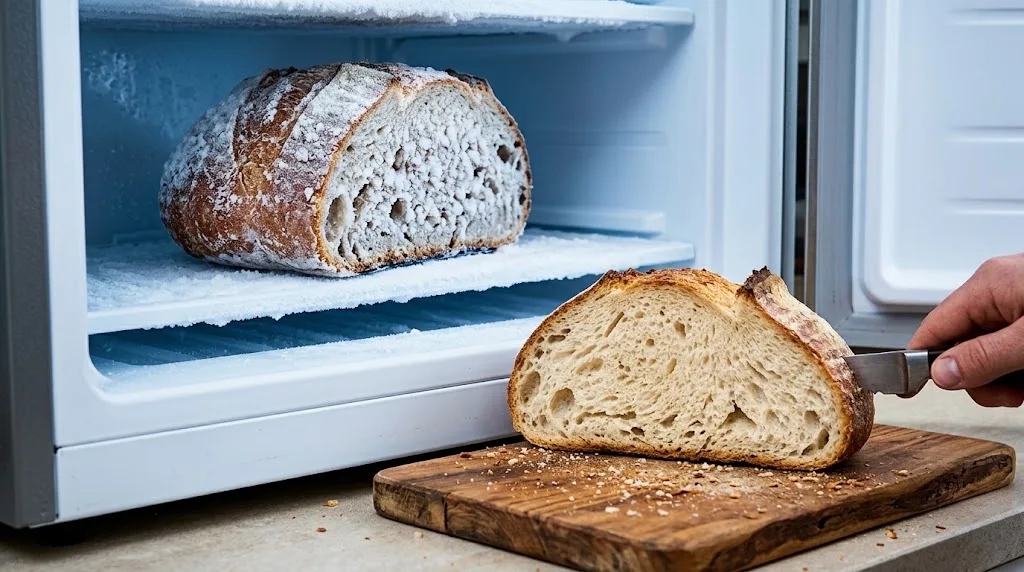
A loaf of bread can go from soft and fresh to firm and disappointing surprisingly quickly. Leave it on the counter for a few days and the crumb changes. Put it in the refrigerator thinking the cold will keep it fresh, and it may come out even firmer.
The freezer is different.
Freezing bread can preserve its quality for much longer because the very process that makes bread stale slows dramatically at freezing temperatures. But freezing isn't a magic reset button. The condition of the bread when it goes into the freezer, how well it's wrapped, how long it stays there, and how it's thawed all affect what you get back.
So if you have more bread than you can eat in the next few days, freezing it is generally a better way to preserve its texture than putting it in the refrigerator.
The reason has a lot to do with what happens to the starch inside the bread after baking.
Why does bread go stale?
It's tempting to think stale bread is simply bread that has dried out.
That's only part of the story.
When bread bakes, the starch in the flour absorbs water, swells and changes structure. This process, called gelatinization, helps create the soft crumb of freshly baked bread. Once the loaf cools, those starch molecules don't remain in exactly the same arrangement.
They gradually begin reorganizing into more ordered structures. Food scientists call this starch retrogradation.
Amylopectin, one of the two main components of starch, plays a major role in the gradual firming of bread as it ages. At the same time, water moves between different parts of the bread and between starch, proteins and the surrounding structure.
That's why bread can become noticeably stale even when it hasn't simply lost all of its water.
A sealed loaf can still become firm.
The structure has changed.
Why does bread sometimes feel dry when it isn't simply dried out?
Think about the difference between a fresh slice of bread and a slice that's been sitting around for several days.
The stale slice may feel dry and crumbly, but the change isn't explained entirely by water escaping into the air.
Some of the water inside the bread is being redistributed as the starch structure changes. The crumb becomes firmer and behaves differently when you bite into it.
That affects how much moisture is released in your mouth and how the bread feels while you're eating it.
Moisture loss still matters, especially when bread is exposed to air. But bread staling is a more complicated process than simply leaving a wet object out until it dries.
This is why packaging alone can't completely stop staling.
It can slow moisture loss, but it doesn't permanently stop the changes happening inside the crumb.
Why does the refrigerator make bread weird?
The refrigerator seems like the obvious place to store food you want to keep fresh.
For many foods, it is.
Bread is one of the awkward exceptions.
The temperatures found in ordinary refrigerators can favor the starch changes associated with bread staling. Research on bread has found that crumb firming can occur faster at lower temperatures above freezing, with starch retrogradation and moisture redistribution playing major roles.
That creates a strange situation.
The refrigerator can slow mold growth while making the bread's texture deteriorate faster.
So a loaf sitting in the fridge may be less likely to develop mold quickly, yet still become unpleasantly firm.
That's why refrigeration isn't usually the best choice when your main goal is preserving the soft texture of ordinary bread.
There are exceptions. Bread products containing ingredients that require refrigeration are a different matter. Food safety comes first when a bread product contains perishable fillings or toppings.
But for an ordinary loaf of bread, the refrigerator isn't necessarily doing what you want.
So what does freezing do?
Freezing changes the situation because the water inside the bread becomes ice and molecular movement slows dramatically.
The starch doesn't simply continue rearranging at the same rate it would at room temperature or in the refrigerator.
The staling process is greatly slowed.
That's the key reason frozen bread can still have a texture surprisingly close to fresh bread after it has been thawed.
Freezing doesn't make an already stale loaf fresh again, though.
If you put a loaf into the freezer after it has already spent several days becoming stale, you're mostly preserving the bread in that condition. The freezer slows further deterioration. It doesn't reverse everything that has already happened.
That makes timing important.
If you know you won't eat the whole loaf soon, freezing some of it while it is still fresh makes more sense than waiting until it has already become hard.
Does freezing damage bread?
It can affect bread, but freezing itself isn't necessarily what ruins it.
One of the biggest problems is what happens around the bread rather than inside it.
Air and moisture can reach the surface of poorly wrapped bread in the freezer. Over time, that can produce freezer burn and changes in texture and flavor.
Ice crystals can also affect the structure of the bread, particularly when moisture moves around during freezing and thawing.
That doesn't mean frozen bread will automatically come out damaged.
Proper packaging makes a big difference.
The goal is to protect the bread from air and moisture loss while it is frozen.
How should you wrap bread before freezing?
If you're freezing bread for more than a very short period, use packaging designed for freezer storage.
A freezer-safe bag works well. Wrapping the bread first and then placing it inside a freezer bag provides another layer of protection.
Try to remove as much excess air as practical before sealing the bag.
Bread wrappers aren't necessarily designed for long-term freezer storage. Freezer-grade packaging is made to provide a better moisture and vapor barrier.
If you're freezing sliced bread, there's another advantage: you don't have to thaw the entire loaf.
You can take out two slices for breakfast and leave the rest frozen.
That reduces the number of times the whole loaf has to go through a freeze-thaw cycle.
Is it better to freeze bread sliced or whole?
It depends on how you use it.
If you're freezing ordinary sandwich bread, slicing it first is usually more convenient. You can take out exactly what you need and put the rest back without thawing the entire loaf.
A whole loaf makes more sense when you plan to serve the bread as a loaf later, particularly with crusty breads where the shape and crust matter.
Either way, the bread should be packaged tightly.
And if you're freezing homemade bread, let it cool completely before wrapping it.
Wrapping a warm loaf traps steam. That moisture can later condense and freeze inside the package, which can affect the crust and texture when the bread thaws.
How long can bread stay frozen?
Freezing keeps bread safe for much longer than the period in which it remains at its best quality.
USDA guidance currently gives about three months as a quality period for commercially baked breads and rolls stored in the freezer. University extension guidance commonly gives a similar two-to-three-month range for baked bread at 0°F (about -18°C).
Those aren't hard expiration dates.
They're quality guidelines.
A loaf that has been frozen longer isn't automatically unsafe simply because it passed the three-month mark. Its texture and flavor may gradually become less appealing, particularly if the packaging wasn't good enough to protect it from freezer air.
So if you want bread that still tastes close to fresh, think in terms of months rather than trying to keep the same loaf frozen indefinitely.
Does frozen bread taste different after thawing?
It can, but the difference depends heavily on the bread and how it was stored.
A well-wrapped loaf that was frozen while fresh can come back with much of its original texture.
Poorly wrapped bread is a different story.
It may have a dry surface, freezer odors, ice crystals or a crumbly texture.
The type of bread matters too. A soft sandwich loaf and a crusty artisan loaf don't respond exactly the same way to freezing and thawing.
A crust that was crisp before freezing may not come back exactly as it was.
That's one reason reheating can help.
Can you toast bread straight from the freezer?
Yes.
Sliced bread can generally go straight from the freezer into the toaster. You don't necessarily have to wait for it to thaw first.
This is one of the practical advantages of freezing bread in slices.
You can keep the loaf frozen and simply remove the number of slices you need.
For a whole loaf, thawing at room temperature is another option. If the crust has softened during thawing, heating the loaf in an oven can help restore some of its crispness.
Heat can temporarily reverse some of the structural changes associated with bread staling, which is one reason reheated stale bread can suddenly feel much softer.
The effect isn't permanent.
As the bread cools again, some of those starch structures can form again.
What happens to bread stored on the counter?
At room temperature, bread continues to age normally.
Starch retrogradation proceeds, moisture moves within the loaf, and exposed surfaces can lose water to the surrounding air.
Eventually, other forms of deterioration can become a problem too, including mold.
How quickly that happens depends on the bread, its ingredients, packaging, temperature and humidity.
A soft packaged sandwich loaf behaves differently from a crusty bakery baguette.
That's why there isn't one exact number of days that applies to every loaf.
What happens if you refrigerate it instead?
The refrigerator slows microbial growth, but it doesn't preserve the soft texture of many breads particularly well.
The starch changes responsible for firming can proceed efficiently at refrigerator temperatures.
So you can end up with bread that has been protected from some forms of spoilage but has lost the texture you actually wanted to preserve.
This is the part that makes bread storage seem backwards.
The colder option isn't automatically the better option.
For bread, freezing is cold enough to slow the staling process dramatically. Refrigeration is cold enough to affect starch behavior without fully stopping it.
Counter, refrigerator or freezer: which one makes sense?
For a loaf you're going to finish soon, room-temperature storage is usually reasonable when the bread is packaged appropriately.
If you need to keep the bread for longer, freezing is generally the better option for preserving quality.
The refrigerator sits in an awkward middle ground for ordinary bread. It can slow mold growth, but its temperature can also encourage the texture changes that make bread stale.
The basic comparison looks like this:
| Storage method | Main effect on bread |
|---|---|
| Room temperature | Staling continues normally |
| Refrigerator | Mold growth slows, but bread can firm faster |
| Freezer | Staling slows dramatically and quality can be preserved for months |
The exact result still depends on the bread and how it is packaged.
The simplest way to freeze bread well
If you know you won't finish the loaf soon, don't wait until it is already stale.
Let homemade bread cool completely.
Slice it if you normally eat it a few pieces at a time.
Package it in freezer-safe wrapping or bags, removing as much excess air as practical.
Label it with the date.
Then freeze it.
When you need bread, remove only what you're going to eat. Slices can usually go straight into the toaster, while whole loaves can be thawed at room temperature and reheated if you want to restore some crust crispness.
That approach is also useful for reducing food waste. Instead of watching half a loaf slowly become stale on the counter, you can preserve it while it is still in good condition.
So, does freezing bread really keep it fresher?
Yes.
Freezing is one of the better ways to preserve bread's freshness and texture for longer storage.
It works because freezing greatly slows the molecular changes involved in staling, particularly the starch and moisture changes that gradually make the crumb firm.
The refrigerator is different. Although it slows mold growth, its temperature can actually speed up some of the starch changes associated with staling.
And packaging matters. Poorly wrapped frozen bread can lose quality even though the freezing itself has slowed staling.
So the practical rule is fairly simple: eat bread soon if you can, freeze it while it's still fresh if you can't, and protect it well from freezer air.
The freezer doesn't make old bread fresh again.
It gives fresh bread a much better chance of staying that way.