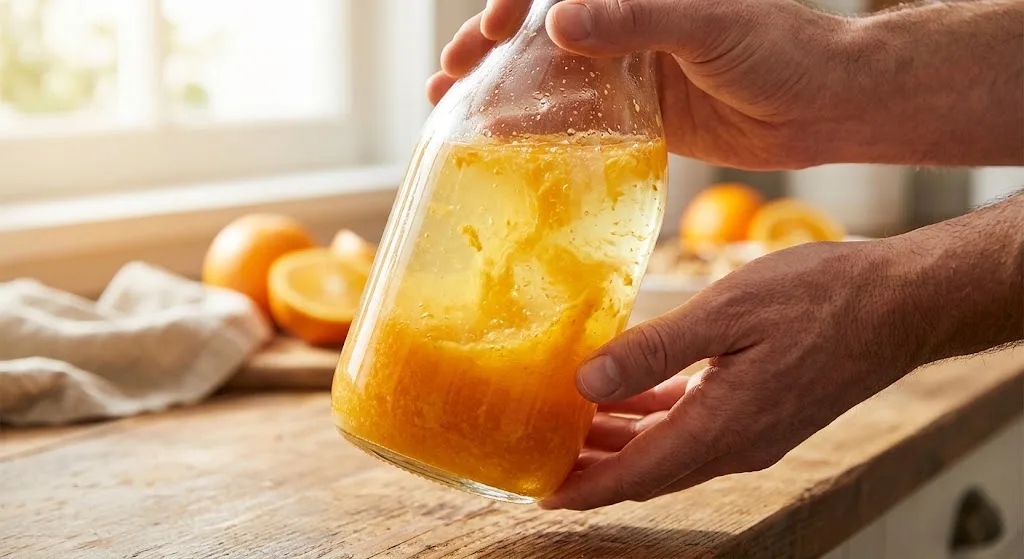
If you've ever poured a glass of orange juice and noticed that the bottom of the bottle looks much thicker than the top, you probably already know what the label is going to tell you: shake well before serving.
And it does make a difference.
But probably not for the reason you might think.
The stuff collecting at the bottom is mostly suspended material that has gradually settled under gravity. Shaking puts those particles back into the liquid, so you get a more even glass of juice. What it does not mean is that all the vitamins, minerals, and other nutrients have somehow fallen to the bottom and need to be shaken back into place.
Orange juice is a more complicated mixture than it looks.
Why does orange juice settle in the first place?
Orange juice isn't a completely uniform liquid like water with sugar dissolved in it. It contains tiny particles from the fruit, including pulp and cell-wall material, suspended throughout the liquid.
Those particles don't stay perfectly suspended forever.
Gravity is constantly pulling on them.
Some particles are dense enough, or large enough, to gradually move downward. The result is sediment at the bottom and a clearer layer above it. Food scientists call this sedimentation.
Pectin also plays a part. Pectin is a naturally occurring substance found in oranges that helps give juice some of its body and helps keep particles suspended. When the conditions allow those particles to remain suspended, the juice looks more uniform. When they aren't held up as effectively, they settle.
That's why one bottle can look almost completely uniform while another develops a noticeable layer at the bottom.
The difference isn't necessarily a sign that one has gone bad.
It can simply be the physics of a suspension.
So what happens when you shake it?
Shaking supplies mechanical energy to the bottle.
The liquid moves rapidly, the settled particles are stirred back into suspension, and the contents become more evenly distributed again.
That's the simple reason the instruction exists.
Food-science research on orange juice shows that pulp sedimentation is a major part of the juice's physical stability. Processing methods that make the particles smaller or keep them better suspended can slow down the separation.
So a gentle shake can take the material sitting on the bottom and spread it through the bottle again.
A harder shake doesn't magically create more nutrition.
It just mixes what is already there.
Is the stuff at the bottom actually the “good stuff”?
This is where things get more interesting.
Pulp can contain dietary fiber and other compounds from the orange. So if a juice has visible pulp, it isn't unreasonable to think that some of that material will be concentrated in the sediment.
But that doesn't mean the bottom of the bottle contains all the important nutrients.
Vitamin C, sugars, potassium and many other components are dissolved or distributed throughout the liquid rather than sitting inside the visible pulp layer.
Orange juice also contains plant compounds called flavanones, including hesperidin and narirutin. These aren't simply sitting in one obvious layer waiting for someone to shake the bottle.
A study examining six commercially available orange juices with and without pulp found that the juices containing pulp had only small differences in several measured compounds. The researchers also found that the amount of pulp had little effect on dietary-fiber content in those particular products.
So the idea that the bottle separates into “nutritious bottom” and “less nutritious top” is too simple.
There is some truth behind the idea, because the physical pulp can settle.
The nutritional conclusion doesn't follow automatically.
Does pulp contain more fiber?
Generally, pulp is where some of the fruit's structural material is found, including fiber.
But orange juice isn't automatically a high-fiber food just because you can see pulp floating around in it.
How much fiber remains depends on how the juice was made and how much pulp is actually present.
In one analysis of six commercial orange juices, total dietary fiber was low and similar between the smooth and pulp-containing juices studied.
That matters because “with pulp” and “high in fiber” aren't interchangeable descriptions.
If you're specifically looking for more fiber, the nutrition label tells you much more than the appearance of the bottle.
Why does some orange juice separate much more than other juice?
There isn't one universal orange-juice formula.
Different juices can contain different amounts and sizes of suspended particles. Processing can also change how easily those particles settle.
Homogenization, for example, can break particles down and make them less likely to settle quickly. Research on not-from-concentrate orange juice has found that homogenized juice can remain more stable than untreated juice, with particle size playing a role in how quickly pulp settles.
Pectin matters too.
Because pectin can increase the viscosity of the juice and help stabilize suspended material, changes in the pectin system can affect whether the juice stays cloudy or develops a sediment layer. Food-processing references describe the loss of cloud stability as a process in which suspended material settles and the juice separates into a clearer upper phase and sediment below.
That's why two bottles of orange juice can behave very differently after sitting in the refrigerator.
One may barely change.
Another may look as though half the bottle has moved to the bottom.
Does shaking change the taste?
It can change the experience of the taste, mainly because it changes what's physically in each sip.
If pulp has settled heavily, the first glass you pour may contain mostly the clearer liquid from the upper part of the bottle. After shaking, more of the suspended material is distributed through the juice.
That can change its texture and mouthfeel.
It may also make the juice seem fuller or more pulpy.
But shaking doesn't normally create a new flavor or increase the amount of sugar, vitamin C, or other nutrients in the bottle. You're redistributing the contents rather than changing their total amount.
Does “shake well” actually matter?
For a juice with visible pulp or other suspended material, yes.
Not because you're recovering a secret layer of vitamins.
You're simply making the contents more uniform.
There's a reason some commercial orange-juice products specifically instruct consumers to shake before serving. For example, product directions for pulp-containing orange juice explicitly say “shake well before serving.”
If you don't shake it, you're likely to get a different mixture depending on where you are in the bottle.
Near the top, you may get more of the relatively clear liquid.
Near the bottom, you may get more of the settled material.
Shaking gives you a better representation of what's actually in the bottle as a whole.
What if you store the bottle upside down?
Turning the bottle upside down doesn't solve the underlying problem.
Gravity still works.
You may simply cause the sediment to collect at the other end of the container.
Once you turn it back over, the particles can settle again.
The useful part isn't the direction the bottle is stored. It's the mixing that happens when you shake it.
And even then, the effect isn't permanent. Leave the bottle sitting long enough and the suspended particles can begin settling again.
Does shaking make orange juice healthier?
Not really.
It can help you consume the pulp that has settled at the bottom, assuming that particular juice contains a meaningful amount of pulp and associated material.
But shaking doesn't increase the nutritional value of the juice.
It doesn't manufacture fiber.
It doesn't create vitamin C.
It doesn't move every nutrient from the bottom to the top.
It simply redistributes material that was already in the bottle.
That's a small distinction, but it's the difference between saying “shaking restores the juice's original mixture” and saying “shaking puts all the nutrients back.”
The first is a reasonable description.
The second is not.
So, does shaking orange juice actually matter?
Yes, but mostly for distribution.
Orange juice containing pulp is a suspension. Over time, some of those particles settle because gravity pulls them downward. Pectin and processing conditions affect how well the particles stay suspended. Shaking disturbs that settled layer and spreads the material back through the juice.
The part about “getting the good stuff back” needs a little correction.
Some of the material at the bottom can contain components associated with the fruit's pulp, including fiber. But the juice's nutrition isn't neatly divided into a healthy bottom layer and an empty top layer. Research on commercial orange juice doesn't support such a simple picture.
So the next time you see a bottle with a thick orange layer sitting at the bottom, give it a shake.
You're not rescuing the vitamins.
You're just putting the orange juice back together.