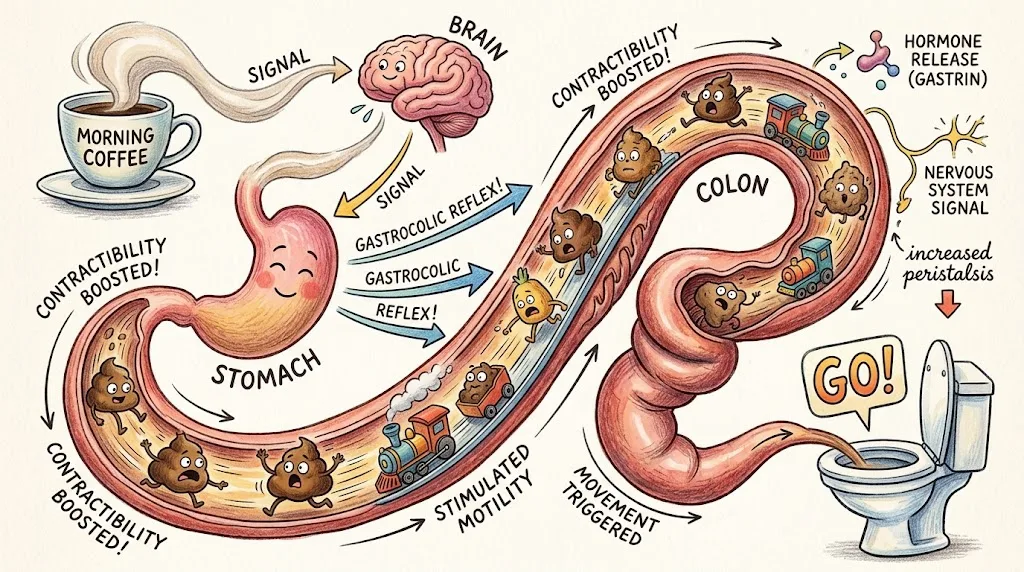
There are people who can drink coffee first thing in the morning and get on with their day.
Then there are people who take a few sips and start looking for a bathroom.
The effect can be surprisingly quick. Sometimes the urge arrives before you've finished the cup, which can make it seem as though the coffee has somehow travelled straight through your digestive system.
It hasn't.
Coffee can make you poop because it can stimulate movement in the colon. The effect involves the gastrocolic response, digestive hormones and the activity of the coffee itself. Caffeine appears to play a part, but it isn't the whole explanation. Decaffeinated coffee can also increase bowel activity.
Researchers have measured this effect directly. In one study, coffee increased movement in the lower colon within about four minutes in people who were sensitive to the effect. The response lasted for at least 30 minutes. Both regular and decaffeinated coffee produced it.
So why does coffee do this?
Coffee can make the colon start moving
Your colon isn't just a storage tube for waste.
It is muscular. Its walls contract and relax in coordinated patterns, moving material toward the rectum. Most of the time, you don't notice these contractions happening.
Coffee can make them more noticeable.
In a 1990 study published in Gut, researchers asked 99 healthy young adults about their bowel habits. Twenty-nine percent said coffee gave them an urge to defecate. The researchers then measured pressure and movement in the lower colon of a smaller group.
Among the people who said coffee affected them, both regular and decaffeinated coffee increased movement in the rectosigmoid region of the colon. The increase appeared within four minutes.
That timing matters.
Food normally takes much longer than a few minutes to travel from the stomach through the small intestine and into the colon. So when you suddenly need the bathroom after drinking coffee, the coffee you just drank isn't simply passing straight through you.
Something else is happening.
The coffee is helping stimulate movement in a part of the digestive system that already contains material.
The gastrocolic reflex is part of the story
Your digestive system has a built-in response to having something enter the stomach.
It's called the gastrocolic reflex.
When the stomach stretches after food or drink enters it, signals involving the nervous system and digestive hormones can increase activity in the colon. The result is more movement through the large intestine.
This makes sense from the body's point of view.
When new material enters the digestive tract, the colon can increase its activity and move older material farther along. It's one of the ways the digestive system keeps things moving rather than allowing everything to pile up behind whatever you've just eaten.
Coffee appears to be able to stimulate this response even when you're drinking it without a meal.
That helps explain why someone can drink a cup of black coffee on an empty stomach and suddenly feel the need to use the bathroom.
The coffee doesn't need to become stool.
It can simply encourage the colon to move the stool that's already there.
So is caffeine responsible?
Partly.
Caffeine is a stimulant, and studies have found that caffeinated coffee can increase colonic motor activity. In one experiment, caffeinated coffee produced a stronger response than decaffeinated coffee.
But caffeine can't be the entire explanation.
That's where decaf becomes interesting.
If caffeine were solely responsible for the bathroom effect, removing most of the caffeine should remove the effect too. Yet studies have found that decaffeinated coffee can still stimulate colonic movement.
In the 1990 study, regular and decaffeinated coffee both increased rectosigmoid activity in people who responded to coffee.
Another study comparing coffee with different drinks found that caffeinated coffee produced substantially more colonic activity than water, while decaf still had an effect.
So caffeine appears to be one contributor rather than the entire mechanism.
Researchers have suggested several other possibilities, including the effects of coffee on digestive hormones and other compounds naturally present in coffee. But there isn't one ingredient that scientists can point to and say, “That's the coffee-poop chemical.”
The evidence is more complicated than that.
Coffee can affect digestive hormones too
Coffee does more than deliver caffeine.
It can stimulate parts of the digestive system and increase the release of hormones involved in digestion.
One of these is gastrin.
Gastrin helps regulate stomach activity and acid secretion, and it is also involved in the broader signaling that affects gastrointestinal movement.
Studies have found that both regular and decaffeinated coffee can increase gastrin levels.
That gives researchers another possible explanation for why decaf can still have an effect.
Coffee contains hundreds of chemical compounds, and researchers are still working out exactly which ones matter for its effects on the gut. Reviews of the evidence have pointed to several possible pathways, including gastrin, cholecystokinin and other neurohormonal signals.
The important point is that the gut response isn't as simple as:
caffeine enters → colon contracts.
There's a whole digestive signaling system between those two events.
Why does coffee make you poop so quickly?
This is probably the part that seems strangest.
You drink coffee.
A few minutes later, you're in the bathroom.
How can anything move that quickly?
Because the coffee doesn't have to travel all the way through your digestive tract.
The colon already contains material from previous meals. When the colon contracts more strongly, that material can move toward the rectum.
The gastrocolic response can begin within minutes of something entering the stomach, and coffee appears to be capable of provoking this response in some people.
In the classic study, the increase in lower-colon activity appeared within four minutes.
So the quick bathroom trip isn't evidence that your coffee has somehow completed digestion at record speed.
It's more like pressing a button on a conveyor belt that already has something sitting on it.
The contents were already there.
The movement is what changed.
Why is coffee especially good at doing this in the morning?
The timing of your coffee may be doing some of the work too.
Your colon isn't equally active at every hour of the day.
Human studies have found that colonic motor activity rises around the time of morning awakening. Strong contractions that can be associated with the urge to defecate are also more common after waking.
That means your first cup of coffee is often arriving at a time when your digestive system is already becoming more active.
Then coffee adds another stimulus.
For someone who is particularly sensitive to coffee's effects, those two things can line up very neatly:
wake up → colon becomes more active → drink coffee → digestive response increases → bathroom
That may be one reason the effect feels almost like part of a morning routine.
The coffee isn't necessarily creating the entire urge from nothing. It can be adding another push at a time when your colon is already primed to move.
Why does coffee affect some people but not others?
This is one of the less satisfying parts of the answer because there isn't a single explanation.
Not everyone responds to coffee with increased bowel activity.
The original research is a good example. Only some of the people studied reported that coffee made them want to defecate, and the measurable increase in lower-colon activity occurred in the people who reported being responders.
People's digestive systems simply don't behave identically.
Differences in gut sensitivity, normal bowel habits, diet, medications, caffeine tolerance and gastrointestinal conditions can all affect how someone responds to a drink.
There's also the possibility that the routine surrounding coffee matters.
If someone drinks coffee every morning after waking and then sits quietly for ten minutes, their bowel movement may become associated with that routine. The body's digestive system is heavily influenced by repeated timing and habits.
So there isn't anything unusual about one person needing the bathroom after every cup while another person can drink three cups without noticing anything.
Why does coffee make you poop even when you haven't eaten?
Because eating isn't the only thing that can influence the colon.
The gastrocolic response is most strongly associated with food entering the stomach, but coffee can stimulate gastrointestinal activity on its own.
Studies have found that coffee can increase colonic motor activity even when consumed without a meal.
That means an empty stomach doesn't necessarily mean an inactive digestive system.
Your intestines are still moving. Your colon still contains material from earlier meals. And coffee can provide a stimulus that increases movement.
This is also why the idea that “coffee can't make you poop because there's no food in your stomach” doesn't really work.
The stool you're passing doesn't have to come from the coffee you just drank.
Can coffee actually help with constipation?
It can make some people's bowels move, so it's understandable why people use coffee as part of their morning routine when they're constipated.
Research has even looked at coffee's ability to help restore bowel function in people recovering from abdominal surgery, with some studies finding earlier bowel movements after coffee consumption.
But that doesn't mean coffee is a universal constipation treatment.
If coffee naturally stimulates your colon, it may help you have a bowel movement. Someone who doesn't respond to coffee may notice little or nothing.
And using large amounts of coffee to force bowel movements isn't a good substitute for figuring out why constipation is happening in the first place.
Persistent constipation can have many causes, including diet, medication, dehydration, changes in routine and medical conditions.
Coffee is a trigger for some people, not a guaranteed fix.
Why can coffee sometimes cause diarrhea?
A stronger bowel response isn't always experienced as a normal, comfortable bowel movement.
For some people, coffee can produce urgency, loose stools or diarrhea.
Part of that may simply be an exaggerated version of the same increased gastrointestinal activity. The stronger the stimulation, the less time the digestive system may spend handling its contents in the usual way.
What you put in the coffee can matter too.
Milk and cream can cause problems for people who don't digest lactose well. Lactose intolerance can lead to bloating, abdominal discomfort and diarrhea.
Sugar-free sweeteners can also affect some people's digestive systems.
So if plain black coffee is fine but a large sweetened latte sends you running to the bathroom, the coffee itself may not be the only suspect.
The combination matters.
Does adding milk make coffee more likely to make you poop?
It can, depending on the person.
For someone who has difficulty digesting lactose, milk or cream can add another reason to develop an urgent bowel movement.
That's different from saying milk automatically makes everyone poop.
Most people can tolerate some amount of lactose, while others develop symptoms after consuming it. The amount matters too.
So if the bathroom effect happens only with coffee containing milk, it's worth considering whether the dairy is contributing rather than assuming caffeine is responsible.
What about decaf?
Decaf is probably the most useful clue in the whole mystery.
It shows why the simple caffeine explanation doesn't work.
Decaffeinated coffee still contains a small amount of caffeine, so it isn't literally caffeine-free. But the amount is much lower than in ordinary coffee, and studies have still found bowel activity after decaf.
Research has also shown that regular and decaffeinated coffee can both stimulate gastrin release.
That suggests compounds other than caffeine are involved.
Scientists haven't completely pinned down the responsible ingredients, so claims that one particular coffee compound has been proven to cause the entire effect should be treated cautiously.
What we can say with confidence is simpler:
caffeine contributes, but coffee's effect on the gut isn't just a caffeine effect.
Is coffee actually speeding up digestion?
Not in the way people often imagine.
If you need to poop ten minutes after drinking coffee, that doesn't mean the coffee has travelled through your entire digestive system in ten minutes.
The immediate effect is mainly about motility, meaning movement.
Coffee can stimulate contractions in the colon and other parts of the gastrointestinal tract. Those contractions can move material that was already farther along in the digestive system.
Digestion and transit are related, but they're not the same thing.
Your body isn't turning the new cup of coffee into waste at superhuman speed.
It's getting the existing contents of the bowel moving.
Why doesn't coffee make everyone poop?
Because the response varies between people.
The research doesn't show that coffee produces a bowel movement in everyone who drinks it. Some people are particularly responsive to coffee's effects on the colon, while others aren't.
Even among people who do respond, the strength of the effect can vary.
One person may simply notice that coffee makes them more regular. Another may get a strong urge within minutes.
And someone else may finish the cup and feel absolutely nothing.
All three experiences can be normal.
What if the effect suddenly becomes much stronger?
An occasional urgent bowel movement after coffee isn't usually something to worry about by itself.
But a persistent change in bowel habits is different.
If coffee suddenly starts causing frequent diarrhea, severe abdominal pain, blood in the stool, unexplained weight loss or other ongoing digestive symptoms, don't automatically blame the coffee. Those symptoms deserve medical attention, particularly if they continue after you reduce or stop the drink.
The same applies if constipation or diarrhea keeps happening regardless of whether you've had coffee.
Coffee may be triggering the symptom without being the underlying reason for it.
So, why does coffee make you poop?
Because coffee can stimulate movement in your colon, partly through the same digestive signaling system that normally becomes active when something enters your stomach.
Caffeine can strengthen the effect, but it isn't the whole story. Decaffeinated coffee can also increase bowel activity, and coffee can stimulate hormones such as gastrin that are involved in gastrointestinal function.
The effect can happen remarkably quickly because the coffee doesn't need to travel through your entire digestive system. It can trigger signals that make the colon move material that was already there.
And when that first cup happens in the morning, it's arriving just as the colon is naturally becoming more active after waking.
So if coffee reliably sends you to the bathroom, your body isn't doing anything mysterious.
Your morning drink is giving your digestive system a fairly strong signal to get moving.