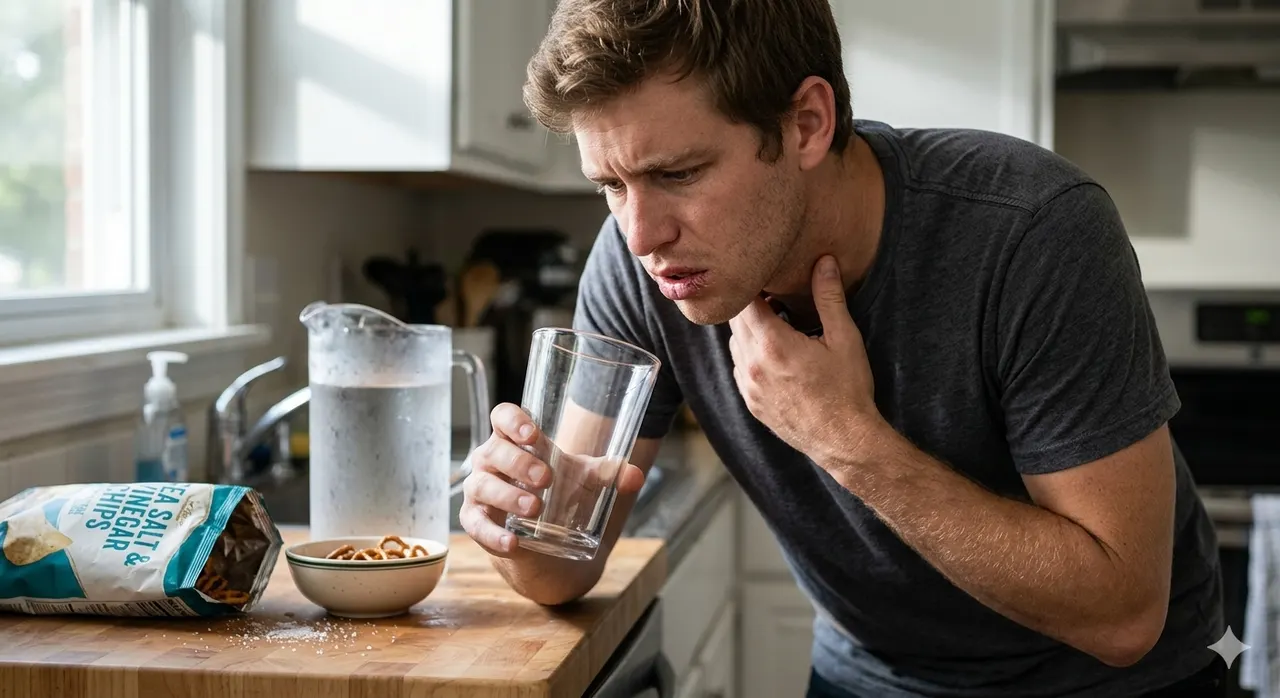
You eat a handful of salted peanuts. Twenty minutes later, you're reaching for a glass of water. This is one of the most universal "facts" about food: salt makes you thirsty. Bars serve salty snacks to keep you buying drinks. Your grandmother tells you to drink water after a salty meal. Medical textbooks have long stated that increased salt intake leads to water loss into urine, reducing body water and triggering thirst.
It sounds airtight. But a 2017 study conducted during a simulated Mars mission found something that contradicts nearly a century of conventional wisdom: when salt intake stays elevated, people actually drink less water and report feeling hungrier, not thirstier.
The answer to "does salt make you thirsty?" is more complicated than the bar-nut industry would like.
The Study That Changed the Story
In 2017, two papers were published in the Journal of Clinical Investigation reporting findings from the Mars500 experiment — a 520-day simulated Mars mission at the German Aerospace Center (DLR) in Moscow, Russia.
Researchers from the DLR, the Max Delbrück Center for Molecular Medicine (MDC) in Berlin, and Vanderbilt University in Nashville took advantage of the controlled environment to study something no one had properly tested before: the long-term relationship between salt intake and drinking behavior.
The setup:
- Two groups of 10 men (20 total) lived in a sealed mock spaceship
- One group was studied over 105 days, the other over 205 days
- All participants ate identical diets, with the only variable being salt intake: 6 grams per day (roughly the recommended daily limit) vs. 12 grams per day (double)
- Every drop of urine was collected and measured daily
- Every sip of water was tracked
- Participants reported thirst and hunger levels regularly
The results were unambiguous:
| Measurement | Low-salt group (6g/day) | High-salt group (12g/day) |
|---|---|---|
| Salt in urine | Lower | Higher (expected) |
| Total urine volume | Lower | Higher (expected) |
| Water consumed | More | Less |
| Reported thirst | Normal | Lower |
| Reported hunger | Normal | Higher |
The men eating twice as much salt drank less water, not more. They peed more, but their urine was more concentrated — meaning the body was holding onto water rather than flushing it out. And they complained about being hungry.
As lead author Jens Titze (University of Erlangen / Vanderbilt University Medical Center) put it: "We showed the biological principle of salt excretion is water conservation and water production."
The Mechanism: Why Salt Actually Makes You Drink Less
To understand why, you need to know what the kidneys actually do with salt — and what role urea plays.
The old model (what textbooks said)
The conventional explanation was simple:
- You eat salt (sodium chloride)
- Sodium and chloride ions enter your bloodstream
- These charged ions attract water molecules (osmosis)
- The kidneys filter the blood, and the salt "drags" water with it into the urine
- You lose water → you get thirsty → you drink more
This model was taught for over 100 years. It made intuitive sense. And it's partly correct in the short term — which is why you do feel thirsty right after eating something salty.
What actually happens (the new model)
The Mars500 data showed the opposite of what the old model predicted. The salt ended up in the urine, yes. But the water moved back into the body, not out with the salt.
The key player: urea.
Here's the corrected sequence:
- You eat salt. Sodium and chloride enter the bloodstream.
- Short term (seconds to minutes): Local osmoreceptors in your mouth, tongue, and throat detect the salt and send a signal to your brain's thirst center. You feel thirsty. This is real.
- Medium term (hours): Your kidneys detect the elevated sodium. Instead of simply letting salt drag water out, they activate a water-conservation mechanism.
- Your liver and muscles ramp up urea production. Urea — long thought of as a mere waste product — is actually a critical osmolyte: a molecule that binds to water and helps transport it.
- Urea accumulates in the kidney's collecting ducts, where it counteracts the water-drawing force of sodium and chloride. The water that the salt is trying to pull into the urine gets pulled back into the body.
- Net result: You excrete the salt but keep the water. Your body's total water content actually increases, not decreases.
- The catch: Making urea is extremely energy-intensive. The liver has to break down protein (sometimes from muscle tissue) to produce the nitrogen that becomes urea. This energy demand registers as hunger, not thirst.
As Friedrich C. Luft (MDC / Charité) explained: "It's not solely a waste product, as has been assumed. Instead, it turns out to be a very important osmolyte — a compound that binds to water and helps transport it. Its function is to keep water in when our bodies get rid of salt. Nature has apparently found a way to conserve water that would otherwise be carried away into the urine by salt."
The mouse confirmation
A companion study in mice confirmed the mechanism. Mice on a high-salt diet:
- Did not drink more water
- Did eat more food
- Showed increased muscle protein breakdown (the body breaking down muscle to fuel urea production)
- Developed a metabolic profile that, in the words of the researchers, "looks a lot like diabetes"
So Is the Claim True or False?
Partly true. Here's the breakdown:
| Timeframe | What happens | Verdict |
|---|---|---|
| Seconds to ~30 minutes after eating salt | Local sensors in mouth/throat trigger thirst signal | TRUE — you genuinely feel thirsty |
| 1–24 hours after sustained high salt intake | Kidneys activate water conservation; urea production ramps up; thirst decreases | FALSE — you drink less, not more |
| Days to weeks of elevated salt | Body adapts; water is conserved; hunger increases; metabolic stress builds | FALSE — the dominant signal is hunger, not thirst |
The short-term thirst is real. It's a local, sensory response — your tongue and throat detecting a high-sodium environment. But it's a misleading signal if you interpret it as "I need to drink more." Your body is actually doing the opposite: it's holding water in and asking for fuel (food) to keep the urea factory running.
What This Means for the "Salty Bar Nuts" Theory
The most common cultural application of "salt makes you thirsty" is the bar/pub theory: restaurants serve salty snacks to make you order more drinks.
The Mars500 data complicates this. If you're eating a steady diet of salty snacks over time, your body is actually conserving water and you're less thirsty, not more. The short-term thirst spike is real but transient.
However, this doesn't mean the bar strategy doesn't work. A few caveats:
- The short-term thirst response is immediate and powerful. You do reach for a drink right after eating salted peanuts. That's the window the bar is exploiting.
- The Mars500 study measured sustained high salt intake (12g/day for 100–200+ days). A single evening of bar food is a different scenario.
- The study involved controlled, identical diets with only salt varied. Real-world eating is messier.
- The participants were 10 men per group — a small sample.
So the bar-nut theory isn't wrong in the moment. It's just not the full story. The long-term effect of a high-salt diet is the opposite of what most people assume.
The Bigger Health Implications
The researchers flagged something that went well beyond "salt and thirst." The metabolic response to sustained high salt intake — increased urea production, muscle protein breakdown, elevated energy demand, increased hunger — resembles the metabolic profile of type 2 diabetes.
Specifically:
- Increased hunger → increased caloric intake → potential weight gain
- Muscle breakdown for urea production → loss of lean mass
- Elevated glucocorticoids (cortisol) → insulin resistance
- Water retention → increased blood volume → elevated blood pressure
- The combination → a metabolic state that predisposes to obesity, diabetes, and cardiovascular disease
This doesn't mean salt causes diabetes. But it suggests that the mechanism by which salt harms your health may be more complex (and more metabolic) than the simple "salt → water loss → thirst → drink more" model implied.
As Titze noted: "This predisposes to overeating. The resulting metabolic response looks a lot like diabetes."
Limitations and Criticism
Intellectual honesty requires noting the weaknesses:
- Small sample size. 10 men per group. All male. All in a controlled environment.
- Artificial conditions. The Mars500 simulation is not a normal diet. The researchers themselves acknowledged the setup was unusual.
- Public health pushback. UK public health campaigners called the results "contrived" and argued that the well-established relationship between salt intake and fluid consumption in normal populations wasn't overturned by a controlled experiment.
- Short-term vs. long-term conflation. The study's most important finding — that the effect reverses over time — is easy to miss when the headline reads "salt makes you hungry." In the first few hours, salt does make you thirsty. The reversal takes time.
- Generalizability. The participants were healthy young men. How this plays out in older adults, people with kidney disease, or those on blood pressure medication is unknown.
None of this invalidates the finding, but it means the conclusion should be stated as: under sustained, controlled high-salt conditions, the body's dominant response is water conservation and increased hunger, not increased thirst. Whether this fully generalizes to everyday eating is still an open question.
The Bottom Line
Does salt make you thirsty?
- Right after you eat it: Yes. Your mouth and throat send a real thirst signal. This is a local, sensory response.
- Over hours and days of elevated salt intake: No. Your body conserves water, you actually drink less, and the dominant signal shifts to hunger because making urea (the molecule that keeps water in your body) is expensive.
- The old model — salt drags water out, you get dehydrated, you drink more — is incomplete at best and wrong for sustained intake.
The next time you finish a bag of salted chips and feel the thirst hit, you're experiencing a real but short-lived signal. Your kidneys are already working on a different plan: keep the water, break down some protein, and make you hungry enough to eat another bag.