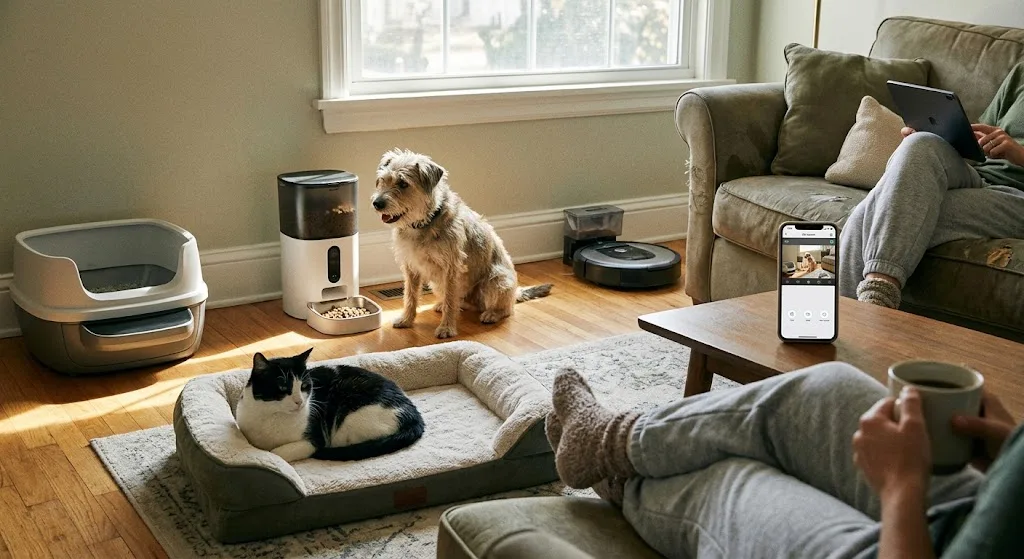
A pet bowl, a leash and a bag of food will get you through the basics. After that, things get more complicated.
Dogs need exercise and mental stimulation. Cats need clean litter and enough water. Teeth need attention. Paws get dirty. Pets wander off. And if you're away from home for several hours, you still have to think about feeding, drinking and keeping an eye on them.
That is why some of the newer pet products are more useful than they first appear. They're not all fancy gadgets. Some simply remove a small daily chore. Others are designed around problems that pet owners have always had, but now have a better way to handle.
Pet retail data from 2026 shows some of these categories growing quickly. Electronic pet toys were up 27% year over year, treat-dispensing toys were up 15%, and treat-dispensing pet cameras were up 32%. That suggests pet owners are spending more on products built around enrichment, convenience and interaction rather than just buying another ordinary toy.
Here are eight products worth knowing about, along with what they actually do and where they make sense.
1. A Gravity Feeder and Water Dispenser
Feeding a pet sounds simple until your schedule gets in the way.
You leave for work. You sleep late. You're stuck somewhere longer than expected. Even when nothing goes wrong, remembering to refill bowls several times a day is one more small job.
A gravity feeder handles part of that problem without batteries, Wi-Fi or an app.
The basic principle is surprisingly simple. Food sits in a reservoir above the bowl. As your pet eats, gravity pulls more dry food downward. The same idea works with the water reservoir. When the water level in the bowl drops, more water flows down from the container.
The Amazon Basics Automatic Pet Water Dispenser and Gravity Food Feeder Set uses this system. The small version we looked at has a 152-fluid-ounce food reservoir and a 135.3-fluid-ounce water reservoir, with transparent containers so you can see the levels without opening them.
Amazon Basics Automatic Pet Water Dispenser and Gravity Food Feeder Set
There is an important limitation, though.
A gravity feeder doesn't know how much your pet is supposed to eat. It doesn't measure portions and it can't stop a pet that keeps eating whenever food is available. For pets that need carefully controlled meals, a programmable feeder can make more sense.
For a pet that already handles free feeding well, however, the simple design can be useful precisely because there isn't much to go wrong.
2. A Treat-Dispensing Pet Camera
A normal pet camera lets you look at your dog or cat while you're away.
A treat-dispensing camera lets you interact with them.
That difference explains why this category has been growing. NIQ's 2026 retail data found treat-dispensing cameras up 32% year over year while ordinary pet cameras were declining.
The basic setup combines a camera, an internet connection and a motorized treat mechanism. You open an app on your phone, see what the camera sees, and can send a treat through the dispenser.
Some models also add two-way audio, night vision, motion detection and automatic tracking.
The TKENPRO 2K Pet Camera Treat Dispenser featured here has a 360-degree pan view, 2K video, night vision, two-way audio and remote treat dispensing. Its manual specifies dry treats between 7 and 15 millimeters to reduce the chance of the dispenser jamming.
TKENPRO 2K Pet Camera Treat Dispenser
There's a practical reason to pay attention to the treat mechanism, rather than just the camera resolution. A beautiful 2K image isn't much help if the machine cannot reliably dispense the treats you use.
There's also a behavioral question. A camera can help you check whether your pet is sleeping, moving around or getting into trouble, but a treat dispenser is not a substitute for exercise, training or attention. It's an extra tool for interacting with a pet when you're not physically there.
3. A Puzzle Toy for Mental Enrichment
A dog can spend hours lying around the house and still be exhausted after a good sniffing session or puzzle game.
That's because physical movement isn't the only thing that uses energy.
Dogs spend a lot of time investigating smells, searching for food and figuring out how to get things they want. Puzzle toys turn some of those natural behaviors into an activity.
A food puzzle might hide kibble behind sliding pieces, compartments or openings. The dog has to manipulate the toy to get the food out. Some designs are simple enough for beginners, while others require more complicated sequences.
The DR CATCH Dog Puzzle featured here is designed around food-based puzzle play and mental enrichment.
DR CATCH Dog Puzzle for Mental Enrichment
The useful part isn't the word "IQ" on the packaging. What matters is that the dog has to work for something it wants.
That can make an ordinary meal take longer and give the dog something to investigate instead of simply swallowing food from a bowl.
Start with an appropriate difficulty level. If a puzzle is too difficult, some dogs simply give up. If it's too easy, the activity may be over almost immediately.
And dogs should be supervised with unfamiliar toys, especially if they chew aggressively or try to break pieces off.
4. A Product for Daily Dental Care
Pet dental care is easy to ignore because problems often develop gradually.
A dog can still eat normally while plaque and tartar build up. Bad breath may be the first thing an owner notices, but dental disease can involve painful gums and problems below the gumline.
The American Animal Hospital Association recommends daily brushing as the best way to reduce plaque at home. Dental chews, water additives and dental diets can also have a role, and AAHA recommends looking for products carrying the Veterinary Oral Health Council seal when choosing dental treats and chews.
The Veterinary Oral Health Council maintains a list of products that have met its standards for helping control plaque and tartar. Its accepted categories include dental diets, edible chews, water additives, toothpastes, powders, toothbrushes and wipes.
The product featured in this section is Pup Labs ProDenta Dog Dental Powder.
Pup Labs ProDenta Dog Dental Powder
There is one distinction worth making here.
A dental powder should not be presented as a replacement for brushing or veterinary dental care. The specific product's listing describes it as a powder intended to support oral care, but the general evidence for pet dental products varies by product and claim. The safest way to evaluate a dental product is to look at what it has actually demonstrated, including whether it has earned VOHC acceptance.
Even daily home care doesn't replace professional examinations. AAHA notes that dental disease can occur below the gumline, where a normal toothbrush cannot reach.
5. Pet Wipes for the Messy Bits
Not every dirty dog needs a bath.
Sometimes the problem is simply muddy paws after a walk, dirt around the rear end, or something unpleasant picked up outside.
That is where pet wipes make sense. They're essentially a middle ground between doing nothing and giving the animal a full bath.
The Earth Rated wipes we looked at are designed for paws, body and the rear area. The unscented version is described as hypoallergenic and uses a plant-based wipe material with ingredients including aloe, shea butter, chamomile and cucumber extract. The wipes are not flushable.
Earth Rated Dog Wipes for Paws & Butt
The important thing is to use a product made for animals rather than assuming a household wipe is interchangeable.
Human skin and animal skin aren't identical, and pets also lick themselves. A product that is harmless on a person's hands isn't automatically appropriate for a dog or cat.
Wipes also aren't a substitute for treating an underlying skin problem. If a dog constantly smells bad, has irritated skin or repeatedly develops discharge around the eyes, ears or rear, cleaning the surface won't fix the cause.
For ordinary dirt between baths, though, they can save a surprising amount of work.
6. A GPS Tracker
A collar tells you that your dog belongs to you.
A GPS tracker can tell you where the dog is.
That becomes particularly useful for dogs that escape yards, slip out of doors or simply have a habit of exploring farther than their owners would like.
GPS pet trackers generally use satellite positioning to determine location and then rely on a communications network to send that information to the owner's phone. That is different from a Bluetooth tracker, which generally works over a much shorter range and depends on nearby compatible devices or a local connection.
The distinction matters when you're choosing one.
A GPS tracker isn't magic. Buildings, terrain, satellite visibility, cellular coverage and the tracker's own hardware can all affect performance.
The tracker we looked at is advertised for dogs without a monthly fee.
GPS Tracker for Dogs, Real-Time Location Tracking
Before buying any tracker, check exactly how the particular model gets its location data and how it communicates that location to your phone. "No monthly fee" can mean something very different depending on whether the device relies on GPS alone, Bluetooth, Wi-Fi, a built-in network arrangement or another system.
For a pet that has a history of escaping, knowing how the tracker actually communicates is more useful than simply seeing "GPS" printed on the box.
7. An Automatic Litter Box
Anyone who has cleaned a cat's litter box knows that the unpleasant part isn't filling it.
It's repeatedly scooping it.
Automatic litter boxes attack that particular chore by separating waste from reusable litter after the cat has used the box.
The mechanism varies by design, but many systems rotate or move part of the litter chamber. Clumped waste is separated from clean litter and moved into a waste container.
The PetPivot Self Cleaning Litter Box we looked at uses an open-top design and multiple sensors. Its documentation describes four infrared sensors and three Hall-effect sensors that help detect when a cat is inside and stop the cleaning cycle if necessary.
PetPivot Self Cleaning Litter Box
That's an important part of an automatic litter box that can get overlooked when people focus on the "self-cleaning" label.
The machine needs to know when it should operate and when it shouldn't.
The PetPivot documentation also specifies clumping litter for this model and warns against using non-clumping, crystal or tofu litter because the wrong litter can interfere with the machine.
So an automatic litter box isn't maintenance-free. You still have to empty the waste container, keep the machine clean, maintain the litter and make sure the sensors aren't obstructed.
What it can do is replace repeated scooping with a different kind of maintenance.
8. A Moving-Water Fountain
Cats can be strangely particular about water.
Some will happily drink from a bowl. Others seem more interested in a dripping tap, a shower floor or water that happens to be moving.
A pet fountain takes advantage of that behavior by continuously circulating water through the system.
The water is pumped upward, flows across the drinking surface and returns to the reservoir. Many fountains also include filters designed to catch debris and reduce some contaminants, although a filter doesn't mean the water can be left unchanged indefinitely.
The Veken 95-ounce/2.8-liter fountain we looked at is designed for cats and dogs and includes filtration, two water-flow modes and a water-level window. It is also marketed as a quiet fountain.
Veken 95oz/2.8L Pet Water Fountain
The useful part of a fountain isn't that moving water somehow makes every pet healthier.
The practical benefit is that it provides a constantly circulating source of water and can make drinking more appealing to some animals. The fountain still needs regular cleaning and fresh water.
The reservoir is also not a substitute for monitoring how much your pet actually drinks. A sudden change in drinking habits can be worth discussing with a veterinarian, particularly when it comes with other changes in behavior, appetite or urination.
Which of These Products Actually Makes Sense?
There isn't a single pet-product setup that every dog or cat needs.
A dog that eats normally and has no escape problem may get more use from a puzzle toy and dental-care routine than from a GPS tracker. A cat owner who hates scooping litter may get far more value from an automatic litter box. Someone who works long hours may appreciate a camera or feeding system that lets them check in during the day.
The useful way to look at these products is by the problem they solve.
All eight are gathered on the HIAW Products roundup page, with every product link in one place.
| Problem | Product that addresses it |
|---|---|
| Keeping food available between refills | Gravity feeder |
| Keeping water available | Gravity water dispenser |
| Checking on a pet while away | Pet camera |
| Interacting remotely | Treat-dispensing camera |
| Boredom and mental stimulation | Puzzle toy |
| Daily oral care | Dental products |
| Muddy paws and quick cleanup | Pet wipes |
| Finding an escaped pet | GPS tracker |
| Reducing litter scooping | Automatic litter box |
| Encouraging interest in drinking | Water fountain |
There is also a useful difference between convenience products and care products.
A gravity feeder mostly saves time. A self-cleaning litter box mostly saves labor. A pet camera gives you information and remote interaction.
Dental care and enrichment are different. They relate more directly to things a pet needs as part of ordinary care and behavior.
That distinction matters because convenience shouldn't be confused with necessity.
A $200 automatic litter box doesn't make a cat healthier simply because it is automatic. A $100 camera doesn't replace spending time with a dog. A puzzle toy isn't a substitute for exercise. And a dental powder doesn't automatically provide the same level of evidence as a product that has been evaluated through the Veterinary Oral Health Council.
The best pet products tend to be the ones that solve a real problem without creating another one.
For some owners, that means something as simple as a gravity feeder that keeps the bowl filled. For others, it might mean a camera that allows them to check on a dog during the workday, a puzzle that turns dinner into an activity, or an automatic litter box that removes one unpleasant household chore.
The technology is changing quickly, but the reason people buy these products is fairly simple. They want to take better care of an animal while making the everyday work of doing it a little easier.