Every few years, a story appears that sounds like it belongs in a tall tale rather than a weather report.
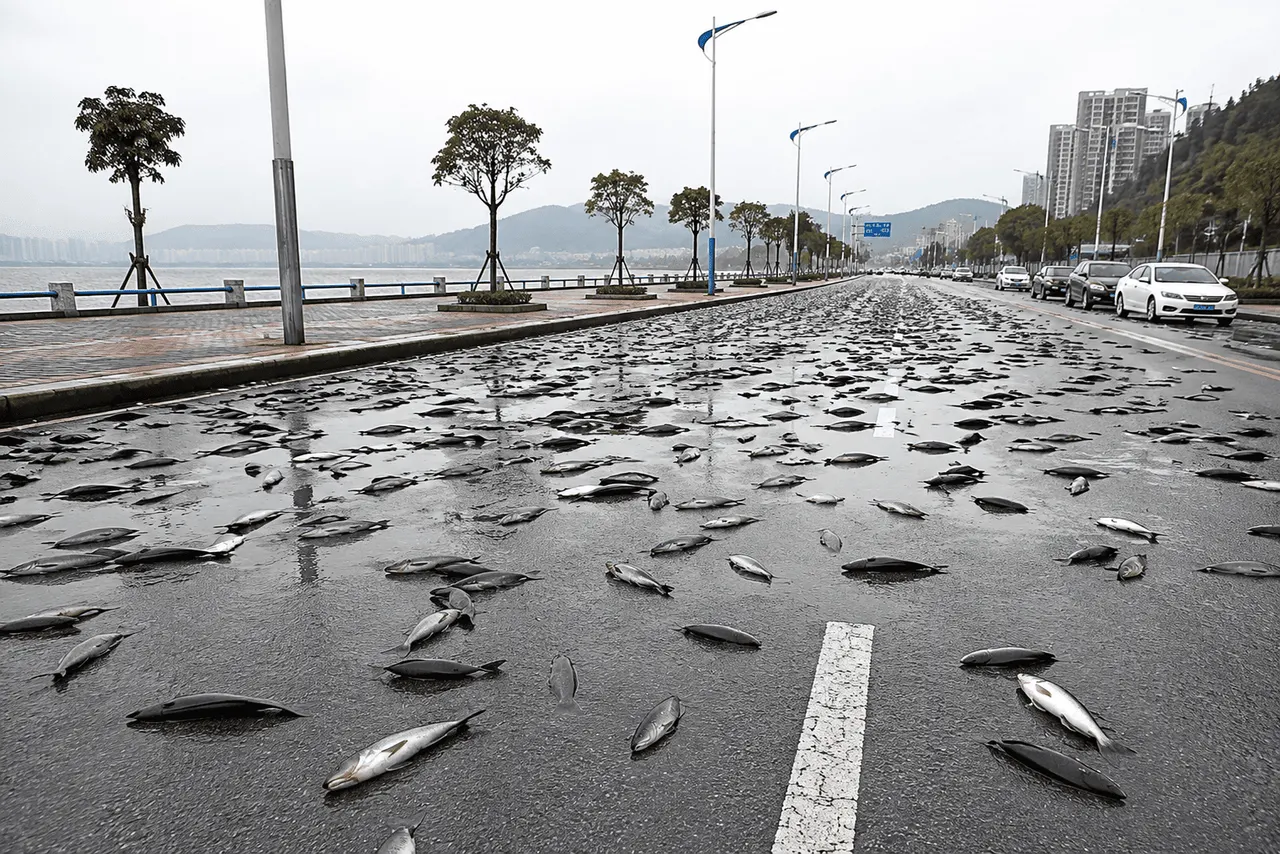
A storm passes through a town. The rain stops. People head outside and find fish scattered across roads, rooftops, parking lots, or fields.
The first assumption is usually that somebody is exaggerating.
The second is that it must be a hoax.
After all, fish live in water. They don't fall from clouds.
Yet reports of fish rain have been recorded for centuries, and enough credible cases exist that scientists generally accept the basic phenomenon as real. The debate isn't really about whether fish have ever fallen from the sky.
It's about how it happens, how often it happens, and which stories deserve to be believed.
Once you start looking into it, fish rain turns out to be one of those rare subjects where the scientific explanation is almost as strange as the claim itself.
Yes, Fish Really Can Fall From the Sky
The first thing worth clearing up is that fish aren't being created inside clouds.
When people talk about fish rain, they're describing fish that started in a lake, river, pond, or coastal water and somehow ended up falling back to the ground after being carried through the atmosphere.
Scientists have proposed a few different mechanisms over the years, but one explanation appears again and again because it fits both meteorology and eyewitness accounts.
Waterspouts.
The Weather Phenomenon Most Scientists Point To
A waterspout is a rotating column of air that forms over water.
If you've ever seen photographs of a tornado stretching down from a cloud, a waterspout looks similar, except it develops above a body of water rather than dry land.
Not every waterspout is powerful enough to lift animals. Many are relatively weak.
But stronger systems can pull water droplets, debris, and small aquatic creatures into rising air currents.
Once those animals are caught inside the storm, they may be carried some distance before gravity eventually wins and they fall back to the ground.
That's the basic explanation you'll find in most scientific discussions of fish rain.
The interesting part starts when you ask what happens next.
How High Can A Waterspout Lift Fish?
Nobody has followed a fish through a waterspout with a tracking device attached to it, so there isn't an exact answer.
What scientists do know is that strong storm updrafts can carry lightweight objects thousands of feet into the atmosphere. In severe thunderstorms, air can rise at speeds well over 100 miles per hour.
That doesn't mean every fish reaches those heights.
Some may only be lifted a short distance before falling back. Others could remain suspended much longer if they become trapped within strong upward-moving air.
The frustrating answer is that nobody knows the exact altitude reached by fish in documented events.
What we do know is that the atmosphere is capable of lifting surprisingly heavy objects when conditions are right. Compared to tree branches, roofing materials, or debris sometimes found inside storms, a small fish isn't particularly difficult to move.
How Far Can Fish Be Carried?
This is another area where estimates vary.
Some reports suggest fish may travel only a few hundred meters from where they originated. Other researchers have suggested that strong storms could potentially transport small animals several miles before releasing them.
The distance depends on several factors:
- The strength of the storm
- The size and weight of the fish
- Wind speed
- How long the fish remains suspended
This helps explain why fish sometimes appear in places that seem completely disconnected from nearby water.
A town doesn't necessarily need a lake in the middle of it for fish rain to occur. The source may be some distance away.
Why Are Fish Usually Small?
One of the strongest pieces of evidence supporting the waterspout explanation is the size of the animals involved.
Fish-rain reports almost always involve small species.
Tiny fish. Minnows. Juvenile fish. Small frogs. Tadpoles.
That's exactly what meteorologists would expect.
Storms can only carry so much weight. Small aquatic animals are far easier to lift and keep airborne than larger ones.
This is also why you don't hear stories about tuna, giant catfish, or sharks falling from the sky.
The atmosphere is powerful, but it still has limits.
A shark would require an extraordinarily unlikely combination of circumstances, and there is no credible scientific evidence that sharks have ever rained from the sky.
Why Do Witnesses Often Report Only One Species?
This detail sounds suspicious at first.
If a storm is pulling creatures from a lake, shouldn't there be a random mixture of fish, plants, insects, and debris?
Sometimes there is.
But many reports describe roads covered almost entirely by one species.
Scientists think this may actually make sense.
Animals of similar size, weight, and shape behave similarly while being carried by wind. As the storm weakens, those animals may settle out of the air together.
Another possibility is that the waterspout passed over an area dominated by a particular species.
If a shallow pond contains thousands of small fish of roughly the same size, that's what the storm is most likely to collect.
Why Are Frogs Reported So Often?
Fish get most of the attention, but frogs may actually be the most famous example of animal rain.
There are a few reasons for that.
Frogs are small, lightweight, and often gather in large numbers around the same habitats. Young frogs can appear by the thousands during certain seasons.
They're also very noticeable.
Finding fish after a storm is strange. Finding hundreds of frogs hopping around a parking lot feels almost surreal, which makes the story more likely to spread.
Some frog-rain reports may also involve animals displaced by flooding rather than literally falling from the sky, which adds another layer of confusion.
Do Fish Ever Survive The Fall?
Surprisingly, some do.
A fish doesn't necessarily fall from a great height. It may descend gradually through heavy rain and turbulent air before reaching the ground.
Waterlogged surfaces, flooded fields, wet grass, and shallow standing water can also soften the landing.
Small animals are often tougher than they look — but even spiders, which routinely survive subzero winters, don't actually survive being frozen solid.
Many reported fish are dead or injured. Others are found alive and still moving.
That fact often appears in eyewitness accounts and is one reason some reports attract scientific attention.
Has Anyone Ever Seen Fish Inside A Waterspout?
This is where the evidence becomes frustrating.
People have observed debris inside waterspouts. People have observed fish on the ground after storms.
What scientists largely lack is a perfectly documented sequence showing a waterspout collecting fish, transporting them, and dropping them somewhere else while being continuously observed.
The event itself is rare. The conditions are dangerous. And storms aren't exactly ideal environments for detailed scientific fieldwork.
So while the waterspout explanation is widely accepted as the most plausible mechanism, direct observations remain limited.
Has Fish Rain Been Scientifically Documented From Start To Finish?
Not really.
This surprises many people.
For a phenomenon that receives so much attention, there is no famous case where researchers tracked the entire process from collection to deposition with complete certainty.
Instead, the evidence is built from multiple pieces:
- Eyewitness reports
- Weather records
- Storm observations
- Recovered animals
- Geographic analysis
Scientists often work backward from the evidence rather than watching the entire event unfold in real time.
That's one reason careful researchers tend to be more cautious than popular articles.
What Is The Strongest Evidence For Fish Rain?
The strongest evidence usually comes from events where several things happen at once:
A documented storm passes through. Numerous witnesses report animals falling. The animals are concentrated in a limited area. The species involved make sense given nearby water sources. And meteorological conditions support airborne transport.
No single photograph proves everything.
But when multiple lines of evidence point in the same direction, the explanation becomes much more convincing.
What Is The Weakest Evidence?
Stories passed down for generations with no documentation.
Reports that appear decades after the alleged event.
Claims involving animals that would be extremely difficult for storms to carry.
Accounts with no corresponding weather records.
Fish rain is real enough that it doesn't need exaggeration.
Ironically, some of the least credible stories are often the most dramatic ones.
Why Meteorologists Don't Automatically Believe Every Report
One common misunderstanding is that scientists either accept all fish-rain stories or reject all of them.
Neither is true.
Meteorologists generally evaluate each case individually.
After major storms, flooding can leave fish stranded in unexpected places. Overflowing waterways can carry animals onto roads. Strong winds can move debris and wildlife without lifting them high into the atmosphere.
By the time people discover the aftermath, it may look as though animals fell directly from the sky even when something less dramatic occurred.
That doesn't mean fish rain never happens.
It means extraordinary claims still need evidence.
Has Fish Rain Happened Recently?
Yes.
Modern reports continue to emerge from different parts of the world. Social media has actually made these stories easier to document because witnesses can immediately share photographs and videos.
The challenge is verification.
A viral post can spread globally within hours, while confirming exactly what happened may take days or weeks.
Some recent reports appear credible. Others become less convincing once investigators examine them more closely.
Which Countries Report Fish Rain Most Often?
Reports come from many regions, but they tend to appear most often in places with frequent thunderstorms, coastal waters, lakes and rivers, and active waterspout activity.
The United States has recorded numerous reports. India, Australia, Japan, Honduras, and parts of Europe have also produced well-known accounts.
The most famous location is probably Yoro, Honduras, where residents have reported a recurring phenomenon known as Lluvia de Peces, or "Rain of Fish."
Scientists continue to debate the exact explanation for every reported event there, which is part of why the story remains so well known.
Can Fish Rain Happen Inland?
Yes.
A waterspout begins over water, but the animals don't necessarily have to land near that water.
Strong storms can travel inland. Once fish are caught within those systems, they may eventually be released far from where they started.
This is one reason some fish-rain stories initially sound impossible. People look around, see no nearby lake, and assume the report must be false.
The atmosphere doesn't always respect the distances that seem reasonable to us.
Could Climate Change Affect Fish Rain?
Nobody can confidently say yet.
Fish rain is already rare, and the number of well-documented events is relatively small.
Climate change may influence storm patterns, rainfall intensity, and severe weather in some regions. If conditions that produce waterspouts become more or less common, that could theoretically affect how often fish-rain events occur.
At the moment, though, there isn't enough evidence to claim a clear connection.
It's one of those questions scientists are still trying to answer.
Why Fish Rain Still Fascinates People
Part of the appeal is that fish rain sits in an unusual space between folklore and science.
The basic idea sounds absurd.
Then you discover that meteorologists don't dismiss it.
Then you discover that some reports are probably misidentified, some remain unexplained, and some fit surprisingly well with what we know about storms.
Most natural phenomena become less interesting once you learn the explanation.
Fish rain is unusual because the explanation remains almost as strange as the event itself.
A rotating column of air forms over water, lifts living creatures into the atmosphere, carries them across the landscape, and eventually drops them somewhere people least expect to find them.
That's a real possibility in the world we live in.
And it's a good reminder that weather is capable of far more than most of us ever see firsthand.