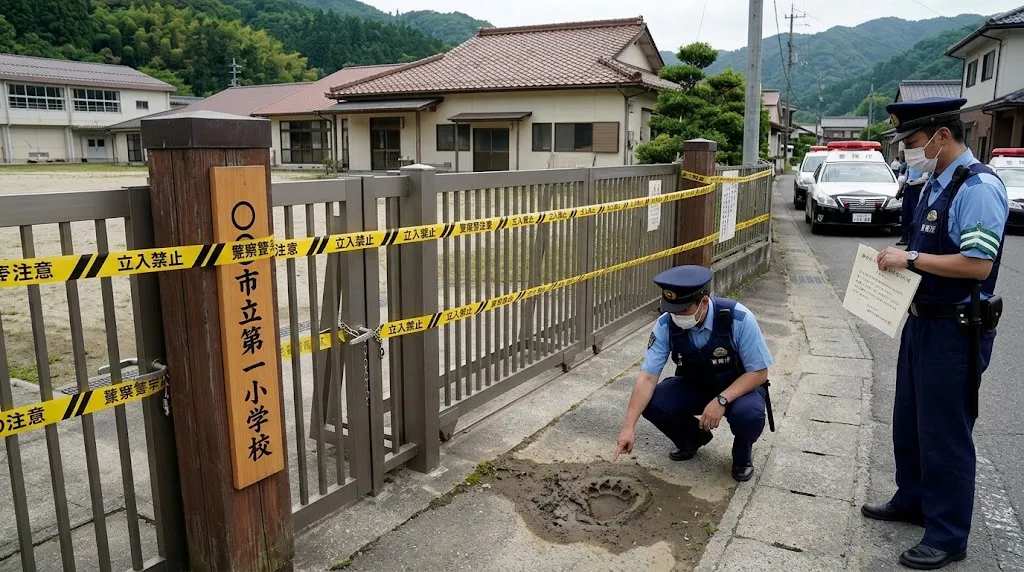
A black bear walking through a Japanese shopping district sounds unusual enough on its own. But when the story started spreading online, another detail appeared alongside it: "American black bear."
That description is wrong.
A bear really did roam through Utsunomiya, Japan, in June 2026, and the city really did close all 94 of its municipal elementary and junior high schools while authorities searched for it. But the animal was not an American black bear. It was an Asiatic black bear, the species native to parts of Japan.
And there is one more detail that has become muddled with the original story. The bear is not still wandering around Japan. It was captured on June 9, after several days of sightings.
So the viral claim contains a real event, but the species and later status of the bear have been mixed up.
Verdict: mostly true, but the "American" part is false
The claim that a black bear caused 94 schools in Japan to close is true.
The claim that it was an American black bear is false.
The claim that the bear is still at large is also false.
Utsunomiya, a city of roughly half a million people in Tochigi Prefecture about 100 kilometers north of Tokyo, closed all 94 of its municipal elementary and junior high schools after repeated sightings of a bear in and around the city. The closures lasted three days, from June 8 through June 10, with classes resuming on June 11. Reuters reported the closure on June 8.
The bear was captured on June 9.
It was an adult male Asiatic black bear.
What actually happened in Utsunomiya?
The incident began on June 6, 2026, when a bear was reported in a residential area of Utsunomiya.
That alone would have been unusual. Utsunomiya is a large urban area, not a remote mountain settlement where seeing a bear would be expected.
Then the sightings continued.
The animal was seen in residential areas and in the city's commercial districts. Security footage showed a black bear moving through the Orion-dori shopping area, where people were going about their normal business.
Police and city officials received numerous reports as the bear moved through different parts of the city. The animal was also spotted close to schools and Utsunomiya University.
By June 8, officials decided that keeping children away from the streets was safer than trying to predict where the bear would appear next.
All 94 municipal elementary and junior high schools were closed.
That part of the viral story is real.
Why did one bear lead to 94 schools closing?
The number sounds enormous because it was a citywide decision.
It wasn't 94 schools being individually attacked by a bear.
The problem was that nobody could reliably predict where the animal would appear next.
Utsunomiya officials later explained that the bear was moving over a wide area, including at night. That made it difficult to predict where it might turn up the following morning, when children would be walking to school. The city's press briefing on the closure laid out that reasoning.
The city therefore chose to close all municipal elementary and junior high schools rather than try to identify only the schools that might be in danger.
The decision was temporary.
Schools remained closed for three days and reopened on June 11 after the captured bear was considered to be the animal responsible for the sightings and no new sightings had been reported. TV Asahi reported the reopening.
So "a bear forced 94 schools to close" is a reasonable shorthand for what happened.
"An American bear shut down 94 schools" is not.
The bear was not an American black bear
This is where the viral story gets its biggest fact wrong.
There are different species of black bear.
The American black bear is Ursus americanus. It is native to North America and is found across large parts of Canada, the United States and into Mexico. The U.S. Geological Survey identifies it as endemic to North America.
The bear involved in the Utsunomiya incident was an Asiatic black bear, Ursus thibetanus. The Japanese population is commonly identified as Ursus thibetanus japonicus.
Asiatic black bears live in Japan's forested areas, particularly on Honshu and Shikoku. Japan's National Parks service calls the species a "moon-ring bear" because of the pale crescent-shaped marking commonly found on its chest.
So these aren't two names for the same animal.
They're different species.
The confusion probably comes from the ordinary phrase "black bear." A news report can say "black bear" without meaning "American black bear." Once the story was picked up and discussed outside Japan, the more specific label "American black bear" could easily become attached to it.
But the evidence from the incident itself and Japanese authorities points to the Asiatic black bear.
Why does the American black bear name matter?
It might seem like a small distinction.
It isn't if you're trying to understand what happened.
An American black bear and an Asiatic black bear belong to the same bear family, but they are different species with different natural ranges.
The American black bear's scientific name is Ursus americanus. The U.S. Geological Survey describes it as endemic to North America.
The Asiatic black bear is Ursus thibetanus, with the Japanese population living in parts of Japan.
Japan actually has two native bear species.
The Asiatic black bear lives on Honshu and Shikoku.
The brown bear lives in Hokkaido.
Japan's National Parks service specifically identifies these as the two bear types visitors may encounter in the country.
There isn't a naturally occurring population of American black bears roaming around Utsunomiya.
So how did an American black bear end up in the story?
This is the part where we need to separate what is known from what is merely plausible.
The available reporting does not establish that Google officially "classified" the Japanese animal as an American black bear.
That's an easy explanation to repeat, but there isn't enough evidence to state it as fact.
What we can say is that the search phrase "American black bear" became associated online with a Japanese black bear story, even though the animal involved was an Asiatic black bear.
That distinction matters because search trends show what people are typing, not necessarily what is scientifically correct.
If thousands of people see a headline saying a "black bear" shut down Japanese schools, some may search for "American black bear in Japan" simply because "American black bear" is a familiar term for the animal they have in mind.
The search phrase itself doesn't prove the species.
The animal's identification does.
Was it really a 100 kg bear?
Reports from the incident estimated the adult bear at around 100 kilograms, or roughly 220 pounds.
That is a substantial animal, but Asiatic black bears can vary considerably in size.
Japan's tourism authorities describe adult Asiatic black bears as generally ranging from about 40 to 130 kilograms, with males tending to be larger.
The bear captured in Utsunomiya therefore wasn't some impossibly enormous animal.
What made the incident unusual was where it was.
It was moving through a populated city.
The bear was eventually captured
The original reports from June 8 understandably described the animal as still at large.
At that point, nobody knew where it would appear next.
But the story developed quickly.
On June 9, local hunting association members and others captured an adult male Asiatic black bear on residential property in Utsunomiya. Japanese broadcaster Nippon TV reported that the animal was about one meter long.
Utsunomiya's municipal government recorded the capture at about 3:45 p.m. on June 9, in its public notice about the bear.
There had initially been concern that more than one bear might be involved because of reports from different locations.
That possibility was investigated.
By June 10, the city had concluded, based on security-camera evidence and expert assessment, that the urban sightings were most likely caused by the one captured bear.
The schools then reopened on June 11.
So if you see a post saying "the bear is still missing", check the date.
That was true during the search.
It isn't the final outcome of the incident.
Why was the city so concerned?
A black bear walking through a city creates a very different safety problem from one spotted deep in a forest.
People may encounter it unexpectedly.
Children may be walking to school.
Drivers may encounter the animal on a road.
People may try to photograph it.
And because the animal is moving through an unfamiliar urban environment, authorities can't simply assume it will stay in one place.
That was part of the reason Utsunomiya officials chose a broad school closure.
The city's later explanation said the bear's movement range was wide and included nighttime movement, making the location of the next sighting difficult to predict.
The response wasn't based on the idea that every school was about to be attacked.
It was a precaution designed to keep children out of the animal's path while authorities searched for it.
Why are bears appearing closer to Japanese cities?
The Utsunomiya incident also fits into a wider problem Japan has been dealing with.
Bear encounters have increased in several parts of the country, including areas close to populated communities.
Reuters reported that Japan recorded 238 bear-related victims in fiscal 2025, including 13 deaths. The same reporting cited reduced natural food supplies, declining rural populations and abandoned farmland as factors experts associate with increasing bear encounters around human settlements.
There isn't one simple explanation for every sighting.
Bear behavior changes with food availability, habitat conditions and human activity.
When food becomes harder to find in forests, bears may travel farther while searching for it. Abandoned farmland and declining rural populations can also change the boundary between human settlements and wildlife habitat.
That makes an urban sighting less mysterious than it first appears.
The surprising part is not that Japan has black bears.
It does.
The unusual part is having one travel through the middle of a city of about half a million people.
Is an Asiatic black bear the same as a moon bear?
Yes.
"Moon bear" is a common name for the Asiatic black bear, referring to the pale crescent-shaped marking that many individuals have on their chest.
You may also see the Japanese name tsukinowaguma, which refers to the same animal.
The species is generally black, with rounded ears and a characteristic pale chest marking, although individual appearance varies.
It is also a capable climber and has strong claws.
So the bear seen running through Utsunomiya wasn't an unusual American animal that somehow crossed the Pacific.
It was a species that already lives in Japan.
It simply ended up somewhere people don't normally expect to see one.
What the viral claim gets right and wrong
Here's the story after separating the pieces:
"A black bear caused 94 schools in Japan to close."
True. Utsunomiya closed all 94 municipal elementary and junior high schools for three days while authorities dealt with repeated bear sightings.
"It was an American black bear."
False. The animal was identified as an Asiatic black bear, Ursus thibetanus japonicus.
"The bear is still loose."
False. The bear was captured on June 9, and the schools reopened June 11 after authorities assessed that the captured bear was responsible for the urban sightings.
"It was seen in the city rather than deep in the mountains."
True. The bear was reported in residential and commercial areas, including a shopping district, which was a major reason the incident attracted so much attention.
The strange part isn't the number 94
The number 94 makes for a memorable headline, but the more useful detail is what it tells us about the incident.
Utsunomiya didn't close 94 schools because a bear physically reached 94 school buildings.
It closed them because officials couldn't predict where the bear would go next.
That distinction gets lost very easily when a local news event becomes a viral international story.
And that's also how "black bear in Japan" can turn into "American black bear in Japan."
The original event was real.
The species was different.
The school closures were temporary.
And the bear was eventually caught.
So, yes, a bear really did help shut down all 94 municipal elementary and junior high schools in Utsunomiya. No, it wasn't an American black bear. It was an Asiatic black bear, a native Japanese species.