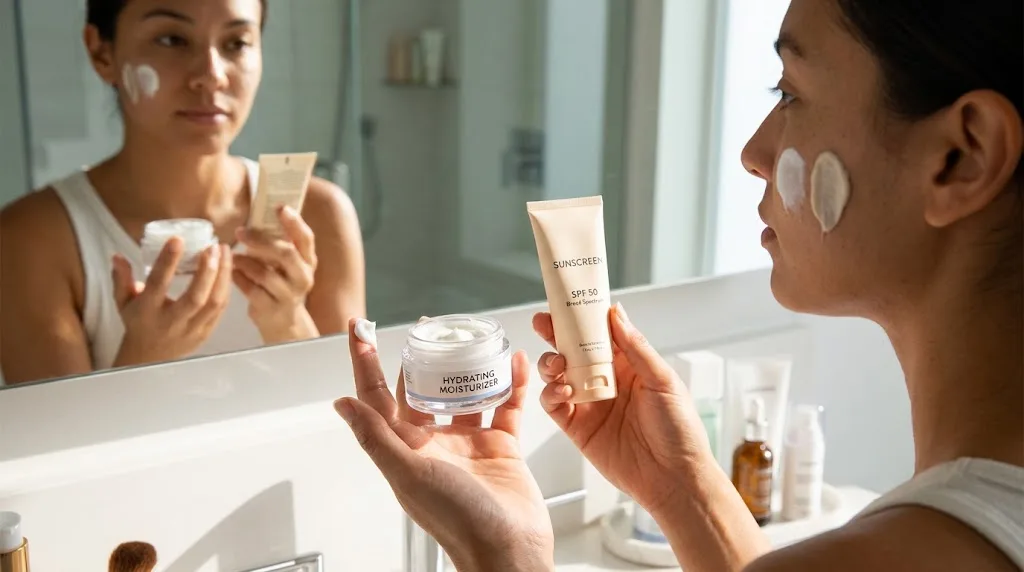
If your morning routine has started turning into a small collection of bottles, it is reasonable to wonder whether all of them are actually necessary.
Sunscreen is already going on your face. Many modern sunscreens feel smooth, creamy and hydrating. Some even contain ingredients such as glycerin, hyaluronic acid, ceramides or emollients that are also found in moisturizers.
So can you just use sunscreen and forget the moisturizer?
Sometimes, yes. But sunscreen does not automatically replace moisturizer.
The deciding factor is not simply whether a product is called sunscreen. It is what the formula actually does for your skin and whether your skin still needs more hydration or barrier support.
That means someone with oily skin who uses a comfortable, hydrating sunscreen may be perfectly fine without a separate morning moisturizer. Someone with dry, irritated or barrier-damaged skin may still benefit from one.
The two products overlap, but they aren't automatically the same thing.
What does a moisturizer actually do?
"Moisturizer" isn't one particular type of chemical. It is a broad category of products designed to improve the water content, feel and function of the outer layer of skin.
A good moisturizer can work through several different mechanisms.
Humectants such as glycerin and hyaluronic acid help attract and retain water in the outer skin.
Emollients help smooth the spaces between cells in the outermost layer of skin, making the surface feel softer and less rough.
Occlusives form a layer that slows the movement of water out of the skin. Petrolatum is a familiar example.
Many moisturizers use more than one of these approaches. A review of skin-barrier research describes humectants, emollients and occlusives as different tools that support hydration and reduce water loss.
That matters because "hydrated skin" isn't simply a matter of putting water on your face.
Your outer skin has to hold onto that water.
The stratum corneum, the outermost part of the epidermis, acts as a barrier. When that barrier is disrupted, water can escape more easily, a process measured as Does Salt Actually Make You Thirsty? (Your Body Conserves Water), or TEWL. Moisturizers can help reduce that loss and support the barrier.
What does sunscreen actually do?
Sunscreen has a different primary job.
Its formulation is designed to protect your skin from ultraviolet radiation. Depending on the product, it may contain organic UV filters, mineral filters such as zinc oxide or titanium dioxide, or a combination of ingredients. Broad-spectrum sunscreen is designed to protect against both UVA and UVB radiation.
But sunscreen isn't just a collection of UV filters.
This is where the chemistry gets interesting.
The UV filters have to be distributed across your skin in a reasonably uniform film. Formulation researchers specifically study film-forming ingredients because the way the sunscreen film forms on the skin affects how effectively the UV filters perform.
A sunscreen can therefore contain emollients, solvents, film formers, moisturising ingredients and other components that affect how it spreads, feels and stays on the skin.
In other words, a sunscreen can also be moisturizing.
That's why the question isn't really:
"Does sunscreen contain moisturizing ingredients?"
Many do.
The better question is:
"Does this particular sunscreen provide enough of the moisturizing functions my skin needs?"
Why some sunscreens can replace your morning moisturizer
Look at the way some modern facial sunscreens are formulated.
They may be creamy or lotion-like. They may contain humectants, emollients and ingredients that reduce water loss. Some are deliberately designed to leave the skin feeling soft rather than dry.
A sunscreen like that may provide enough hydration for someone who has normal or oily skin.
The American Academy of Dermatology's sunscreen guidance includes moisturizers with sunscreen among the products people can use, provided the product offers appropriate broad-spectrum protection and SPF. Its guidance also recognizes that people with oily skin may sometimes need less moisturizer or a lighter formulation.
That can be a perfectly sensible minimalist routine.
Cleanse if needed, apply your sunscreen properly, and stop there.
There is no rule saying that every face needs a separate moisturizer simply because a skincare routine diagram contains one.
When sunscreen isn't enough
The situation changes when your skin is telling you that it needs more.
If your face feels tight, flaky, rough, itchy or uncomfortable after using sunscreen, the product may not be providing enough moisturizing support for your skin.
Dry or irritated skin can also have different needs from oily skin.
The American Academy of Dermatology recommends creams or ointments for people with dry skin because they generally hold more moisture than lighter lotions. It also points to ingredients such as glycerin, hyaluronic acid, dimethicone, mineral oil and petrolatum depending on the situation.
Some people also need moisturizer because of other products they use.
Retinoids, benzoyl peroxide, salicylic acid and other acne treatments can cause dryness or irritation. The AAD specifically recommends moisturizer as part of acne care when treatment is drying the skin.
In that situation, simply putting sunscreen over the skin doesn't necessarily solve the underlying dryness.
The sunscreen may protect the skin from UV radiation while the moisturizer handles the separate problem of maintaining hydration and reducing water loss.
Does moisturizer under sunscreen make the sunscreen less effective?
This is one of the more commonly repeated skincare claims, and it deserves a little caution.
The general dermatology recommendation is to apply moisturizer before sunscreen when you are using both. JAMA Dermatology's 2026 patient guidance, for example, recommends moisturizer followed by sunscreen. The AAD similarly lists moisturizer and/or sunscreen as part of a normal skincare sequence.
That does not mean every moisturizer automatically improves sunscreen performance, nor does it mean putting two products together creates a higher SPF.
Sunscreen performance depends heavily on its own formulation and on forming a sufficiently uniform protective film. Research has shown that ingredients in the vehicle can affect UV-filter behavior, although the effects aren't as simple as "moisturizer ruins sunscreen." In one formulation study, different emollients changed how the tested UV filters absorbed light, while the simulated SPF of the tested combinations was not substantially affected overall.
The practical point is simpler:
Apply moisturizer and sunscreen as separate products rather than mixing them together.
Then allow the sunscreen to form its own film.
You don't need to perform chemistry experiments on your face to simplify your routine.
What if your skin is oily?
This is where skipping moisturizer can make sense for some people.
Oily skin already produces plenty of sebum, and putting a rich cream underneath sunscreen may simply feel unpleasant. It can also make the face look shinier.
The answer isn't necessarily to stop moisturizing forever.
You can choose a lighter moisturizer, use less of it, moisturize only the areas that feel dry, or choose a sunscreen that already provides enough hydration.
Dermatologists writing for the AAD specifically note that some people with oily skin may benefit from skipping a separate moisturizer or using a lighter gel formulation.
If your sunscreen alone leaves your skin comfortable and doesn't cause tightness or flaking, there may be no practical reason to add another morning layer.
That's different from saying oily skin doesn't need hydration.
Oil and water are not the same thing.
Skin can be oily and still become dehydrated or irritated.
Can sunscreen clog your pores if you don't use moisturizer?
Not using moisturizer does not automatically make sunscreen more likely to clog your pores.
What matters more is the formulation of the products you're putting on your skin.
For acne-prone skin, the American Academy of Dermatology recommends looking for sunscreen and skincare products labeled non-comedogenic, oil-free, or won't clog pores.
And moisturizer itself isn't automatically a pore-clogging product either.
There are lightweight, non-comedogenic moisturizers specifically designed for acne-prone skin. In fact, moisturizer can sometimes help people tolerate acne treatments that would otherwise leave their skin excessively dry and irritated.
So the useful question isn't:
"Should I avoid moisturizer because I have acne?"
It's:
"Which moisturizer and sunscreen formulations work with my skin?"
Why does your skin sometimes feel dry even when you use sunscreen?
Several things can be happening.
Your sunscreen may simply not contain enough moisturizing ingredients for your skin.
You may be using a cleanser that removes too much oil from the skin.
You may be using acne treatments, retinoids or exfoliating products that increase dryness.
Weather can matter too. Low humidity can increase water loss from the skin, while frequent washing can make dryness worse.
And some sunscreen formulas can feel different from others. A lightweight gel designed for oily skin is not going to behave like a rich cream designed for dry skin.
Sunscreen also doesn't prevent every factor that can affect the skin barrier.
Ultraviolet radiation itself can affect barrier function, while research on sunscreen formulations shows that different products can have different effects on measures such as TEWL and skin hydration.
So if your face is becoming dry while you're faithfully wearing sunscreen, the answer isn't to stop sunscreen.
The answer is to look at the rest of the routine and the particular sunscreen formula.
Do you need moisturizer at night if you wear sunscreen during the day?
Sunscreen doesn't become a nighttime moisturizer simply because you wore it during the day.
Its purpose during the day is UV protection.
At night, there is no reason to keep sunscreen on your face for protection from sunlight. You can cleanse as appropriate for your routine and use moisturizer if your skin needs it.
This can be particularly useful for dry or irritated skin because nighttime is when you aren't trying to maintain a daytime UV-protective film.
The AAD recommends moisturizing dry skin regularly, while dermatology guidance generally treats sunscreen as a daytime product.
You also don't have to use the same moisturizer morning and night.
A lightweight sunscreen may provide enough hydration during the day, while a richer moisturizer may make more sense at night if your skin is dry.
Is SPF 100 the same as 100% sun protection?
No.
This is worth clearing up because the phrase "100% sunscreen" can create the wrong impression.
SPF is not a percentage of total UV radiation blocked.
JAMA Dermatology's 2026 patient guidance gives approximate UVB protection figures of about 93% for SPF 15, 97% for SPF 30 and 98% for SPF 50 under test conditions. It also emphasizes that no sunscreen blocks every UV ray.
So SPF 100 does not mean your skin is receiving zero UV radiation.
And SPF mainly describes protection against UVB under standardized testing. That's why "broad spectrum" matters for UVA protection as well.
The bigger practical issue is application.
People often apply much less sunscreen than the amount used to establish the labeled protection. The Skin Cancer Foundation notes that most people apply less than half of the recommended amount.
A very high SPF applied too thinly isn't a substitute for using sunscreen properly.
So when can you skip moisturizer?
A simple way to think about it is this:
You can probably skip a separate morning moisturizer if:
- Your sunscreen is clearly hydrating.
- Your skin feels comfortable after applying it.
- You aren't experiencing tightness, flaking or irritation.
- Your skin type and climate make a heavier layer unnecessary.
- You're using an appropriate sunscreen for your skin, such as a non-comedogenic formula if you're acne-prone.
A separate moisturizer may still be useful if:
- Your skin feels tight or dry.
- You have visible flaking or roughness.
- Your skin is sensitive or easily irritated.
- You're using drying acne treatments or retinoids.
- Your sunscreen has a lightweight, low-moisture formulation.
- Your skin barrier is already damaged or unusually dry.
You don't have to make the decision based on a skincare routine chart.
Your skin gives you useful information.
The simplest way to build the routine
For someone who wants a minimal routine, there are several reasonable approaches.
If your skin is comfortable with your sunscreen alone:
Cleanse as appropriate, apply your sunscreen, and you're done with the morning moisturizing step.
If your sunscreen isn't moisturizing enough:
Use a moisturizer first, then sunscreen.
If your skin is oily:
Consider a lightweight, non-comedogenic moisturizer or a hydrating sunscreen and see which combination keeps your skin comfortable without excessive shine.
If your skin is dry:
A separate moisturizer is more likely to be useful, particularly one containing ingredients that help hold water and reduce water loss.
The point isn't to reach some perfect number of skincare products.
It's to give your skin what it actually needs while keeping reliable sun protection in the routine.
Verdict: True, but only under certain circumstances
Can sunscreen replace moisturizer?
Sometimes.
A well-formulated sunscreen can contain many of the same types of ingredients used in moisturizers, and some people can comfortably use it as their only morning moisturizing product.
But sunscreen's primary job is UV protection. Moisturizers are designed around hydration, reducing water loss, smoothing the outer skin and supporting the skin barrier. Those functions can overlap, but they aren't identical.
So there is no universal rule that everyone needs moisturizer under sunscreen.
There also isn't a rule that sunscreen makes moisturizer unnecessary.
If your sunscreen keeps your skin comfortable and hydrated, skipping a separate morning moisturizer can be a perfectly reasonable minimalist routine. If your skin stays dry, tight or irritated, adding a moisturizer is doing a different job rather than simply adding another unnecessary step.
The useful question isn't whether sunscreen and moisturizer are the same product.
It's whether the sunscreen you're using is actually providing enough of the functions your skin needs.