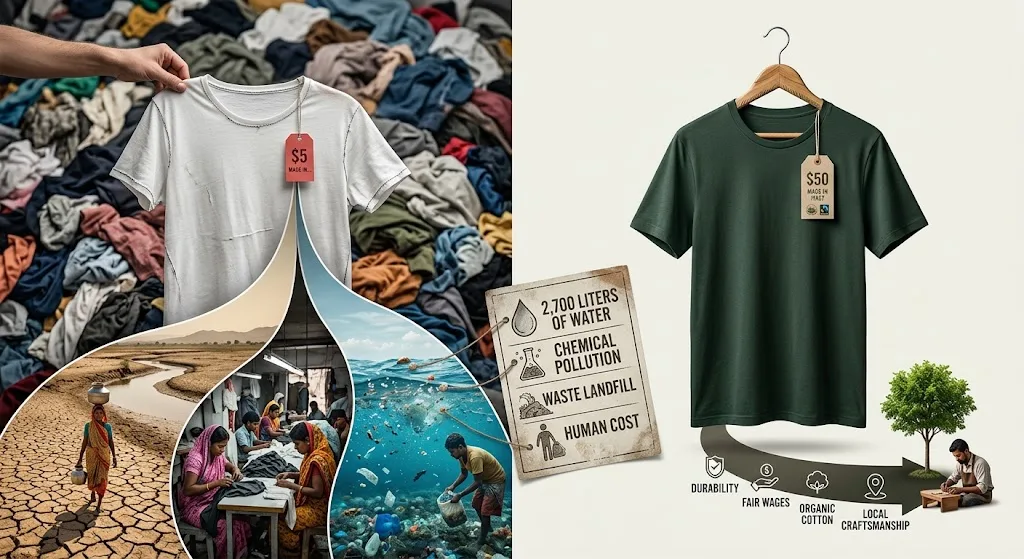
Walk into almost any clothing store and you'll see the same choice in front of you: one shirt costs a few dollars, another costs ten times as much, and both look perfectly fine on the hanger.
The obvious assumption is that the expensive one must be better.
That isn't necessarily true.
Research into clothing durability has found that retail price alone is a poor predictor of how long a garment will last. In one University of Leeds study commissioned by the environmental charity Hubbub, researchers tested 65 garments across a range of price points under controlled lab conditions. Durability ranged from excellent to very poor at both the low and high ends of the price scale. WRAP's larger clothing-durability research has also found that price, fibre composition and fabric weight don't reliably predict how durable a garment will be.
So are cheap clothes actually cheaper?
Sometimes. Sometimes they're not.
The price tag tells you what the shirt costs today. It doesn't tell you how many times you'll wear it, how quickly it will lose its shape, whether you'll need to replace it, or whether you'll actually like wearing it enough to keep reaching for it.
That's where the economics of clothing gets interesting.
Why are some clothes so cheap?
A shirt has to go through a surprisingly long chain before it reaches a shop.
Fibres have to be produced, spun or processed into yarn, turned into fabric, dyed or finished, cut into pieces, sewn together, inspected, packaged and transported. Large-scale production can reduce the cost of many of these steps because factories produce huge numbers of similar garments and spread fixed costs across them.
Labour costs, manufacturing location, production efficiency, order size, material choice and supply-chain structure all affect the final price.
A cheap shirt isn't necessarily cheap because somebody simply decided to make an inferior shirt.
Sometimes the manufacturer has found a very efficient way to produce millions of similar garments.
Sometimes the garment uses less expensive materials or simpler construction.
Sometimes the retailer is operating with a different margin.
And sometimes the price reflects things that have little to do with physical durability, such as branding, marketing, design, retail positioning or exclusivity.
That's why two shirts made from broadly similar materials can end up with very different price tags.
The price is a combination of many costs and business decisions. It isn't a laboratory measurement of quality.
The surprising problem with expensive clothing
Most of us use price as a shortcut.
If one shirt costs $5 and another costs $50, it feels reasonable to assume that the $50 shirt contains better fabric, stronger stitching and better construction.
People also tend to associate expensive brands with durability. Research into clothing durability across several regions has found that consumers commonly use both price and brand as signals of expected quality.
The problem is that the shortcut doesn't always work.
In the Leeds research, independent testers from the School of Design put each garment through repeat washing, visual assessment and technical tests — abrasion resistance, seam strength, shrinkage for jeans; pilling, ripping resistance and colour fastness for T-shirts and hoodies. The conclusion: retail price could not be used to identify good or inferior durability. Durability ranged from excellent to very poor among both cheap and expensive garments.
Some of the specific findings were striking:
Women's T-shirts priced under £10 outperformed one retailing at around £40.
A men's T-shirt costing under £5 ranked as the second most durable of 17 items tested — beating one at ten times the price.
Women's hoodies between £11 and £20 ranked higher than others priced near £50 and £100.
And a £15 pair of women's jeans showed only negligible durability differences compared with one costing more than ten times as much.
That doesn't mean cheap clothes are secretly better.
It means something more useful:
Price isn't enough information.
What actually makes clothing last?
A shirt doesn't become durable because somebody puts a high price on it.
Its physical durability comes from the materials, fabric construction, stitching, garment design, finishing and how the item is used and washed.
Researchers can test several of these properties directly.
They can measure things such as tensile strength, seam strength, dimensional stability and resistance to pilling. They can also repeatedly wash garments and look for changes in appearance and structure.
That matters because different garments fail in different ways.
A T-shirt might become covered in pills.
Another might stretch around the collar.
Another might shrink.
Another might fade badly.
A pair of jeans might remain structurally intact but develop worn areas from repeated friction.
So even "lasting longer" isn't one simple measurement.
A garment can remain wearable while looking completely different from the day you bought it.
Why fabric quality matters, but isn't the whole story
The fabric is one of the first things people think about when discussing clothing quality.
And it does matter.
The fibres used, how they're spun, how the fabric is knitted or woven, and how the fabric is finished can all affect how a garment behaves.
But even fibre content doesn't tell the whole story.
WRAP's durability research found that fibre composition and fabric weight were not guarantees of durability either — their fieldwork found that higher prices, fibre composition and fabric weight are no guarantee of a more durable product.
That makes sense when you think about how clothing is actually constructed.
A fabric can be strong but poorly suited to the garment.
A heavy fabric can still have weak seams.
A good fibre can be combined with poor construction.
A lightweight fabric can be perfectly adequate for something that doesn't need to withstand much stress.
There's no single number printed on a label that can tell you exactly how long a shirt will survive.
So what happens when the $5 shirt wears out?
This is where the original price starts to become misleading.
Suppose you buy a $5 shirt and wear it five times before it develops holes, loses its shape or becomes uncomfortable.
You've paid:
$5 ÷ 5 wears = $1 per wear
Now suppose another shirt costs $50 but you wear it 100 times.
That's:
$50 ÷ 100 wears = $0.50 per wear
The shirt that cost ten times as much at the checkout has cost half as much each time you actually used it.
This calculation is called cost per wear.
It's simple:
Cost per wear = total cost ÷ number of wears
The idea is useful because clothing isn't really a one-time-use purchase. Its value depends partly on how much use you get from it.
Research from the University of Bath's Retail Lab examined how communicating cost per wear affects people's clothing choices. It found that showing the per-wear figure can shift preferences away from cheaper, low-quality options toward more expensive, higher-quality garments with a lower indicated cost per wear.
But there's a catch.
You don't know the number of wears in advance.
That's the part people often skip.
Cost per wear can fool you too
Imagine buying a $100 jacket because you think you'll wear it for ten years.
If you actually wear it 200 times, the purchase looks pretty reasonable.
If you wear it six times and then decide you don't like the fit, the weather changes, your size changes or the style stops working for you, the calculation looks very different.
The same thing happens with cheap clothing.
A $5 shirt that survives for years and gets worn constantly can be excellent value.
A $5 shirt bought because it looked like a bargain, worn twice and forgotten at the back of the wardrobe isn't cheap in any meaningful sense.
This is why cost per wear is better used as a comparison tool than as a magic number. The formula is easy. Predicting actual use is the hard part.
Does expensive clothing last longer?
Not reliably.
Some expensive clothes are genuinely better made and may last longer.
Others aren't.
The research is pretty clear on the first part: price by itself cannot tell you how durable a garment will be.
A higher price can reflect better materials, more careful construction or better quality control. It can also reflect branding, marketing, retail costs, design, exclusivity or a combination of several things.
That means the useful question isn't:
"Is this shirt expensive?"
It's:
"What am I getting for the extra money?"
If the answer is stronger construction, better fit, better fabric and a garment you're likely to wear for years, the higher price may make sense.
If the answer is mostly a logo or brand positioning, the economics are different.
When is an expensive shirt actually worth paying for?
An expensive garment makes more financial sense when three things line up.
First, you'll actually wear it.
Second, it's built well enough to survive that use.
Third, the extra price buys something you genuinely value.
That could be durability.
It could be a better fit.
It could be comfort.
It could be a fabric that works better in your climate.
It could be a jacket you'll wear several times a week for years.
A $150 coat that becomes part of your regular wardrobe can make more financial sense than three $50 coats that you rarely wear.
But that's not because expensive clothing is automatically better.
It's because the expensive garment is providing more useful wear.
When is cheap clothing actually the better buy?
There are plenty of situations where paying less makes sense.
Maybe you need a basic T-shirt for a specific occasion.
Maybe you're trying a particular style and don't know whether you'll wear it regularly.
Maybe the inexpensive garment fits well and performs just as well as the more expensive alternatives.
Or maybe you've found a genuinely durable low-priced item.
The Leeds research is useful here because it shows that low price and poor durability aren't automatically linked. Several of the cheapest garments performed very well under testing.
There's nothing inherently irrational about buying inexpensive clothing.
The mistake is assuming that the lowest price always represents the lowest long-term cost, or assuming that the highest price represents the highest quality.
Neither assumption is safe.
What should you look at instead of the price?
If you want to judge whether a garment is likely to be good value, look beyond the number on the tag.
Look at the construction
Check seams, stitching and areas that will experience repeated stress.
A garment intended for heavy use needs construction that can handle that use.
Look at the fabric
Consider whether the material makes sense for what you'll be doing with the garment.
A very lightweight fabric may be perfectly suitable for one purpose and a poor choice for another.
Look at the fit
A technically durable shirt isn't much of a bargain if you hate wearing it.
Fit affects how often a garment gets used, which directly affects its cost per wear.
Think about care
A garment that requires expensive or inconvenient care may cost more to own than its price tag suggests.
Washing, drying, alterations and repairs can all affect the real cost over time.
Ask how often you'll wear it
This may be the most overlooked question.
A $20 shirt you wear 100 times can be a much better purchase than a $200 shirt you wear three times.
That's not a fashion opinion. It's simply what happens when you divide the price by actual use.
Does buying fewer clothes save money?
It can, but the answer depends on what replaces those purchases.
Buying fewer items only creates savings if the clothes you keep actually get used.
Replacing five cheap shirts every few months can cost more than keeping two or three durable shirts in regular rotation. But buying an expensive wardrobe full of things you barely wear doesn't solve the problem either.
The useful goal isn't simply to own expensive clothing.
It's to own clothing that gets used.
WRAP's durability work puts a similar emphasis on extending the useful life of garments, because longer use reduces the need for replacement and can reduce the environmental impact associated with clothing.
So what are you really paying for when a shirt costs $50?
Not necessarily better quality.
You're paying for the entire chain behind the garment.
That can include the fabric, manufacturing, labour, transportation, retail costs, design, marketing, brand positioning, margins and the many other expenses involved in getting clothing from raw materials to your wardrobe.
Some of those costs can improve the garment.
Some don't necessarily make it last longer.
That's why a $50 shirt isn't automatically a better version of a $5 shirt.
And a $5 shirt isn't automatically a false economy.
The real comparison happens after the purchase.
If the $5 shirt lasts through 50 wears, its cost is 10 cents per wear.
If the $50 shirt lasts through 500 wears, it also costs 10 cents per wear.
The expensive shirt only becomes financially better because it delivered more useful wear.
And if both shirts last 50 wears, the cheaper shirt wins that particular piece of arithmetic.
So, is cheap clothing actually cheaper?
Partly true — it depends on what happens after you buy it.
The claim that cheap clothes are a false economy isn't supported by the durability research: lab testing has found excellent and terrible durability at every price level, and price alone can't tell you which is which.
The claim that expensive clothes are automatically better value isn't supported either. A higher price can buy better construction — or it can buy marketing.
The honest answer is that cheap clothing is cheap at the moment you buy it, and that doesn't necessarily make it cheap to own. The reverse is also true: expensive clothing isn't automatically good value simply because the price suggests higher quality.
Price is not a reliable durability test.
What matters is what you get for the money: how well the garment is made, how often you wear it, how long it remains useful, how much care it needs, and whether you're paying for something that actually improves the garment rather than simply increasing the number on the tag.
So the $5 shirt and the $50 shirt shouldn't really be compared by their prices.
Compare what happens after you take them home.
That's where the real cost starts.