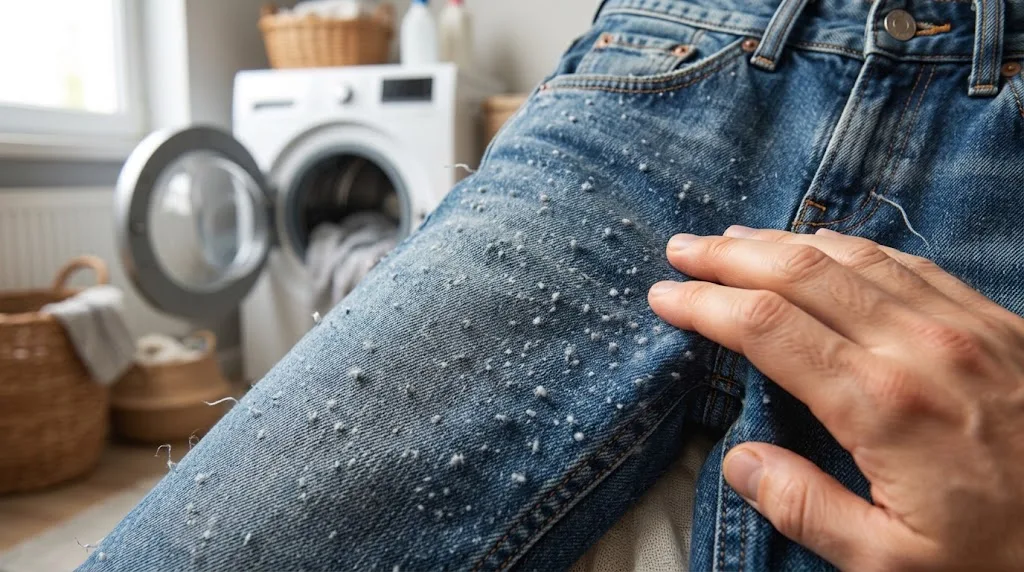
Pull an old sweater out of the wardrobe and you may notice them immediately. Tiny fuzzy balls have appeared across the chest, around the sleeves or under the arms. A shirt that once looked smooth now looks slightly worn, even though there may be nothing seriously wrong with it.
Those little balls have a name: pills. The process that creates them is called pilling.
Pilling happens when fibers near the surface of a fabric become loosened by friction. Some of those fibers work their way out of the yarn, become tangled with other loose fibers, and roll into small knots. Because some of the fibers are still attached to the fabric, the little knot stays there instead of simply falling away.
It is basically a tiny ball of the garment's own fibers, held to the surface by the fibers that haven't broken free.
What actually happens when a fabric pills?
A piece of clothing may look like one solid sheet of material, but it is really a structure made from yarns, and those yarns are made from fibers.
Those fibers aren't all perfectly buried inside the yarn. Some tiny fiber ends sit close to the surface.
Everyday movement puts those fibers through a surprising amount of rubbing.
Your sleeve brushes against your desk. Your shirt rubs against your jacket. Your sweater presses against a chair. Your thighs rub against the fabric when you walk. A backpack strap repeatedly moves across the same part of a shirt.
Each bit of friction can disturb the fibers a little.
Eventually, some fibers loosen and stick out from the surface. Once they're exposed, continued rubbing makes them twist and tangle with other loose fibers.
The tangled fibers gradually form a small knot.
That knot is the pill.
The process can be thought of in five simple steps:
Friction → loose fibers → surface fuzz → tangled fibers → pill
That sounds simple, but the type of fiber and the way the fabric was made determine how easily the process happens.
Why don't the loose fibers just fall off?
This is one of the more interesting parts of pilling.
If a fiber completely breaks away from the fabric, it can simply disappear into the laundry or fall away. But some fibers don't detach completely.
They remain connected to the yarn while their loose sections become tangled with other fibers.
Those remaining fibers act like little anchors.
This is one reason polyester-containing fabrics can sometimes develop persistent pills. Research on polyester-cotton fabrics has found that broken cotton fibers can become wrapped around polyester fibers, while the stronger polyester fibers remain attached to the fabric and hold the pill in place.
So the pill isn't just sitting on top of your shirt.
It can still be connected to the fabric underneath.
Why do sleeves and underarms pill first?
Look at the places where pilling tends to appear and you'll usually find a common factor: repeated friction.
Underarms are a good example.
The fabric there repeatedly rubs against itself as your arms move. A sweater can also rub against the shirt underneath it. The result is thousands of small mechanical interactions over the life of the garment.
Sleeves experience similar treatment.
The cuffs and forearms rub against desks, tables, armrests and other surfaces. If you wear a jacket or coat over a sweater, the two fabrics can rub against each other every time you move.
Backpack straps create another obvious example. A strap pressing against the same area of a shirt while you walk can produce much more abrasion in that spot than the rest of the garment receives.
This is why pilling often appears in specific patches rather than evenly across the whole garment.
The fabric isn't necessarily wearing out at the same rate everywhere.
The friction isn't either.
Why do some clothes pill much more than others?
Fabric type matters, but there isn't a simple rule such as “natural fibers don't pill” or “synthetic fibers always pill.”
Several things can affect pilling, including the length and characteristics of the fibers, the yarn construction, the fabric structure and the amount of abrasion the material experiences.
Shorter fibers can be more likely to work their way toward the surface.
The way those fibers are spun into yarn also matters. Yarn twist affects how tightly the fibers are held together, while the structure of the fabric affects how easily fibers can migrate.
Knitted fabrics can also be more susceptible than tightly woven fabrics because of the way their yarns are constructed.
So two shirts made from materials with similar labels can behave quite differently.
The fiber content is only part of the story.
Does polyester pill more than cotton?
It depends on the fabric construction and the particular fibers involved.
Polyester is often associated with pilling because its strong fibers can remain attached to a garment while other fibers break and become tangled around them. Polyester-cotton blends can therefore be particularly interesting.
In one study of polyester-cotton woven fabrics, researchers found that fractured cotton fibers could become wrapped by polyester fibers during pill formation.
That doesn't mean every polyester garment will pill badly.
A fabric's yarn construction, fiber dimensions, weave, finishing and friction exposure all matter.
This is why looking only at the percentage printed on a clothing label doesn't tell you exactly how that garment will behave.
Can expensive clothes pill too?
Yes.
Pilling is not a simple price tag test.
A cheap garment can pill badly, but an expensive sweater can pill too. Some soft, fine fibers are particularly vulnerable to friction even when the garment itself is well made.
What matters is the combination of fiber properties and construction, along with how the garment is worn and washed.
Quality can affect resistance to pilling, but pilling by itself isn't proof that a garment is cheaply made.
A sweater that develops a few pills doesn't necessarily have a manufacturing defect.
Sometimes the material and the way it is being used simply make pilling more likely.
Does washing cause pilling?
Washing can make pilling worse because a washing machine adds another source of mechanical agitation.
Clothes rub against one another, the drum and sometimes zippers, buttons or other hard parts of garments.
That doesn't mean the washing machine suddenly creates pills from nothing.
The garment may already have loose fibers from normal wear. Washing can help those fibers become further tangled and detached.
Dryers can add another round of friction because clothes tumble against one another repeatedly.
This is why a garment that looks fine when new can gradually develop more pills after repeated wear and washing.
The washing machine isn't necessarily the original cause.
It's another opportunity for the fibers to rub.
Does turning clothes inside out really help?
It can.
Turning a garment inside out before washing doesn't change the fibers themselves. What it does is move the visible outer surface away from some of the direct abrasion happening during the wash.
That can be useful for garments that are particularly prone to pilling.
The same principle applies to other laundry habits that reduce unnecessary rubbing. Washing similar fabrics together, fastening zippers and hooks, avoiding overloaded machines and using a gentler cycle can reduce mechanical stress.
A care label should still take priority because different fabrics need different treatment.
The basic idea is simple: less unnecessary friction means fewer opportunities for loose fibers to become pills.
Can you stop clothes from pilling completely?
Usually, no.
You can reduce it, sometimes substantially, but you can't make a garment completely immune to friction.
Every time you wear clothing, the fabric moves against something.
That could be your skin, another garment, a chair, a seatbelt, a desk or a bag.
Over time, some amount of fiber movement is normal.
If a particular garment is very prone to pilling, reducing abrasion is probably more useful than searching for one magical laundry product.
Turn it inside out before washing.
Use the cycle recommended for the garment.
Avoid washing delicate clothing alongside rough, heavy items when the care instructions allow you to separate them.
And consider air drying garments that are especially prone to pilling if the care instructions permit it.
The goal isn't to eliminate friction from your life.
It's to avoid adding unnecessary friction.
Can you remove the little balls?
Yes, and this is where a fabric shaver can be useful.
A fabric shaver is designed to cut the pills away from the surface of the garment. It doesn't restore the fibers that originally formed them. It simply removes the visible knot.
That distinction matters.
Once a pill has formed, shaving it off makes the surface look smoother, but the original fibers have already been disturbed.
Fabric shavers need to be used carefully because pressing too hard or using the wrong tool on a delicate fabric can damage the material. Manufacturer guidance for fabric-care tools generally recommends checking whether the tool is suitable for the particular fabric and testing carefully rather than attacking the garment aggressively.
A fabric comb can be another option for suitable knitwear.
For delicate garments, the safest method depends on the fabric, so the care instructions matter.
For garments that regularly battle pills, a rechargeable fabric shaver is one of the tools designed specifically for this problem:
Electrolux Rechargeable Fabric Shaver, 3-Speed Lint Remover for Cloth

Should you pull the pills off with your fingers?
It's better not to make a habit of it.
Remember what a pill actually is.
Some of those tangled fibers are still connected to the fabric.
Pulling the pill can therefore pull additional fibers out of the yarn rather than simply removing the loose ball.
Cutting or carefully shaving the pill removes the visible part without deliberately tugging at the surrounding fabric.
That doesn't mean every pulled pill will damage a garment. It means pulling is not the most controlled way to remove something that is already attached to the fabric.
Is pilling a sign that your clothes are wearing out?
It can be a sign that the fabric is experiencing wear, but it doesn't tell you the whole story.
Pilling is a physical consequence of fibers being loosened, tangled and retained on the surface. The amount of pilling depends on many variables, including fiber characteristics, yarn construction, fabric structure and friction.
A heavily pilled garment may have experienced a lot of abrasion.
A lightly pilled garment may simply contain fibers that are more prone to forming pills.
And a garment can be expensive, comfortable and well made while still developing some pilling.
The little balls tell you that fibers have moved and tangled.
They don't tell you everything about the quality of the garment.
Why does a sweater sometimes pill after only a few wears?
A new sweater can contain loose surface fibers left from manufacturing and finishing.
When the garment begins to experience friction, some of those fibers can migrate and tangle quickly.
The effect can be especially noticeable on soft knitted fabrics because their structure and surface characteristics can make them more vulnerable to fiber movement.
This is also why the first few areas to pill can be very predictable.
The places receiving the most rubbing tend to show the problem first.
Under the arms.
Along the sides.
Across the chest where another garment rubs.
Around the sleeves.
Where a bag or strap repeatedly touches the fabric.
The pattern is basically a record of where the fabric has been experiencing mechanical stress.
The tiny balls are actually part of your clothes
Pilling looks like something that has landed on your clothes.
It isn't.
Those little balls are largely the result of the fabric itself changing at the surface.
Fibers loosen through friction. Some migrate outward. They become tangled with other fibers, and because some remain attached to the underlying yarn, the tangled fibers form a small ball that stays on the garment.
That's why the problem can get worse with repeated wear and washing.
And that's also why the best way to slow it down is to reduce unnecessary friction rather than treating the pills as ordinary lint.
The next time you see those little balls appearing on a sweater, shirt or pair of trousers, you're looking at a small mechanical process happening in the fabric: fibers moving, breaking, tangling and holding on.