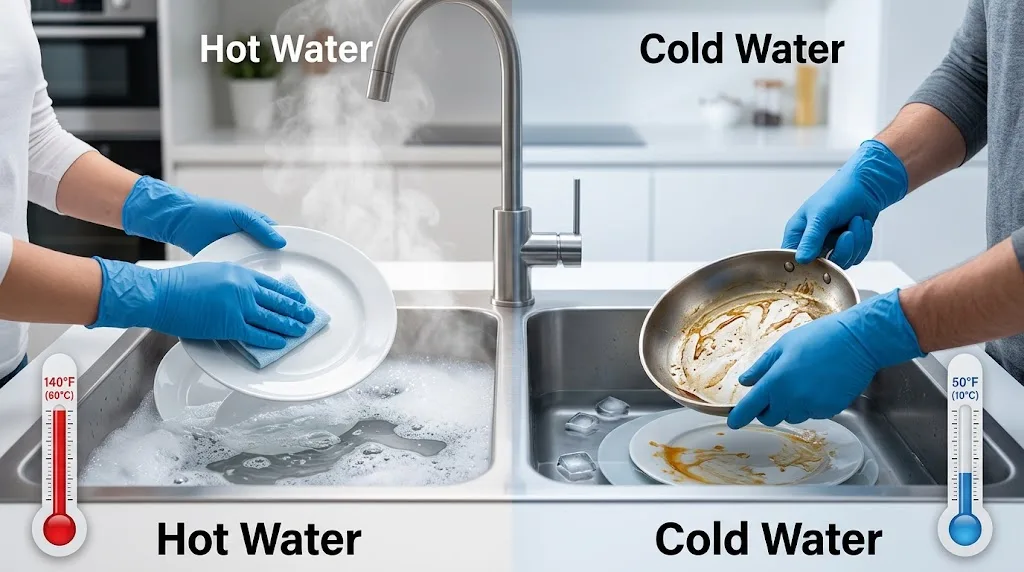
Standing at the sink with a greasy plate, it seems obvious that hot water should work better. Cold water can leave fat looking cloudy and stubborn, while warm water seems to make the same mess disappear much more easily.
But temperature isn't doing all the cleaning.
Hot water can make some types of dirt easier to remove, especially grease and oily food. It can also affect how some detergents work. But cold water can still clean dishes when you use detergent and enough physical action to remove the food. And water that feels very hot to your hands isn't automatically hot enough, or in contact long enough, to sanitize a dish.
So the simple answer is that hot or warm water is generally more useful for greasy dishwashing, but hot water isn't the thing that makes dishes clean by itself. Cleaning depends on temperature, detergent, scrubbing and contact time working together.
Why hot water helps with grease
Grease is one of the biggest reasons hot water feels so much more effective at the sink.
Fats and oils behave differently as their temperature changes. Many become softer and less viscous when warmed, which makes them easier to move around and remove from a surface.
That's why a frying pan covered with cooled cooking fat can be much harder to wash than the same pan immediately after cooking.
Cold water can still remove the grease, but it doesn't give the grease the same help from heat. Instead, the detergent and the mechanical action from the sponge or brush have to do more of the work.
This is also why washing a greasy pan with cold water can sometimes feel as though you're simply spreading the grease around.
Warm water changes the physical state of the fat enough to make the cleaning process easier.
But the water isn't actually dissolving all that grease and carrying it away by itself.
The detergent is doing a lot of the work.
What dish soap actually does to grease
Dishwashing liquid contains surfactants.
A surfactant has parts that interact well with water and parts that interact with oily substances. These molecules help water spread across a dirty surface and interact with grease rather than simply sliding around it.
Dishwashing detergents contain mixtures of surfactants and other ingredients designed to remove food residues and grease.
Once detergent has loosened and surrounded oily material, the grease can be dispersed into the wash water and carried away during rinsing.
This is why saying that "hot water cleans dishes" leaves out an important part of the process.
Soap is not just an accessory to hot water. It is one of the main cleaning agents.
Temperature changes the conditions under which that chemistry takes place, while scrubbing physically helps separate the food and grease from the dish.
The cleaning result comes from the combination.
So does detergent work better with hot water?
Sometimes, yes.
Temperature affects the physical behavior of grease and can affect the performance of detergent formulations. Research on dishwashing detergents has found that formulation matters significantly, with some detergent systems maintaining good cleaning performance across relatively cool and warmer washing temperatures.
That means there isn't a universal rule saying that every detergent suddenly becomes ineffective when the water is cold.
Modern detergents are formulations designed to do a particular job. Some perform well at lower temperatures.
But temperature can still matter, particularly when the mess contains a lot of grease.
A useful way to think about the process is that the detergent is doing the chemical work while the water temperature can make the environment more favorable for that work.
Can cold water actually clean dishes?
Yes.
This is where the usual hot-versus-cold argument gets too simple.
A lightly soiled glass, plate or spoon doesn't necessarily require very hot water to become visibly clean. If there isn't much grease on the surface, detergent, rubbing and rinsing can remove the residue with cooler water.
Research into manual dishwashing has also shown that effective microbial reduction can occur under lower-temperature washing conditions when the overall washing and sanitizing process is appropriate. In one study, researchers tested contaminated plates, glasses, cutlery and trays under different dishwashing conditions and found substantial bacterial reductions under some low-temperature conditions when sanitizer was used.
That doesn't mean cold water is always equivalent to hot water.
It means water temperature is only one part of the cleaning process.
A person washing a lightly dirty plate with cold water, detergent and a sponge is doing something very different from someone rinsing a greasy frying pan with cold water alone.
The first can work.
The second is likely to be frustrating.
Does hot water kill germs on dishes?
This is where another common assumption needs some care.
Hot water can kill microorganisms, but temperature alone isn't enough to say that a dish has been sanitized.
The amount of microbial reduction depends on factors including the temperature, how long the microorganisms are exposed to it, the type of microorganism and the material surrounding them.
In other words, there's a big difference between:
warm water that feels hot
and
water maintained at a controlled temperature for a sufficient amount of time.
Water around 60°C can kill many microorganisms under appropriate exposure conditions, but water at that temperature is already hot enough to burn skin. That's one reason ordinary handwashing shouldn't be treated as a heat-based disinfection process.
Professional dishwashing and sanitizing systems can use controlled temperatures and exposure times that aren't practical for someone standing at a kitchen sink.
So if the question is, "Should I make my sink water painfully hot because that will sterilize my plates?" the answer is no.
Cleaning and sanitizing are related, but they're different jobs.
What matters more than water temperature?
Imagine two people washing identical plates.
The first uses cold water, plenty of detergent and spends enough time scrubbing the surface.
The second uses very hot water but barely uses detergent and gives the plate a quick rinse.
The first plate can easily end up cleaner.
That's because dishwashing involves several variables.
Detergent
Detergent helps chemically loosen and disperse grease and food residues.
Mechanical action
Scrubbing with a sponge, brush or cloth physically removes material from the surface.
Contact time
Giving detergent and water time to work can make stubborn residue easier to remove.
Temperature
Heat can soften grease, change its flow properties and affect detergent performance.
Rinsing
The loosened food and detergent have to leave the dish rather than simply being moved around its surface.
Dishwashing research has repeatedly treated these factors as interacting parts of the process rather than reducing cleaning to temperature alone.
Why greasy dishes are different
Temperature becomes much more noticeable when the mess contains a lot of fat.
A drinking glass with a little juice residue is not a difficult cleaning problem.
A frying pan covered with cooled cooking oil is.
The grease can become thicker and more resistant to movement as it cools. Warm water helps soften it, while detergent helps separate it from the surface and keep it dispersed in the wash water.
That's why warm water is particularly useful for oily pans, plates and cooking utensils.
There are exceptions, though.
Some food residues behave differently.
Protein-rich foods such as egg can respond differently to heat, and certain cookware can also have temperature limitations. A very hot pan shouldn't automatically be hit with very cold or very hot water because sudden temperature changes can damage some materials.
For a pan with a mixture of grease and food residue, the useful approach may be to remove excess food first, use detergent, allow the mess to soak, and then wash with appropriately warm water.
Is very hot water better than warm water?
Not necessarily.
There's a point where making the water hotter stops being useful for ordinary hand dishwashing.
You don't need water hot enough to make your hands hurt.
The aim is to create conditions in which the detergent can work, grease is easier to remove and the washing process is comfortable enough that you can actually scrub the dishes properly.
Extremely high temperatures also introduce practical problems. They can increase the risk of burns and may not be suitable for every type of dishware.
For everyday handwashing, warm or comfortably hot water with detergent is a much more sensible combination than trying to make the sink as hot as possible.
When can cold water be useful?
Cold water isn't the enemy of dishwashing.
It can be useful for rinsing off certain residues, particularly when heat could make a particular food residue harder to handle.
Protein-based residues are one example. With foods such as egg, using cold water during the initial rinse can help prevent the protein from becoming more firmly set by heat.
Cold water is also perfectly reasonable for lightly soiled dishes when detergent and mechanical cleaning are doing most of the work.
And there's another simple consideration: energy.
Heating water takes energy. If a dish doesn't need warm water to be cleaned effectively, using cooler water can reduce that energy demand.
That doesn't mean every dish should be washed cold.
It means temperature should match the cleaning problem.
What about a dishwasher?
A dishwasher is a different situation because it controls several variables that are difficult to control by hand.
It controls water temperature, detergent concentration, spray action, washing time and rinsing.
Modern dishwasher detergents also contain combinations of surfactants, enzymes, builders and, in many formulations, bleaching agents. These ingredients are designed to work together with the machine's mechanical and thermal action.
Recent research on domestic dishwashers has found that lowering wash temperature can affect antimicrobial performance, although the effect depends on the detergent and the microorganism being tested.
That's one reason dishwasher temperature settings can't simply be translated into advice for someone washing dishes by hand.
A dishwasher can hold a controlled temperature for a controlled period.
Your hands usually cannot.
If your dishes are still greasy, don't just turn up the heat
If a dish remains greasy after washing, temperature may be part of the problem, but it isn't necessarily the only problem.
Check the basics first.
Remove large amounts of food before washing.
Use enough detergent for the job.
Give greasy dishes enough contact time.
Use a sponge or brush that can physically remove the residue.
Use warm water when you're dealing with substantial grease.
Rinse thoroughly.
For stubborn cookware, soaking can give the detergent more time to loosen the residue before you scrub it.
If a particular material has care instructions, follow those rather than assuming hotter is always better.
The goal isn't to find the hottest possible water.
It's to make the entire cleaning process work.
What a real HIAW test would need to measure
This question would make an excellent genuine HIAW experiment, but there is a big difference between planning that experiment and claiming that we already performed it.
A proper test shouldn't simply wash a few plates and decide which ones "look cleaner."
For a useful comparison, we'd want identical dishes or standardized test surfaces carrying the same amount and type of food residue.
Then we'd keep the other variables as constant as possible:
- Same detergent
- Same detergent amount
- Same sponge
- Same washing time
- Same scrubbing method
- Same amount of water
- Controlled water temperatures
- Same type and amount of food residue
The temperatures could be compared across cold, lukewarm and warm conditions.
The result could then be measured using more than eyesight alone.
Grease removal could be measured.
Remaining visible residue could be photographed under controlled conditions.
The amount of detergent remaining after rinsing could be assessed.
And bacterial reduction would require proper microbiological methods rather than simply assuming that a dish is sanitary because it was washed in hot water.
That would turn this from a general explanation into a genuine We Tested investigation.
Until that experiment is actually performed, it shouldn't be presented as one.
So, does hot water clean dishes better?
For everyday handwashing, warm or hot water is generally helpful, especially when you're dealing with grease.
But hot water isn't the whole cleaning process.
Dish detergent does much of the chemical work. Scrubbing provides mechanical action. Time allows the detergent to interact with the residue. Rinsing carries the loosened material away.
Cold water can still clean lightly soiled dishes when those other parts of the process are done properly.
And hot water shouldn't be confused with automatic sanitization. Water hot enough to reliably provide substantial microbial killing under controlled conditions is much hotter than most people should be putting their bare hands into at the sink.
So the useful rule is fairly simple: use warm water when grease makes the job harder, use detergent and mechanical action regardless of temperature, and don't assume that hotter automatically means cleaner.