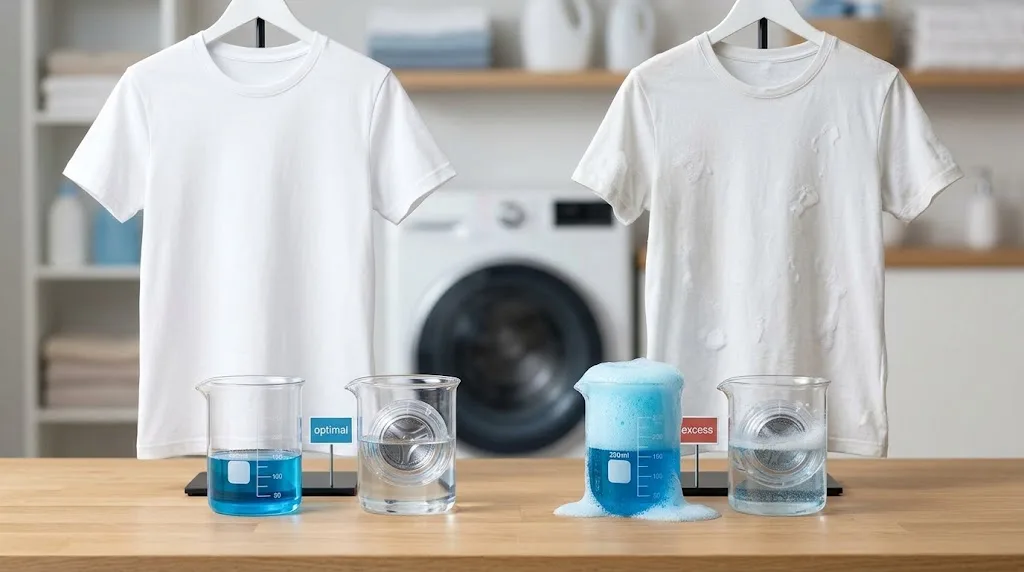
Pouring detergent into a washing machine is one of those chores people rarely think about very much. You look at the pile of clothes, judge how dirty it is, and add what seems like a reasonable amount.
If the clothes are especially dirty, it can be tempting to add a little more.
That seems logical. Detergent removes dirt, so more detergent should mean more cleaning.
Except that laundry doesn't really work that way.
Using more detergent than the load needs usually does not make clothes cleaner. Once there is enough detergent for the job, adding extra can make rinsing harder, leave residue behind, create excessive foam and, in some washing machines, interfere with the mechanical action that actually helps clean the clothes. The American Cleaning Institute specifically advises using the proper amount because both too much and too little detergent can produce worse cleaning than the optimal amount.
The interesting part is why.
What detergent is actually doing to your clothes
Laundry detergent isn't simply a stronger version of water.
Most detergents contain surfactants, molecules that help water interact with oily dirt and other soils that plain water doesn't remove very well. The molecules have one part that interacts with water and another part that is attracted to oils and grease.
During washing, surfactant molecules can surround oily material and form structures called micelles. Those structures help pull the soil away from the fabric and keep it suspended in the wash water so it can eventually be rinsed away.
Detergents can also contain enzymes, builders, bleaching agents and other ingredients that deal with different kinds of stains and water conditions. Builders and related ingredients can help prevent minerals in hard water from interfering with cleaning.
So there is a point at which adding detergent gives you more of the cleaning chemistry you need.
But there isn't an unlimited benefit from adding more.
Once the wash has enough detergent to do its job, the extra detergent still has to go somewhere.
That is where things start to go wrong.
More detergent can make rinsing harder
A washing machine isn't designed to remove an unlimited amount of detergent from the clothes.
The wash cycle uses a particular amount of water, agitation and rinsing. If you put substantially more detergent into the machine, you haven't necessarily given the washer a better cleaning solution. You've simply increased the amount of material that eventually has to be removed.
This is especially relevant with modern high-efficiency machines, which use less water than older washing machines.
LG says excessive detergent can create too much foam for a front-load washer to rinse thoroughly. Bosch similarly lists excessive detergent as a common cause of detergent residue remaining on clothes.
That residue can leave clothes feeling stiff, coated or strangely soapy even though they have just been washed.
It can also become part of a longer-term buildup problem.
Why clean clothes can start smelling bad
This is one of the stranger consequences of using too much detergent.
People sometimes respond to clothes that smell bad by adding more detergent. It seems reasonable: if the clothes smell dirty, use more cleaning product.
But detergent residue can contribute to the problem.
Good Housekeeping notes that excess detergent may remain in fabric and trap body oils, bacteria and other odor-producing material. Towels can be particularly revealing because their thick fibers hold onto water, oils and residue.
So you can end up with a cycle that looks something like this:
More detergent → more residue → harder rinsing → buildup in fabric → odors → more detergent.
That isn't inevitable with every washer or every detergent, but it explains why adding more product isn't a reliable solution to laundry that doesn't smell fresh.
The washing machine itself can also accumulate detergent residue. Appliance manufacturers warn that excessive detergent can contribute to buildup, excessive foam and unpleasant odors inside the machine.
What happens when there is too much foam?
This is where the idea that “more soap means more cleaning” gets particularly misleading.
Laundry detergent is not supposed to produce a giant mountain of bubbles.
In fact, many modern laundry detergents are designed to be relatively low-sudsing, particularly those intended for high-efficiency machines.
Excess foam can interfere with the way the machine moves water and clothing through the wash.
Miele says excessive detergent can produce excess foam that prevents laundry from moving freely in the drum, reducing washing and cleaning performance. Electrolux makes a similar point, noting that heavy foam can cause clothes to float rather than receive the mechanical action needed during the wash.
That mechanical action matters.
Cleaning isn't just a chemical process. The clothes have to move through water and detergent so that soil can be loosened and carried away.
A load covered in suds isn't necessarily a load being cleaned more aggressively.
Sometimes it's simply a load containing too much detergent.
So is half the recommended amount better?
Not necessarily.
This is where the answer gets more interesting than simply saying “less is better.”
The goal isn't to use as little detergent as possible.
The goal is to use the right amount for the particular load.
The American Cleaning Institute says both too much and too little detergent can leave clothes less clean than using the optimal amount.
Too little detergent can mean there isn't enough cleaning chemistry available for the amount of soil in the load.
Too much can create excessive foam and leave residue behind.
The useful range is somewhere in between, and that range depends on several things.
The amount you need depends on more than the number of clothes
Detergent dosing isn't simply a matter of counting shirts.
The amount recommended can depend on:
- Load size
- How dirty the clothes are
- Water hardness
- Detergent concentration
- Type of washing machine
- Type of detergent
- The manufacturer's dosing instructions
Whirlpool, for example, recommends adjusting detergent according to load size and soil level.
Concentrated detergents also change the calculation. Modern formulas can contain substantially more cleaning ingredients in a smaller amount of product, which is one reason filling an entire measuring cap by habit can result in using far more detergent than the load requires.
The American Cleaning Institute recommends following the detergent label and using the supplied measuring device rather than guessing.
What about hard water?
Hard water complicates the question.
Hard water contains minerals, particularly calcium and magnesium, that can interfere with cleaning chemistry. Detergents contain ingredients designed to deal with those minerals, but water hardness can affect how much detergent is needed.
The American Cleaning Institute explains that hard water can reduce cleaning effectiveness because minerals interfere with the cleaning process. It also notes that somewhat more detergent may be appropriate in hard-water conditions.
That does not mean “the harder the water, the more detergent you should pour in.”
It means the correct dose depends partly on the water conditions the detergent was designed for.
This is one reason blindly using a huge dose isn't a good substitute for following the detergent manufacturer's instructions.
Why towels are a good example
Towels make detergent problems particularly obvious.
A towel has a lot more absorbent material than a thin T-shirt. It holds water, oils, detergent and anything else that isn't fully removed during washing.
If too much detergent is used repeatedly, residue can accumulate in the fibers.
The result can be towels that feel stiff, don't absorb water as well as they used to, or develop a musty smell when they become wet again.
Recent laundry guidance from Good Housekeeping and BHG both points to detergent buildup as one contributor to towel odor and reduced absorbency.
That can create another misleading situation.
A towel can come out of the washing machine smelling strongly of detergent and still not be particularly clean.
The smell is evidence that fragrance remains.
It isn't a measurement of how much dirt was removed.
Does more foam mean cleaner clothes?
No.
Foam is one of the easiest things to see during a wash, which makes it tempting to use it as a visual measure of cleaning power.
But foam and cleaning performance are not the same thing.
Surfactants are important to cleaning, but the amount of visible foam depends on the detergent formulation, water conditions, washing machine and amount of product present.
You can have a highly effective wash without seeing much foam.
And you can have far too much foam because someone added excessive detergent.
Some washing machines can even respond to excessive suds by changing how they operate, adding rinsing or extending parts of the cycle. Consumer Reports notes that excessive detergent can cause washing machines to add extra water and time to deal with excess suds.
So the bubble level in the door isn't a cleanliness meter.
What would happen if you compared half, normal and double detergent?
This is where the question becomes a particularly good experiment.
Imagine taking identical pieces of fabric and applying the same stains to each one. You use the same washing machine, the same water, the same cycle and the same detergent.
Then you change only the dose.
You could compare:
| Test | Detergent |
|---|---|
| A | Very small dose |
| B | Half the recommended dose |
| C | Recommended dose |
| D | Double the recommended dose |
The useful part wouldn't be simply looking at the clothes afterward.
You'd want to measure several things.
Stain removal: How much of the original stain remains?
Residue: Does the fabric feel coated or show visible detergent residue?
Odor: Does the fabric smell clean after drying, or does it retain detergent or musty odors?
Foam: How much foam develops during the cycle?
Rinsing: Does the machine appear to struggle with excess suds or require additional rinsing?
Fabric feel: Does the material feel soft and normal, or stiff and coated?
That would tell us much more than simply saying one load “looked cleaner.”
And it would give HIAW something most ordinary laundry articles don't have: a controlled comparison between detergent doses.
The test has one important complication
A proper test would have to control the water.
If the experiment were done using hard water, for example, the results could differ from an experiment performed with soft water.
The detergent formulation matters too.
A concentrated liquid detergent, a powder and a detergent pod aren't directly interchangeable simply because they occupy the same amount of space.
The washer matters as well.
A front-load high-efficiency machine uses a different washing system from many traditional top-load machines, and excessive detergent can behave differently depending on the machine's water level and mechanical action.
For that reason, a genuine HIAW test should document the detergent, washer, water conditions, load size, cycle, temperature and stain type rather than simply pouring different amounts into random loads.
What about very dirty clothes?
This is where people can easily misunderstand the “don't use more detergent” advice.
A heavily soiled load may legitimately call for more detergent than a small, lightly soiled load.
That's different from adding extra detergent simply because the clothes look dirty.
Whirlpool specifically recommends adjusting the amount according to load size and soil level.
And some stains need more than detergent.
A greasy food stain, grass stain or other stubborn mark may respond better to appropriate pretreatment or a detergent designed for that type of soil than to simply doubling the detergent in the washing machine.
Adding more of the same product doesn't necessarily solve a problem caused by the wrong cleaning method.
What is the right amount of detergent?
There isn't one universal number.
The safest starting point is the detergent manufacturer's recommended dose for your load, machine and water conditions.
Pay attention to the actual measuring instructions rather than filling a cap to the top out of habit.
The American Cleaning Institute recommends using the proper amount and following the product label, while appliance manufacturers repeatedly warn that excessive detergent can produce foam, residue and poor washing results.
If your laundry is coming out with white marks, a slippery or stiff feel, excessive fragrance, persistent odors or visible detergent residue, using more detergent is probably not the first thing to try.
It may be part of the problem.
So, does more laundry detergent make clothes cleaner?
Usually, no.
There is a useful amount of detergent for a given load. Once you've reached that point, adding more doesn't give the washing machine an unlimited supply of extra cleaning power.
Instead, the extra detergent still has to be rinsed away.
Too much can create excessive foam, interfere with the movement of clothes, leave residue on fabric and contribute to buildup inside the washing machine.
The best laundry isn't the laundry that contains the most detergent.
It's the laundry where the detergent, water, mechanical action, temperature, cycle and rinsing are working together properly.
And that leaves one part of the question worth testing for ourselves: how large is the difference between using too little, the recommended amount and substantially too much?
That's the experiment that could put numbers on the difference.