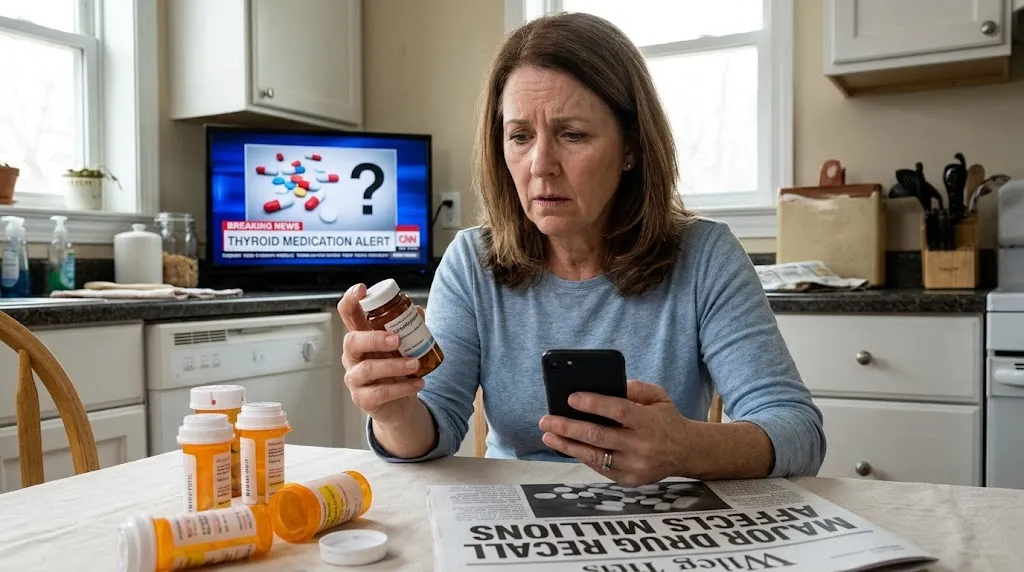
If you take thyroid medication every day, seeing headlines about a thyroid medication recall can make you reach for the bottle before you've even finished reading the story.
There is a real recall. But the phrase "thyroid medication recall" makes it sound much broader than it is.
The FDA has classified a recall involving one lot of Vitruvias Therapeutics Thyroid Tablets, USP 30 mg as a Class I recall, its highest risk category. The affected lot is 504950, with NDC 69680-166-00 and an expiration date of September 30, 2026.
The tablets were recalled because testing found they could be superpotent, meaning they could contain more thyroid hormone activity than intended.
That does not mean every thyroid medication has been recalled. It also does not mean every levothyroxine prescription is affected.
In fact, part of the confusion comes from the fact that there was a separate recall involving certain levothyroxine sodium tablets earlier in 2026.
So if you've searched "Is levothyroxine recalled?" and ended up worried about the bottle in your medicine cabinet, the first thing to do is identify exactly which product you have.
What exactly was recalled?
The Vitruvias recall applies to:
Thyroid Tablets, USP 30 mg
Manufacturer: Vitruvias Therapeutics, Inc.
Lot: 504950
NDC: 69680-166-00
Expiration date: September 30, 2026
The affected product was distributed nationwide in the United States between January 31 and September 30, 2025.
Vitruvias released 3,655 units from the affected lot and reported that 1,955 units were sold.
The recall began in August 2026 after testing indicated that the product could be more potent than intended. On September 22, the FDA classified the recall as Class I, the agency's most serious recall category.
That classification sounds alarming, but it needs to be understood correctly.
A Class I recall means the FDA believes there is a reasonable probability that use of the recalled product could cause serious adverse health consequences or death. It does not mean that everyone who took the product will become seriously ill, or that the entire thyroid medication supply is dangerous.
The recall still applies to a specific product and a specific lot.
Why was the medication recalled?
The problem is potency.
Thyroid hormone medicines have to deliver the intended amount of hormone. If a tablet contains substantially more hormone than expected, someone taking the prescribed dose may receive more thyroid hormone than their body needs.
The Vitruvias tablets were found to have the potential to be superpotent.
Too much thyroid hormone can push the body toward hyperthyroidism, which means the body is being exposed to more thyroid hormone than it should have.
Possible symptoms can include:
- Weight loss
- Heat intolerance
- Fatigue
- Nervousness
- Muscle weakness
- High blood pressure
- Chest pain
- Rapid heartbeat
- Abnormal heart rhythms
The FDA specifically identifies older adults, pregnant women and infants as groups that can face greater risks from excessive thyroid hormone, particularly with prolonged exposure.
That doesn't mean a person with one dose from a recalled bottle will automatically experience these effects. The risk depends on factors such as the amount taken, duration of exposure and the person's health.
Is this the same thing as a levothyroxine recall?
This is where the story gets confusing.
Not exactly.
The Vitruvias product is a natural thyroid preparation made from porcine thyroid glands. It contains both levothyroxine, or T4, and liothyronine, or T3.
That is different from a standard prescription labeled levothyroxine sodium, which contains synthetic T4.
The distinction matters because a search for "thyroid medication recall" can bring together several different products and recalls.
There was, in fact, another thyroid medication recall in 2026 involving Major Pharmaceuticals.
That recall involved certain lots of levothyroxine sodium tablets that were found to be potentially subpotent, meaning they might contain less medication than the label indicated.
So there are two different problems:
| Product | Manufacturer | Problem | Affected lots |
|---|---|---|---|
| Thyroid Tablets, USP 30 mg | Vitruvias Therapeutics | Potentially too potent | Lot 504950 |
| Levothyroxine Sodium Tablets | Major Pharmaceuticals | Potentially too weak | Multiple lots |
They are not the same recall.
This is one reason a broad search for "thyroid recall" can be misleading.
How do you know if your bottle is the recalled Vitruvias product?
This is the part that matters most if you have thyroid medication at home.
Check the information printed on the bottle or packaging.
For the Vitruvias recall, the identifying information is:
| What to check | Recalled product |
|---|---|
| Product | Thyroid Tablets, USP 30 mg |
| Manufacturer | Vitruvias Therapeutics |
| Lot number | 504950 |
| NDC | 69680-166-00 |
| Expiration | 09/30/2026 |
The lot number is especially important.
A bottle containing thyroid medication is not automatically part of the recall simply because it says "thyroid," "T4," or "levothyroxine."
The product information has to match the recalled lot.
If your bottle does not match the recalled product and lot, don't assume it is affected just because you saw a headline about a thyroid recall.
What if your medicine is levothyroxine?
Don't automatically assume that the Vitruvias recall applies to you.
Levothyroxine is one of the most commonly used thyroid hormone medicines, and there are many manufacturers and products.
The Vitruvias recall concerns a particular Thyroid Tablets, USP product and one specific lot.
There was also a separate 2026 recall of certain Major Pharmaceuticals levothyroxine sodium products because some lots could be subpotent.
That means the words on your prescription bottle matter much more than the phrase "thyroid medication recall" appearing in a headline.
Check the manufacturer, product name, strength, lot number and expiration date.
If you aren't sure what you're looking at, a pharmacist can identify the product for you.
What does "superpotent" actually mean?
The word sounds technical, but the basic idea is simple.
A medication has an intended amount of active ingredient.
If testing shows that a batch may deliver more active ingredient than intended, it can be described as superpotent.
For thyroid medication, that matters because thyroid hormones affect many systems throughout the body.
Too much thyroid hormone can increase the body's activity and put additional strain on the cardiovascular system. Someone taking excessive amounts over time may develop symptoms associated with hyperthyroidism.
This is different from a medication being contaminated or containing something completely unrelated.
The issue here is that the medication may be stronger than it is supposed to be.
What happens if thyroid medication is too weak?
This is where the separate levothyroxine recall becomes relevant.
If a thyroid hormone tablet is subpotent, the patient may receive less hormone than the label indicates.
For someone being treated for hypothyroidism, too little thyroid hormone can allow hypothyroid symptoms to return or become worse.
Those can include tiredness, feeling unusually cold, constipation, difficulty concentrating and other symptoms associated with an underactive thyroid.
The important point is that "too strong" and "too weak" are different problems.
The Vitruvias recall concerns potential superpotency.
The Major Pharmaceuticals levothyroxine recall concerned subpotency.
Neither should be generalized to every thyroid medication.
Should you stop taking your thyroid medication if you're worried?
Don't make that decision based on a headline alone.
The FDA's recall notice specifically says that patients currently taking the recalled Vitruvias product should not discontinue it without contacting their healthcare provider for further guidance and, if necessary, a replacement prescription.
That is especially important with thyroid hormone treatment because abruptly changing or stopping a prescribed medication can create its own problems.
If your bottle appears to match the recalled product, contact your doctor, pharmacist or other healthcare professional and tell them exactly what is printed on the bottle.
Have the product name, strength, lot number and expiration date available.
If you have symptoms such as chest pain, a very rapid heartbeat or other concerning symptoms, seek appropriate medical care rather than waiting for a routine prescription discussion.
Has anyone been harmed by the recalled Vitruvias tablets?
The FDA's original recall notice said that Vitruvias had not received reports of adverse events known to be related to the recall at the time of the announcement.
That is an important distinction.
A recall is issued because a product presents a potential risk. It does not mean the manufacturer or FDA has established that patients have already been harmed by every recalled product.
The FDA's Class I classification reflects the seriousness of the potential consequences if the recalled product is used, not a statement that everyone who received it has been injured.
Why is everyone suddenly searching for "thyroid medication recall"?
The timing is part of the story.
The Vitruvias recall was announced in August, but the FDA's later Class I classification gave the story another burst of attention.
Once news reports began describing the recall as the FDA's highest risk category, people who take thyroid medication naturally started asking whether their own prescription was involved.
That produces a second wave of searches.
Someone sees:
"FDA gives thyroid medication recall highest risk classification."
They then search:
"Is levothyroxine recalled?"
Another person searches:
"Is my thyroid medication recalled?"
Someone else searches:
"Vitruvias thyroid recall lot number."
Those searches can all end up in the same news cycle even though they don't necessarily refer to the same medication.
That's why identifying the actual product is more useful than simply asking whether "thyroid medicine" has been recalled.
The simplest way to check your bottle
If you're checking your medicine cabinet, start with these five things:
1. Product name
Look at exactly what the bottle says.
2. Manufacturer
Find the company listed on the label.
3. Strength
Check the dose, such as 30 mg, 25 mcg, 75 mcg or another strength.
4. Lot number
This is often the most useful piece of information when checking a recall.
5. Expiration date
Compare it with the information in the official recall notice.
For the Vitruvias recall, the combination to look for is:
Thyroid Tablets, USP 30 mg
Lot 504950
NDC 69680-166-00
Expiration 09/30/2026
If those details don't match, don't assume your medication is part of this particular recall.
So, is there really a massive thyroid medication recall?
There is a real and serious recall, but "massive thyroid medication recall" is an oversimplification.
The Vitruvias recall involves one lot of Thyroid Tablets, USP 30 mg. That lot contained 3,655 released units, with 1,955 reported sold.
It was distributed nationwide in the United States, and the FDA has now classified the recall as Class I because of the potential seriousness of taking a superpotent product.
But that is very different from saying that all thyroid medication, all levothyroxine, or all generic thyroid prescriptions have been recalled.
There was also a separate recall involving certain Major Pharmaceuticals levothyroxine sodium products earlier in 2026, which involved a different potency problem.
So if you've seen "thyroid medication recall" trending and immediately wondered whether your own prescription is unsafe, don't judge your bottle by the headline.
Check the actual product, manufacturer, lot number, NDC and expiration date.
For the Vitruvias recall, the number that matters is lot 504950.