A dead smart-lock battery is one of those problems you don't think much about until you're standing outside your own house.
Traditional locks have an obvious fallback. You use a key.
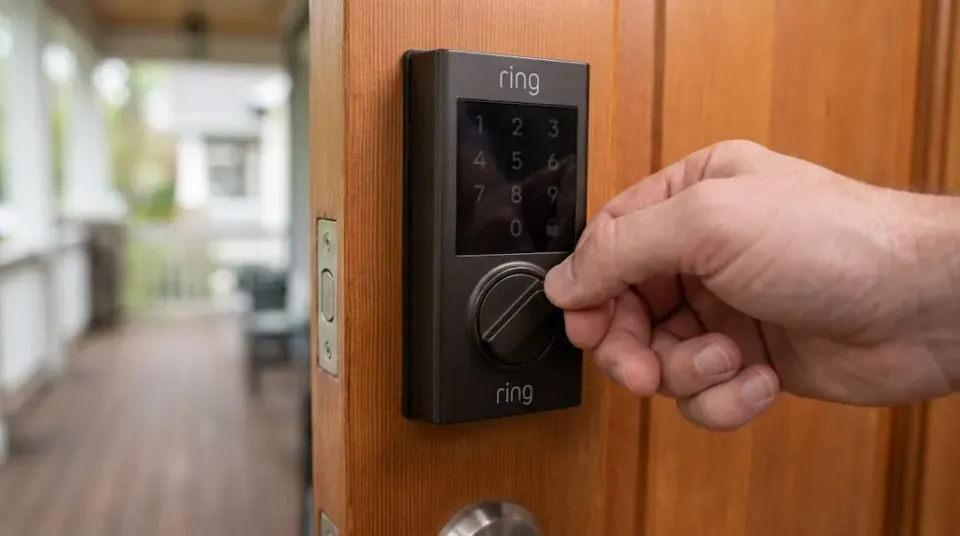
Smart locks have tried several versions of the same idea: a hidden physical key, a USB port, or contacts for an external battery. Ring is taking a different approach with its first smart lock. If the battery dies, you turn a small dial on the front of the lock by hand, and the movement generates enough electricity to bring the electronics back to life temporarily. (Ring / Amazon announcement)
The basic idea is surprisingly simple.
The dial turns a small generator. The generator converts the movement of your hand into electrical energy. That energy is stored briefly in a supercapacitor, which can then supply the lock's electronics with enough power to let you authenticate and unlock the door.
It isn't magic, and the hand crank isn't replacing the main battery.
It's an emergency power source.
What is the Ring Smart Lock?
The Ring Smart Lock is Ring's first smart door lock. It is planned for release in the United States in early 2027 at $249, subject to Federal Communications Commission authorization. It will come in black, silver and brass. (Ring / Amazon)
The lock is designed to fit a standard single-cylinder deadbolt and doesn't require additional wiring. Ring says it offers four ways to get inside: a fingerprint reader, a backlit touchscreen keypad, the Ring app and Alexa.
There is no traditional keyhole.
That makes the emergency power system more than a novelty. If there is no physical key to use when the battery is empty, the lock needs another way to wake up.
That's what the Power Dial is for.
What happens when the Ring Smart Lock battery dies?
Suppose the main battery has completely run down.
You arrive at the door and the lock isn't responding.
The Power Dial gives you another source of electricity. You turn it by hand several times. Inside the lock, that movement drives a small generator. The generator converts your mechanical effort into electrical energy.
The electrical energy is then used to charge a small energy-storage component, reported to be a supercapacitor.
Once enough energy has been collected, the lock can operate for a short period.
Ring describes the process simply as turning the crank a few times to power the lock back up. Reporting from interviews with Ring gives more specific figures, although they aren't completely consistent. GeekWire reported roughly five to 10 turns depending on how the dial is turned, while TechRadar reported roughly five to eight turns and about 10 to 30 seconds of emergency power. (GeekWire; TechRadar)
So the safest description right now is a few turns for a short emergency power window, rather than claiming a final exact number.
That distinction matters because the product has not reached consumers yet.
How does turning a dial make electricity?
The same basic principle is used by an ordinary electric generator.
Mechanical movement can be converted into electrical energy through electromagnetic induction. A generator uses movement between magnets and coils of wire to produce an electrical voltage. The U.S. Department of Energy describes generators as machines that convert mechanical energy into electrical energy using magnetic induction. (U.S. Department of Energy)
The Ring lock simply puts a very small version of that system behind the dial.
The power path looks roughly like this: your hand turns the Power Dial, the dial rotates a small generator, mechanical energy becomes electrical energy, that emergency energy is stored, the lock's electronics wake up, you authenticate, and the lock unlocks.
The generator doesn't create energy from nothing. Your hand supplies it.
That's also why you may feel resistance while turning the dial. Generating electricity requires mechanical work. The Department of Energy uses the same principle when explaining hand-cranked generators: the crank doesn't spin freely because energy is being converted from your movement into electrical energy. (U.S. Department of Energy)
What does the supercapacitor do?
This is the clever part of the system.
A supercapacitor is an electrical energy-storage device. Unlike a normal battery, which is designed to store a comparatively large amount of energy for longer periods, a supercapacitor can accept and release energy very quickly. The Department of Energy describes supercapacitors as devices that store electrical charge and notes their ability to charge and discharge much faster than typical batteries. (U.S. Department of Energy)
That makes a supercapacitor a good match for the problem Ring is trying to solve.
The lock doesn't need you to refill its main battery while standing outside.
It only needs enough energy to wake up the electronics and give you a brief opportunity to get through the door.
Think about the difference in scale.
The main battery has to power a smart lock for normal everyday use, potentially for months.
The emergency system only has to provide enough power for a short burst.
That's why the Power Dial can be useful without being powerful enough to replace the main battery.
Does the hand crank recharge the main Ring battery?
No, at least not according to the current reporting.
This is one of the easiest details to misunderstand.
The emergency mechanism is designed to provide a temporary burst of power. TechRadar reports that the hand crank charges a supercapacitor rather than refilling the main Ring battery pack. (TechRadar)
That makes sense from an engineering standpoint.
Imagine trying to refill a large swimming pool with a garden hose. You could do it eventually, but that's not what you want from an emergency system.
Ring only needs the crank to provide enough energy to run the lock briefly.
Once you're inside, the normal battery can be dealt with separately.
The main battery is a replaceable Ring battery pack, and Ring says the lock is designed to operate without additional wiring. GeekWire reports that the normal battery is expected to last about a year, although real battery life will depend on use and other conditions. (GeekWire)
Can you still use the fingerprint reader when the battery dies?
The emergency power system is intended to restore normal operation for a short period, rather than leaving the lock in a special mechanical-only mode.
Current reporting says the temporary power can be used for the lock's normal access methods, including the fingerprint reader, keypad and Ring app. GeekWire also reports that the lock indicates when the emergency power is ready. (GeekWire)
Ring's announcement lists four ways to get in: fingerprint, touchscreen keypad, Ring app and Alexa. (Ring / Amazon)
There is an important distinction here, though.
We shouldn't assume every remote function will work in exactly the same way during a completely dead-battery situation. The emergency power is being generated locally at the door, while remote features also depend on the lock's network connection.
The physical access methods are the part that matters most when you're standing outside.
Does the Ring Smart Lock need Wi-Fi?
Not in the way a typical Wi-Fi smart lock does.
Ring says the Smart Lock uses Amazon Sidewalk rather than relying on your home's Wi-Fi for its network connection. Sidewalk is a low-bandwidth network that can use nearby compatible Amazon devices to keep supported devices connected. (Ring / Amazon)
That means a Wi-Fi outage doesn't automatically make the lock lose all connectivity.
There is a catch.
Sidewalk coverage varies by location. Amazon specifically says coverage can vary and can be interrupted.
So there are really two different questions.
Can you physically unlock the door? The emergency power system is designed to handle the dead-battery problem locally.
Can the lock communicate remotely? That depends on its network connection, including Sidewalk availability.
Those aren't the same problem.
What happens if your home Wi-Fi goes down?
A Wi-Fi outage shouldn't be the same thing as a dead lock.
Ring designed the Smart Lock around Amazon Sidewalk, so the lock isn't simply waiting for your home router to provide its connection. Ring says remote locking, status updates and PIN syncing can happen through Sidewalk.
But the local unlock methods are still the most relevant ones at the door.
If you're physically standing in front of the lock, the fingerprint reader and keypad don't need you to connect your phone to the home's Wi-Fi before you can enter.
That's a useful separation between connectivity and access.
What happens during a power outage?
The lock is battery-powered, so a normal household power outage isn't automatically a dead-lock event.
The bigger issue is whether the lock's own battery has run down.
That's why Ring's emergency system is aimed at battery failure rather than at restoring power to an entire house.
If the lock still has battery power, the outage itself shouldn't remove the energy stored inside the lock.
If the battery is already empty, the Power Dial becomes the backup.
How long does the emergency power last?
This is one area where the final specification should be treated cautiously.
Ring's announcement says turning the dial a few times provides enough power to get the lock working again.
Current reporting gives a wider range. TechRadar says approximately 10 to 30 seconds, while other reporting describes roughly 30 seconds of normal operation. (TechRadar)
That may sound like a tiny amount of time.
It is.
But the lock doesn't need hours.
You need enough time to put your finger on the reader, enter a code or use the available access method and unlock the door.
The short runtime is actually part of what makes the design practical. The system is storing just enough energy for a brief, high-value job.
Does the Ring Smart Lock have a physical key?
No physical key appears to be part of the design.
That's one of the reasons the emergency power feature exists in the first place.
Traditional smart locks often keep a keyhole as a final backup. Ring's approach is to remove that fallback and replace it with locally generated electrical power.
The advantage is convenience.
You don't have to hide a spare key somewhere or carry one specifically for the smart lock.
The tradeoff is obvious too: the electronic backup system becomes a more important part of the product's design.
That's why the Power Dial is not just a weird extra feature. It is solving a problem created by removing the key.
Does the Ring Smart Lock work with Alexa?
Yes.
Ring says the Smart Lock works with Alexa and can be integrated with other Ring and Amazon devices. The Ring app can also be used to manage access, including giving people access at specific times. (Ring / Amazon)
The lock can also connect with Ring doorbells, cameras and alarms.
That means the Smart Lock isn't being sold as an isolated deadbolt. It's part of the wider Ring and Amazon smart-home system.
Does it work with Apple Home or Matter?
As of the announcement, Ring has not announced Apple Home or Matter support for the Smart Lock.
TechRadar specifically reported that neither was announced and noted that Ring's current approach is centered more heavily around Alexa. (TechRadar)
That could change before launch.
The product is still scheduled for early 2027 and hasn't yet received its required FCC authorization, so some details can still change before it reaches consumers. (Ring / Amazon)
For anyone building a smart home around Apple Home, this is therefore one of the specifications worth checking again when the lock actually goes on sale.
How long will the main battery last?
Ring says the main battery should last about a year, according to reporting from the company's announcement and founder interview. (GeekWire)
That's a very different job from the Power Dial.
The normal battery is responsible for everyday operation.
The Power Dial is the emergency reserve.
A simple way to think about the two systems is:
| Power source | Job |
|---|---|
| Main battery | Normal everyday operation |
| Power Dial | Emergency power after the main battery is depleted |
| Supercapacitor | Stores the short burst generated by the dial |
That separation is the key to understanding the whole system.
How much does the Ring Smart Lock cost?
The planned U.S. price is $249.
Ring says the lock is expected to become available in early 2027, with the exact availability dependent on regulatory authorization. It will be offered in black, silver and brass. (Ring / Amazon)
As of October 7, 2026, it isn't a normal retail product that you can simply buy and install.
That matters when reading specifications online.
A lot of the information currently available comes from launch announcements and interviews rather than a finished owner's manual.
So, does the dead-battery hand crank really make sense?
Yes.
The mechanism is not as strange as it first sounds.
A hand crank can turn a small generator. A generator can convert mechanical movement into electrical energy through electromagnetic induction. A supercapacitor can store that energy quickly and release it over a short period. The resulting power burst can wake the lock's electronics long enough for you to get inside. (U.S. Department of Energy)
The interesting part isn't that humans can generate electricity by turning something.
We've been doing versions of that for a long time.
The interesting part is choosing to use a tiny generator and a supercapacitor specifically for the moment when a smart lock's main battery has failed.
Ring is essentially saying: you don't need enough electricity to run the lock for another year. You need enough to get through the door.
That's a much smaller engineering problem.
And for a smart lock with no traditional keyhole, it may be one of the more sensible ways to solve it.
What we know, and what we don't know yet
As of the October 7 announcement, these details are confirmed or strongly reported.
Confirmed by Ring:
- $249 planned U.S. price
- early-2027 availability target
- Power Dial for emergency power
- fingerprint access
- touchscreen keypad
- Ring app access
- Alexa support
- Amazon Sidewalk connectivity
- standard single-cylinder deadbolt compatibility
- no additional wiring
- black, silver and brass finishes
Reported from interviews and launch coverage:
- roughly five to 10 turns may be enough to activate emergency power
- the emergency system uses a supercapacitor
- emergency operation may last roughly 10 to 30 seconds
- the main battery should last about a year
- the crank does not refill the main battery
Still worth confirming when the final documentation appears:
- exact crank count
- exact emergency runtime
- final battery specifications
- detailed installation instructions
- battery replacement procedure
- full Sidewalk requirements
- final smart-home compatibility
- final regional availability
- detailed security specifications
That's the part that will change this article from a launch explainer into an actual owner's guide.
For now, the basic mechanism is clear: the Ring Smart Lock doesn't try to make a dead battery last longer. It gives you a completely separate way to generate a small amount of electricity yourself, stores that energy briefly, and uses it to wake the lock long enough to let you in.
And that's why the little dial on the front matters so much.