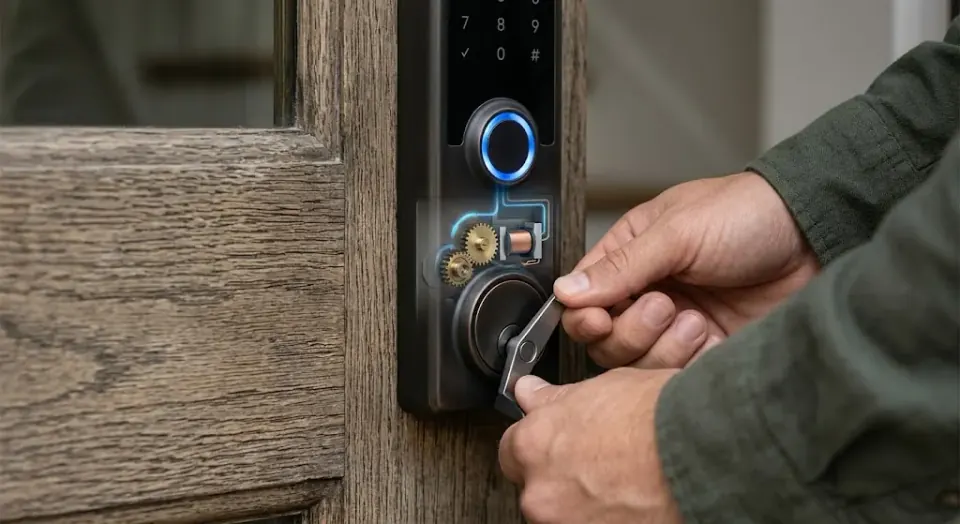
Ring's new Smart Lock has an unusual backup plan for the day its battery dies: turn a little dial by hand and make some electricity.
The idea sounds almost too simple. The lock has no working battery, yet a few turns of the dial can give its electronics enough power to wake up and let you inside.
Ring calls the mechanism a Power Dial. Reporting on the new lock says that roughly five to eight turns can charge a supercapacitor, giving the lock a short burst of power, around 10 to 30 seconds depending on the source and how quickly the dial is turned. (TechRadar)
The dial isn't magically creating electricity from nothing. Your hand is supplying the energy.
Inside the lock, a small generator converts the mechanical energy from your turning motion into electrical energy. That electricity is stored briefly in a supercapacitor, which can then release it quickly enough to run the lock's electronics.
The basic process is:
turn the dial → spin the generator → generate electricity → charge the supercapacitor → power the lock
That's the same basic physics behind hand-crank radios, emergency flashlights and many other small generators.
Turning the dial really does generate electricity
An electric generator is basically an energy converter.
You put mechanical energy into it by moving something. The generator converts that movement into electrical energy.
In a hand-crank device, your hand supplies the mechanical energy. The crank turns an internal mechanism, which moves magnets and coils relative to one another. That changing magnetic environment induces a voltage in the wire.
This is electromagnetic induction, the principle described by Faraday's law.
University physics demonstrations use hand-crank generators specifically to show this process. Turn the crank and the generator produces an electromotive force that can drive current through an electrical circuit. (Purdue Physics & Astronomy)
The important part isn't simply that a magnet is near a wire.
The magnetic conditions around the wire have to change.
That can happen by moving a magnet past a coil, moving a coil through a magnetic field, or rotating the components inside a generator. The result is the same basic conversion of mechanical motion into electrical energy.
What is happening inside the Ring lock?
Ring hasn't publicly described every component of the internal generator in the level of detail you'd find in an engineering schematic.
But reporting on the product describes a small motor being used to generate electricity when the Power Dial is turned, along with a supercapacitor that stores the generated energy. (TechRadar)
That arrangement makes sense because an electric motor and a generator are closely related machines.
A motor takes electrical energy and turns it into mechanical motion.
A generator does the reverse.
If you rotate the appropriate motor mechanism mechanically, it can produce electrical energy. The same electromagnetic effects that make current produce motion in a motor can be used in reverse to produce voltage from motion.
So when you turn the Ring dial, you're effectively doing a tiny version of what happens inside much larger generators.
You're supplying the rotation.
The machine does the electrical conversion.
Why does turning the dial produce more electricity?
Because you're doing work.
Your muscles are providing energy to the mechanism. The mechanism uses that mechanical energy to move the generator's magnetic and electrical parts.
Turn it slowly and gently and you're putting in relatively little power.
Turn it more quickly and with more force, and you can transfer energy into the generator faster, within the limits of the mechanism.
This is why a hand-crank generator can become noticeably harder to turn when it's powering something.
The electricity isn't free.
The energy has to come from somewhere, and in this case it comes from your arm.
Physics demonstrations with hand-crank generators make this especially clear. When the generator is connected to an electrical load, the person turning it has to supply the mechanical work that ultimately becomes electrical energy. (University of Iowa)
Why can only a few turns be enough?
This is the clever part of the Ring design.
The lock doesn't need to run for an hour.
It doesn't even need to recharge its main battery.
It only needs enough energy to wake up the electronics long enough for you to unlock the door.
Ring's main battery is intended to provide the normal long-term power. The hand crank is an emergency system for the moment when that battery has already run down. Amazon describes the Power Dial as a way to bring the lock back to life after the battery dies. (Ring / Amazon)
That makes the energy requirement much smaller.
Imagine trying to fill a swimming pool with a cup.
That would be a terrible way to fill the pool.
But if you only need enough water to rinse your hands, the cup suddenly makes perfect sense.
The hand crank works on the same principle. It isn't trying to replace the main battery. It's supplying a small amount of energy for a very specific job.
The supercapacitor is what makes the trick practical
The electricity generated by your turning doesn't have to be used at exactly the same instant.
The lock can collect it first.
That's where the supercapacitor comes in.
A supercapacitor is an energy-storage device that can accept and release electrical energy very quickly. It behaves differently from a conventional battery, but the basic idea is easy to understand: you put electrical energy into it, and it holds that energy until the circuit needs it. (University of Washington Clean Energy Institute)
Supercapacitors are particularly useful when you need a relatively quick burst of power rather than a large amount of energy stored for a long time.
That's a good match for the Ring lock.
You turn the dial several times.
The generator produces electricity.
The supercapacitor charges.
Then you stop turning and use the stored energy to operate the lock.
University demonstrations use the same generator-and-capacitor arrangement. A hand-cranked generator can charge a capacitor, which can then discharge its stored energy through a circuit. (University of Iowa)
Why doesn't Ring just use the hand crank to recharge the main battery?
Because the two jobs are very different.
A rechargeable battery is designed to store a substantial amount of energy and provide it over a much longer period.
The supercapacitor in this system only needs to hold enough energy for a short emergency burst.
That makes the supercapacitor a much better fit for the immediate problem Ring is trying to solve.
TechRadar reports that the hand crank doesn't recharge the lock's main battery. Instead, it charges the supercapacitor, which provides enough temporary power to operate the lock. (TechRadar)
That's also why a handful of turns can be useful without turning the lock into a miniature human-powered charging station.
You're not refilling the tank.
You're putting enough fuel in the engine to get through the next few seconds.
How much electricity can a hand crank actually make?
There isn't one universal number.
The output depends on the generator's design, the speed of rotation, the magnetic field, the coils, the gearing, the electrical load and how efficiently the system converts mechanical energy into electricity.
Small hand-crank generators used in emergency radios and educational equipment can produce enough electricity to run low-power electronics or charge a storage device. University demonstrations show the same basic generator principle being used to light bulbs and charge capacitors. (Purdue Physics & Astronomy)
But this doesn't mean a person can comfortably generate household-scale electricity by turning a crank.
Human muscles can provide useful mechanical power for a short period, but generators and electronics also have losses. Some of the energy becomes heat, sound and friction instead of useful electrical output.
That's why the Ring application is sensible.
The system doesn't ask a person to generate much electricity.
It asks them to generate enough electricity.
Those are very different requirements.
Why doesn't the lock stay powered after you stop turning?
Because the supercapacitor only stores a limited amount of energy.
Once the lock starts using that stored energy, the capacitor's charge falls.
Eventually there isn't enough available energy to keep the electronics operating.
That's exactly what the design is supposed to do.
Ring isn't trying to create a second battery hidden behind the dial. It's creating a temporary emergency power source.
Current reporting puts the available operating window at roughly 10 to 30 seconds after several turns, depending on the cranking conditions. (TechRadar)
That is plenty of time for the intended task: enter a code, use the fingerprint reader or otherwise unlock the door.
Is this the same electricity used in a normal power plant?
At the basic physics level, yes.
The scale is completely different.
A power plant can use steam, falling water, wind or another source of mechanical energy to rotate a large generator.
The generator still relies on electromagnetic induction to convert mechanical motion into electrical energy.
A hand-crank generator does essentially the same thing on a much smaller scale.
The energy source is different.
The generator is smaller.
The amount of electricity is vastly smaller.
But the underlying idea is the same: mechanical motion changes the magnetic conditions around electrical conductors, producing a voltage.
That's why the same principle can appear in something as large as a power station and something small enough to fit inside a smart lock.
Does turning faster always mean more electricity?
Generally, increasing the rate of change in the magnetic field can increase the induced voltage, which is one reason generator output depends strongly on rotational speed.
But a real device has limits.
The generator has resistance, friction and electrical losses. The electronics connected to it also have their own requirements.
So "turn faster" isn't a magic rule that produces unlimited power.
The generator has been designed around a particular range of motion and load.
Ring's reported five-to-eight-turn figure is therefore not a universal law for hand-crank generators. It's a characteristic of this particular system under its intended conditions. (TechRadar)
What makes the Ring idea different from a normal emergency crank?
The physics isn't new.
Hand-crank generators have been around for a long time. They're used in emergency radios, flashlights, educational equipment and other devices where electricity needs to be available without a wall outlet or a conventional battery. (Purdue Physics & Astronomy)
What's unusual about Ring's design is where the generator is being used and what it needs to accomplish.
Instead of asking a person to crank continuously to operate a radio or light, the lock only asks for a short burst of manual input when its main source of power has failed.
That changes the engineering problem.
You don't need a generator capable of producing sustained power.
You need a small generator, a fast energy-storage device and electronics that can operate long enough to complete one job.
The result is a much more practical use of hand-generated electricity.
So, can a few turns really power a smart lock?
Yes.
But the wording matters.
A few turns aren't producing enough electricity to replace the lock's main battery. They're producing enough mechanical energy to generate a small amount of electricity, which is stored temporarily and then released to power the lock for a short period.
That's why the idea works.
The process is not:
hand crank → unlimited electricity
It's:
hand crank → mechanical energy → generator → electrical energy → supercapacitor → short burst of power
Once you see the chain, the strange part disappears.
The Ring Smart Lock isn't making electricity from nowhere. You're doing the work with your hand. The generator converts that motion into electricity, and the supercapacitor holds enough of it to give the lock a brief second chance when its main battery has run out. (TechRadar)
And that is really what makes the little dial useful. It doesn't have to power the whole house. It only has to give the lock enough energy to let you get through the door.