
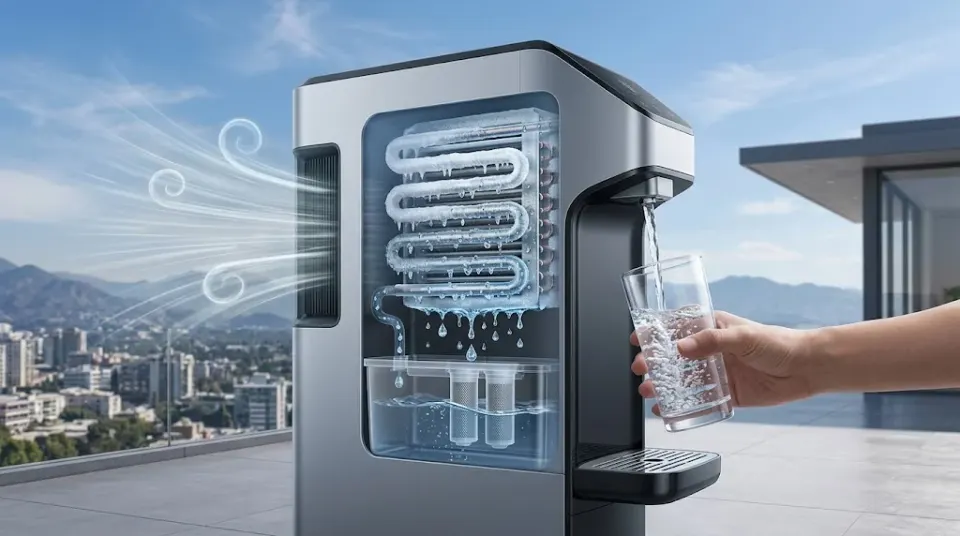
A glass of cold water can tell you a lot about how an air water generator works.
Leave that glass sitting in warm, humid air and droplets begin forming on the outside. The glass hasn't leaked, and the water hasn't come through the glass. Water vapor that was already in the surrounding air has cooled enough to become liquid.
An air water generator does essentially the same thing, except it controls the process inside a machine.
It pulls air in, removes some of the water vapor from that air, collects the resulting liquid water and then treats it before it reaches the drinking-water outlet. Most machines designed for homes and offices use refrigeration to cool the air below its dew point. Other atmospheric water harvesting systems use materials that capture water vapor and release it later.
So the machine isn't creating water from nothing.
It's harvesting water that was already floating around you as an invisible gas.
How much water is actually in the air?
There is more atmospheric water than most people realize. The U.S. Geological Survey estimates that about 12,900 cubic kilometers of water are present in the atmosphere at any given time. That's water vapor, clouds and other atmospheric moisture spread around the planet. (USGS)
But the amount available to an air water generator depends heavily on the local conditions.
Warm air can contain considerably more water vapor than cold air. Relative humidity matters too, although humidity by itself doesn't tell the whole story.
Consider two rooms at the same temperature.
At about 30°C and 60% relative humidity, the air contains roughly three times as much water vapor per kilogram of dry air as it does at 30°C and 20% relative humidity.
That difference matters enormously to an AWG.
A machine operating in warm, humid air has much more moisture to work with than the same machine operating in hot but very dry air. Research published in 2026 shows just how large the difference can become, with atmospheric water harvesting performance changing sharply across different humidity and climate conditions. (Next Energy, 2026)
This is one reason an advertised number such as "20 liters per day" needs some context. The number only means something when you also know the temperature, humidity, operating mode and energy consumption used to obtain it.
The first step is simply pulling air inside
An air water generator starts with a fan.
The fan draws surrounding air into the machine. That air normally passes through an air filter before reaching the part of the system that removes its moisture.
This serves two purposes.
The obvious one is to keep dust and airborne particles out of the machine.
The other is to control what reaches the water-producing surfaces. The machine is processing a stream of ordinary room air, so whatever is floating around in that air has to be considered as part of the system.
Once the air is inside, the machine has to get its temperature down far enough for water vapor to leave the air as liquid.
That's where the dew point comes in.
The dew point is the part that makes the water appear
Dew point is the temperature at which air reaches saturation with the amount of water vapor it contains.
You don't need to calculate it to understand what the machine is doing.
Think about that cold glass again.
Warm air touches the cold surface. The air immediately next to the glass cools. Once it reaches its dew point, some of the water vapor can no longer remain in the gas phase. It condenses into tiny liquid droplets on the glass.
An air water generator creates a controlled version of the same process.
Instead of cooling the outside of a glass, it cools a heat-exchange surface inside the machine.
When humid air passes over that cold surface, water vapor condenses on it.
The droplets grow.
They run down the surface.
They collect in a tray.
That's the water the machine is harvesting.
Why does an air water generator need electricity?
Because getting water out of air isn't just a matter of waiting for condensation.
The machine has to move heat.
Most commercial AWGs use a refrigeration cycle similar in principle to the system inside an air conditioner or dehumidifier. A compressor circulates refrigerant through the system. The refrigerant absorbs heat at the cold side and releases that heat elsewhere.
The air passing over the cold heat exchanger loses heat.
Its water vapor condenses.
The resulting water is collected.
But the machine also has to reject the heat it has removed from the air, along with the heat generated by the refrigeration equipment itself. Fans, pumps, controls and water-treatment components can require additional electricity.
That is why an AWG isn't simply a passive water collector.
The machine is spending energy to force a naturally occurring phase change to happen at a useful rate.
Research published in 2026 repeatedly identifies energy consumption as one of the main practical limits of active atmospheric water harvesting, particularly when humidity is low. (Results in Engineering, 2026; Next Energy, 2026)
Why humidity changes everything
Suppose an air water generator is running in warm, humid weather.
There is plenty of water vapor in every cubic meter of incoming air. The machine can therefore collect a useful amount of water without processing an enormous amount of air.
Now move that same machine into much drier conditions.
There is less water vapor available in every cubic meter of air.
The machine has to move more air to collect the same amount of water, and getting that remaining moisture to condense can require more cooling.
The result is usually lower water production and higher energy use per liter.
This is why relative humidity isn't just a minor specification on an AWG.
It is one of the things that determines whether the machine has a lot of water available to harvest or only a little.
A 2026 review of atmospheric water harvesting found that active condensation systems can produce tens of liters per day under humid conditions while production can fall to very low levels in arid conditions. The same review found large differences in energy consumption as climate conditions change. (Next Energy, 2026)
So when a manufacturer gives a maximum daily output, that figure shouldn't be treated as a universal amount of water the machine will make every day.
Temperature matters too
Humidity and temperature work together.
Warm air can hold more water vapor than cold air. But that doesn't mean "hotter is always better."
What matters is the actual amount of moisture in the air and how much cooling the machine has to provide to reach the conditions needed for condensation.
This is one reason an AWG can behave differently during the afternoon and at night even in the same location.
The air may have a different temperature and humidity level. The dew point changes with those conditions. The amount of water available to collect changes with them too.
The engineering literature describes this in terms of humidity ratio, dew point, heat transfer and the energy required to remove moisture from air. In practical terms, the machine's climate matters almost as much as the machine itself.
The water doesn't go straight from the coil into your glass
Condensation is only the first half of the job.
The water that forms on the cold surface still has to be collected and treated.
A typical system may send the condensate into a collection tray and then through some combination of sediment filtration, activated carbon, membrane filtration and disinfection. Some machines also use ultraviolet light, ozone or other treatment methods. The exact setup varies considerably from one machine to another.
This distinction matters because condensed water isn't automatically drinking water.
The fact that water came from the air doesn't guarantee that it is safe to drink.
Water safety depends on the entire system, including the collection surfaces, pipes, storage tank, treatment stages and maintenance.
The CDC points out that different water-treatment methods remove different contaminants. Filtration, ultraviolet treatment, activated carbon and reverse osmosis do different jobs, and no single treatment method should automatically be assumed to remove everything. (CDC)
The World Health Organization's 2026 drinking-water guidelines likewise treat water safety as a system-wide risk-management problem rather than something that can be established simply by looking at where the water came from. (WHO, 2026)
That is why a properly designed drinking-water AWG is much more than a cold coil with a bucket underneath it.
What happens to pollutants in the air?
Some people assume that because an AWG starts with air, the resulting water must be completely pure.
It isn't that simple.
Air contains dust, particles, gases and other substances. An AWG therefore has two different contamination questions to deal with.
The first concerns the air entering the machine.
The second concerns the water after it has condensed.
Filters on the air intake can reduce the amount of particulate material entering the system, while water-treatment stages deal with contaminants in the collected water. Different technologies target different substances.
This is also why the phrase "pure water from air" needs some care.
A machine can be designed to produce drinking water from atmospheric moisture, but the safety of that water depends on its treatment system and maintenance. It isn't a property automatically granted to every drop of condensed water.
Why does atmospheric water often contain few minerals?
Rain, groundwater and tap water pick up dissolved substances as they move through the environment.
Groundwater, for example, spends time in contact with rock and soil. That can add minerals to the water.
Water harvested directly from atmospheric moisture has followed a different path.
After condensation, it can contain relatively little dissolved mineral content compared with many conventional water sources. Some commercial systems therefore include a remineralization stage.
That stage isn't what creates the water.
It's part of conditioning the collected water for taste or other desired characteristics.
This is another reason two AWGs can produce water with different characteristics even though they both start with atmospheric moisture.
The collection process may be similar, but the treatment system can be very different.
Is an air water generator the same thing as a dehumidifier?
They're close relatives.
A conventional dehumidifier also pulls humid air across a cold surface, causes some of the water vapor to condense and collects the liquid water.
The basic physical process is essentially the same.
The difference is what the machine is designed to do with the result.
A dehumidifier's main job is to reduce humidity in a room. The condensed water is normally treated as a byproduct.
An air water generator is designed around the water itself. Its air intake, collection surfaces, water pathways, treatment system, storage and dispensing system are designed to turn the collected condensate into a usable water supply.
That distinction matters.
You shouldn't assume that water collected by an ordinary dehumidifier is suitable for drinking simply because it was produced through the same condensation process. Water treatment and sanitary design are separate questions from condensation.
Not every air water generator uses refrigeration
Cooling-based systems get most of the attention because they are relatively easy to understand.
But atmospheric water harvesting is a broader field.
Some systems use sorbent materials that capture water vapor from the air. Instead of cooling the entire incoming air stream until moisture condenses, a material takes up the water vapor and then releases it during a later regeneration step.
Researchers are investigating materials including silica-based desiccants, hygroscopic salts, hydrogels and metal-organic frameworks.
There are also systems involving radiative cooling and hybrid approaches that combine several methods.
The advantage of these approaches is that they can potentially operate under conditions where conventional cooling becomes less attractive. The trade-off is that the water still has to be released from the material, and that regeneration step can require heat or other energy.
A 2026 review of atmospheric water harvesting groups the main technologies into condensation, sorption, radiative cooling and hybrid systems and shows that each has different strengths depending on climate and operating conditions. (Applied Thermal Engineering, 2026)
So "air water generator" describes the purpose of the machine more than one single piece of hardware.
Why do manufacturers give such different water-production numbers?
This is one of the easiest things to misunderstand.
Imagine two machines.
One is advertised as producing 20 liters per day.
Another claims 30 liters per day.
That doesn't automatically mean the second machine is 50% better.
The machines may have been tested at different temperatures and humidity levels. One may have measured production under unusually favorable conditions. They may also use different definitions of output or energy consumption.
Water production depends on the moisture available in the incoming air, the amount of air the machine processes, the temperature of the heat exchanger, the efficiency of the refrigeration system, the airflow, heat rejection and other design details.
The 2026 research literature specifically points to inconsistent reporting of energy use and product-water quality as a problem when comparing atmospheric water systems. (Results in Engineering, 2026)
A meaningful comparison therefore needs more than a liters-per-day number.
You want the temperature.
The relative humidity.
The operating conditions.
The energy consumed.
And ideally the amount of water actually delivered as usable product water.
Can an air water generator work in a dry climate?
Physically, yes.
Practically, the question is how much energy and equipment are required to get a useful amount of water.
An air water generator doesn't need the air to be visibly wet. Even apparently dry air contains some water vapor.
The problem is that the drier the air becomes, the less water is available to collect.
At very low humidity, the machine may have to process large quantities of air to recover relatively small quantities of water. Cooling also becomes less favorable from an energy standpoint.
This is one reason researchers are interested in sorption-based systems and hybrid designs that can operate more effectively at lower humidity.
Atmospheric water harvesting can therefore be physically possible in a dry climate without necessarily being economically or energetically attractive there.
Those are two different questions.
Could an air water generator supply an entire house?
That depends on the machine, the household's water demand and the local climate.
A small countertop unit and a commercial atmospheric water system are not doing the same job.
A household also uses far more water than it drinks. Cooking, bathing, laundry, cleaning and toilets can consume vastly more water than drinking alone.
So a machine producing several liters or even several dozen liters per day shouldn't automatically be described as a replacement for a conventional household water supply.
It may be useful as a drinking-water source, a backup source or part of an off-grid system.
Whether it can provide most or all of a household's needs is an engineering and economics question that depends on the scale of the system and the environment in which it operates.
So, does an air water generator really make water from air?
Yes, but "make" is slightly misleading.
The machine doesn't create new water molecules.
It collects water that was already present in the atmosphere as water vapor.
The most common systems do this by cooling humid air below its dew point, causing the vapor to condense on a cold surface. The droplets are collected and then treated before the water is stored or dispensed.
The difficult part isn't proving that water exists in air.
It does.
The difficult part is collecting enough of it, using a reasonable amount of energy, and treating and storing it safely.
That's why humidity, temperature and system design matter so much.
An air water generator is essentially a controlled way of making the atmosphere give up some of the water it is already carrying. The machine supplies the engineering needed to turn an invisible gas into liquid water you can collect.