
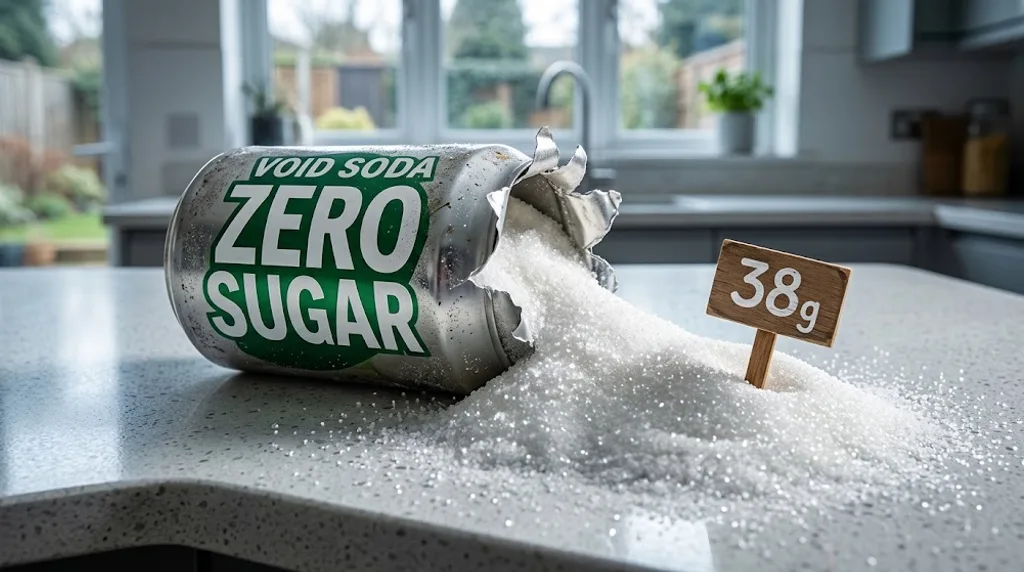
A can of soda doesn't have to look damaged, taste strange, or have anything visibly wrong with it for its label to be incorrect.
That's what makes the recent 7UP Tropical recall so unusual. Some cans labeled 7UP Tropical Zero Sugar were found to contain the regular full-sugar version of the drink instead. Each 12-ounce can of the regular Tropical formula contains about 38 grams of sugar, while the Zero Sugar version is formulated with no sugar. (7UP)
The affected product was part of a recall involving 3,240 cases, or 77,760 cans, distributed in Utah. The FDA classified the recall as Class II on September 29, 2026. The recall was initiated by Admiral Beverage Corporation on August 20. (Allrecipes)
So how does a zero-sugar can end up containing a full-sugar drink?
The short answer is that the liquid and the packaging are separate parts of the manufacturing process. If the wrong combination of product and packaging gets through the production and checking systems, the finished can can look perfectly legitimate while containing something different from what its label says.
The FDA has not publicly identified the exact production mistake behind this particular recall. But the manufacturing process helps explain how such a mismatch is possible.
What actually happened with the 7UP recall?
The recalled product was 7UP Tropical sold in 12-ounce cans packed in 12-packs.
According to the reported recall information, the outer cases were labeled as 7UP Tropical, while the cans inside were labeled 7UP Tropical Zero Sugar. The liquid inside those cans, however, was the full-sugar formula. The affected lot was identified by the code UT06176, with a best-by date of March 17, 2027, and UPC 0 78000 03798 2. The distribution listed by the FDA was Utah. (Allrecipes)
That's a little different from saying that somebody simply put a regular soda label on a can by mistake.
There are several pieces involved: the beverage itself, the can, the printed information on that can, the outer case, the production code and the records connecting that product to a particular production run.
Those pieces have to stay matched.
When they don't, a labeling recall can happen even though the beverage itself is a normal product.
Regular 7UP Tropical and Zero Sugar 7UP Tropical aren't the same drink
The two products are made differently.
The current 7UP product information lists regular 7UP Tropical as containing 38 grams of sugar per 12-ounce serving. Its ingredients include high-fructose corn syrup. The Zero Sugar version lists zero calories and zero grams of total carbohydrate, and uses high-intensity sweeteners instead of sugar. (7UP)
So this wasn't a case where a tiny amount of sugar somehow appeared inside an otherwise sugar-free drink.
The recall involved the wrong formulation being associated with the wrong label.
That's a much more ordinary manufacturing problem than it sounds.
How can the wrong drink get into the right-looking can?
Large beverage plants don't make one product from beginning to end in a single step.
A production line has equipment for preparing or supplying the beverage, moving it to the filling equipment, filling containers, sealing them, applying or printing identifying information, packing them into cases and moving the finished product into distribution.
Different products can run through related equipment.
That means production has to keep track of which formulation is being made and which packaging is being used at every stage.
For a zero-sugar soda, the filling system has to receive the zero-sugar formulation. The cans moving through the line also have to correspond to that product. The packaging and production records need to identify what was made and when.
If one of those pieces gets out of sync, the finished product can be wrong even though each individual part looks normal.
For example, a plant could theoretically have a production run in which the beverage formula and the can specification don't match. The precise cause could involve a setup or changeover mistake, packaging being supplied incorrectly, or another failure in the production controls.
That does not mean one of those things definitely happened in the 7UP case. The FDA's public information does not identify the exact root cause.
That's a distinction worth making because the recall tells us what was wrong, not necessarily which machine, employee or procedure caused it.
The label doesn't know what's inside the can
This is the part that makes the situation easier to understand.
A printed can doesn't chemically inspect the liquid that goes into it.
The artwork on the can says what product the can is supposed to contain. The filling equipment puts liquid into it. Other systems handle sealing, coding, packing and distribution.
Those processes are connected by manufacturing controls, but the printed label itself isn't checking the formula.
Think about two identical-looking bottles being filled on a production line. One is supposed to receive the regular drink and the other the zero-sugar version.
The packaging can be correct.
The liquid can be correct.
But if the wrong liquid is sent to the wrong packaging, the finished product can still be incorrect.
That's why food manufacturing relies on more than simply looking at the finished package.
How do factories keep different products from getting mixed up?
Production facilities use procedures and records to keep track of products as they move through manufacturing and distribution.
The exact systems vary between companies and products, but the basic problem is always the same: the plant needs to know what was made, when it was made, where it went and which products belong to the affected production run if something goes wrong.
This is where production codes and lot information become useful.
A lot code can identify a particular production group. The FDA describes traceability lot codes as identifiers used to connect a particular lot with records about where and how it moved through the supply chain. (U.S. Food and Drug Administration)
The point isn't that the code tells a consumer everything about a can.
It gives the manufacturer and regulators a way to narrow the problem down.
Instead of saying, "Every 7UP Tropical product might be affected," a company may be able to identify a particular production run, date, facility or distribution area.
That's why recalls often come with very specific codes.
Why wasn't every can of 7UP recalled?
Because the problem wasn't necessarily present in every 7UP Tropical product.
The FDA's enforcement system records product codes, lot information, dates and distribution information to help identify the affected product. (U.S. Food and Drug Administration)
In this case, the recall was tied to a particular lot and distribution area rather than every 7UP product sold everywhere.
That matters.
A recall isn't simply a company saying, "Something went wrong with this product, so remove every example of it from the planet."
The goal is to identify the affected portion as accurately as possible and remove that product from the market.
Smaller, well-defined lots can make that job easier.
What does the lot code actually do?
The string of letters and numbers printed on a package can look meaningless to a shopper.
For the manufacturer, it can be much more useful.
FDA guidance explains that lot codes and related traceability records help connect food to the businesses and locations that handled it. That information can help investigators determine the scope and source of a problem. (U.S. Food and Drug Administration)
That's why a recall notice may give you several identifiers instead of simply saying "7UP Tropical."
The affected 7UP product, for example, can be identified using the lot code UT06176, the UPC 0 78000 03798 2, and the March 17, 2027 best-by date. (Allrecipes)
Those details turn a vague warning into something that can be checked against an actual product.
How does a company discover something like this?
There isn't just one way.
A mismatch could potentially be discovered through production checks, quality-control procedures, records, complaints, testing or information that comes to light after products have entered distribution.
The important point is that the finished product has to be checked against what it is supposed to be.
In this case, the FDA record establishes that cans labeled as Zero Sugar contained the full-sugar beverage. It does not publicly explain which particular check first detected the problem or exactly how the mismatch occurred. (Fox Business)
That missing detail is worth keeping in mind when reading stories about the recall.
The headline tells you the result.
It doesn't necessarily tell you the failure point.
Why would the FDA call this a Class II recall?
"Class II" can sound like a rating of how bad a recall is, but it has a specific FDA meaning.
The FDA defines a Class II recall as one involving a product that may cause temporary or medically reversible adverse health consequences, or where the probability of serious adverse health consequences is remote. (U.S. Food and Drug Administration)
For this recall, the problem is undeclared sugar rather than contamination of the beverage itself. That's especially relevant to people who need to monitor their sugar intake.
The classification also doesn't mean that every person who drinks the product will become ill. It describes the level of health risk the FDA assigns to the recalled product under its recall classification system.
Why is 38 grams of sugar such a big deal here?
Because the person buying the drink was specifically given different information.
The regular 7UP Tropical formula contains about 38 grams of sugar in a 12-ounce serving. The Zero Sugar version is listed with zero grams of total carbohydrate. (7UP)
Someone choosing the zero-sugar drink might be doing so for several reasons, including controlling their overall sugar intake or following dietary advice.
The problem isn't that 38 grams of sugar is somehow dangerous to every person.
The problem is that the consumer wasn't expecting it.
That's what makes an incorrect label more than a cosmetic packaging mistake.
How do recalls find their way back through stores?
Once a problem is identified, manufacturers and regulators need to work backward and forward through the distribution chain.
Which production lot was affected?
Where was it shipped?
Which distributors received it?
Which stores may have received it?
Which packages can be identified?
The answers determine how broadly the recall needs to reach.
FDA recall notices commonly provide product descriptions, package sizes, UPCs, product or lot codes, dates and distribution information specifically so affected products can be identified. (U.S. Food and Drug Administration)
That is also why two products that look almost identical can have very different recall instructions.
The difference may be a few characters printed somewhere on the package.
What happens to the recalled soda?
The affected products are removed from the distribution chain and stores are notified as part of the recall process.
The FDA describes a recall as a firm's removal or correction of a marketed product that violates applicable requirements. Recalls can be initiated by the company itself, requested by FDA, or ordered under certain legal authorities. (U.S. Food and Drug Administration)
The recall remains a process rather than a single event.
Products have to be identified, located and removed or otherwise handled according to the recall strategy. FDA records can later show whether a recall is ongoing, completed or terminated. (U.S. Food and Drug Administration)
So, can a "Zero Sugar" soda really contain real sugar?
Yes.
But not because the zero-sugar formula somehow turns into ordinary soda.
In the 7UP case, the evidence points to a product and packaging mismatch: cans carrying a Zero Sugar label contained the full-sugar beverage. The regular Tropical formula contains 38 grams of sugar per 12-ounce can, while the Zero Sugar version contains none. (7UP)
The exact manufacturing error that produced the mismatch has not been publicly explained by the FDA.
What the incident does show is how many separate pieces have to stay synchronized inside a modern food-production system. The formula, containers, labels, production codes, cases, records and distribution information all have to describe the same product.
When one of those links breaks, a perfectly ordinary drink can end up inside a package that says something else.
And that's how "Zero Sugar" can end up containing 38 grams of sugar.