
If you've seen the latest news about the Amazon Prime settlement, you may have noticed that the instructions look different from the ones people were given earlier this year.
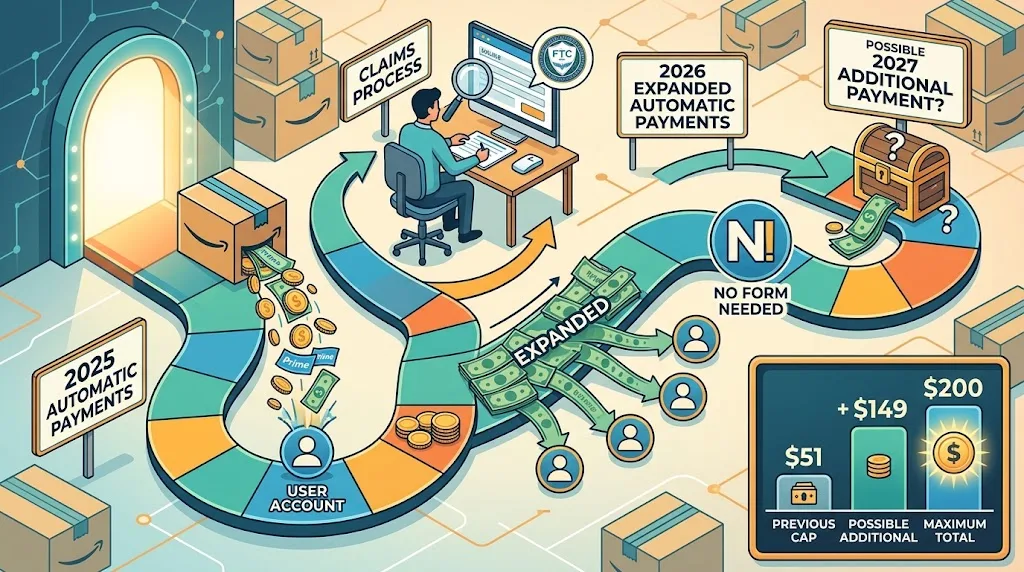
There used to be a claims process. There were emails and claim forms. Some eligible customers were told to submit paperwork.
Now the Federal Trade Commission says future payments under the revised settlement will be made automatically.
That's true, but there's an important detail behind the word automatically. It doesn't mean every Amazon Prime customer is getting $200. It means Amazon's claims administrator will use its records to identify eligible customers and send payments without requiring them to submit a new claim or fill out another form.
The change comes from a revised federal court order approved in September 2026. Starting October 1, Amazon is scheduled to begin another round of automatic payments to eligible Prime customers who used more than 10 but no more than 20 Prime benefits during a 12-month period. (Federal Trade Commission)
So, yes, the refunds are automatic now.
But who gets them, how much they receive, and what happens if they already got money are separate questions.
What changed in the Amazon Prime settlement?
The original settlement was reached in September 2025 after the FTC accused Amazon of enrolling consumers into Prime without their consent and making it difficult for some customers to cancel.
Amazon agreed to a $2.5 billion settlement. Of that amount, $1.5 billion was set aside for consumer refunds and $1 billion was a civil penalty. The settlement did not simply send $1.5 billion to every affected Prime customer. Instead, the money is being distributed through a court-approved process with different eligibility and payment stages. (Federal Trade Commission)
The first automatic payments went to consumers who met the original criteria and had used no more than three Prime benefits during a 12-month period after enrollment.
A later claims process covered eligible consumers who used no more than 10 Prime benefits. The deadline for submitting those claims was July 27, 2026. (Federal Trade Commission)
The September 2026 court order changed what happens to the remaining money.
Instead of waiting for each benefit-use group to be processed one at a time, Amazon can now move through several groups together. The next major group is people who used more than 10 but no more than 20 Prime benefits during a 12-month period. (Federal Trade Commission)
That's why October 1 matters.
Who can receive an automatic Amazon Prime settlement refund?
The revised FTC refund information says you must meet three basic conditions.
You must be a Prime customer in the United States.
You must have signed up through one of the enrollment methods covered by the case, or have tried to cancel Prime through the online cancellation process and been unable to complete the cancellation, during the relevant period from June 23, 2019, through June 23, 2025.
And you must have used no more than 20 Prime benefits during a 12-month period following enrollment. (Federal Trade Commission)
The covered enrollment methods included several Prime sign-up flows identified in the case, including the Prime decision page, shipping selection page, single-page checkout and Prime Video enrollment flow. (Federal Trade Commission)
That doesn't mean simply having had Amazon Prime at some point makes you eligible.
The settlement is tied to specific enrollment or cancellation circumstances and Prime usage.
What is happening on October 1?
October 1 is the beginning of another automatic payment stage.
The court order says Amazon's claims administrator will begin issuing payments to eligible consumers who used between 11 and 20 Prime benefits during any 12-month period of Prime enrollment.
There is one particularly important detail: this October group excludes customers who were previously issued a payment from the consumer fund. (Federal Trade Commission)
The payments are not dependent on people discovering a new claim form.
The FTC says eligible customers don't need to file a new claim, respond to a notice or complete additional paperwork. Payments can be sent electronically through PayPal or Venmo, or by mailed check. (Federal Trade Commission)
So if you're waiting for this particular automatic payment, there isn't a new application sitting somewhere that you need to find.
Amazon's claims administrator is supposed to identify eligible people from its records.
Does that mean everyone gets $200?
No.
This is probably the easiest part of the story to misunderstand.
$200 is the maximum total payment under the revised process. It is not a guaranteed $200 refund.
The original payment phases had a $51 cap per eligible consumer. The revised order allows a later distribution of up to another $149 for certain consumers, bringing the total possible payment to $200. (Federal Trade Commission)
The amount someone receives depends on the settlement's payment process and their eligibility.
So a headline saying "Amazon is giving everyone $200" would be misleading.
The official information says eligible consumers can receive refunds of up to $200 in total.
Those are two very different statements.
What if you already received an Amazon Prime settlement refund?
This is where the extra $149 comes in.
The court order says Amazon will calculate how much of the required consumer redress has actually been accepted after the current payment rounds.
If less than $1 billion has been accepted by the end of March 2027, Amazon will make a pro-rata distribution from the remaining funds to eligible consumers who previously accepted a payment.
Those additional payments can total up to $149 per person, but the combined payments to an individual cannot exceed $200. (Federal Trade Commission)
So someone who already received $51 could potentially receive another payment of up to $149.
But that second payment isn't guaranteed.
It depends on how much of the settlement money has been accepted by consumers.
The court order says those pro-rata payments are scheduled to begin by the end of April 2027 if the required threshold has not been reached. (Federal Trade Commission)
What if you never filed a claim?
This is one of the stranger parts of the revised process.
Earlier in the settlement, some consumers received claim forms and were given a deadline to submit them. That deadline passed on July 27, 2026.
But the later payment process does not simply say, "You missed the form, so you're finished."
The revised order allows the claims administrator to issue payments to certain eligible consumers identified in Amazon's records even if they did not submit a claim form, provided they meet the applicable eligibility conditions and haven't already received a payment. (Federal Trade Commission)
That is why the current situation can look confusing if you compare an older article with the latest FTC information.
The rules changed.
An article explaining only the old claim process can now give a reader the wrong impression.
How will the Amazon Prime refund arrive?
The FTC says automatic payments can be sent electronically through PayPal or Venmo, or by mailed check. (Federal Trade Commission)
There is another detail worth knowing.
Payments don't necessarily sit around indefinitely waiting for you.
The FTC says payments expire 60 days after their issue date. The September court order also gives the October payment group until March 5, 2027, to accept its payments, after which unaccepted payments can be voided. (Federal Trade Commission)
So "automatic" doesn't mean "you never have to pay attention."
It means you don't have to apply for the payment.
If a legitimate payment is sent to you, you still need to accept it within the applicable period.
Is the FTC sending the Amazon refund?
No.
Amazon is administering the refund program.
The FTC has specifically warned that it is not contacting people about their Amazon refund. Someone calling, emailing or messaging you while claiming to be the FTC and offering to process your Amazon payment should therefore be treated with suspicion. (Federal Trade Commission)
The FTC also says neither it nor Amazon will ask you to pay money to receive a refund.
That's worth remembering because large settlement payments attract scammers.
A message saying you need to pay a fee to "unlock" your $200 refund is not part of the official process.
Why did the settlement change?
The original settlement was designed around a staged distribution process.
The first automatic group covered customers who used three or fewer Prime benefits. The claims process then covered eligible customers who used up to 10 benefits. The settlement's third phase was supposed to expand the automatic payments gradually if the required amount of money had not been paid out. (Federal Trade Commission)
The September 2026 order changed that process because moving from one benefit threshold to the next one at a time would take much longer.
The court-approved plan allows the claims administrator to process multiple groups together.
That is what opened the door to the October 1 payment round for people who used between 11 and 20 Prime benefits. (Federal Trade Commission)
So the new automatic payments aren't a brand-new lawsuit or a separate $2.5 billion settlement.
They're part of the existing Amazon Prime settlement.
The Amazon Prime refund timeline
The easiest way to understand the whole thing is to look at the payment stages.
September 2025: The $2.5 billion settlement was approved, including $1.5 billion for consumer redress and a $1 billion civil penalty. (Federal Trade Commission)
November 2025: The first automatic refund payments began going out to eligible consumers.
2026: Additional consumers went through the claims and payment process.
July 27, 2026: The deadline for submitting claims under the claims process passed. (Federal Trade Commission)
September 2026: A federal court approved the revised distribution plan.
October 1, 2026: Amazon begins the next automatic payment stage for eligible consumers in the expanded group, including those who used more than 10 and no more than 20 Prime benefits in a 12-month period. (Federal Trade Commission)
March 2027: The October payment group can have unaccepted payments voided after March 5. The settlement fund is also expected to be reconciled by the end of March. (Federal Trade Commission)
April 2027: If the required amount of consumer payments has not been accepted, pro-rata payments of up to $149 may begin for eligible people who previously accepted settlement payments. (Federal Trade Commission)
The FTC's current refund page says eligible customers should receive their refund by April 2027. (Federal Trade Commission)
So, are Amazon Prime settlement refunds really automatic?
Yes, under the revised settlement process, future payments are automatic for eligible consumers.
You don't need to submit a new claim or fill out another form to receive an automatic payment.
But there are three things the word "automatic" doesn't mean.
It doesn't mean every Prime customer qualifies.
It doesn't mean everyone receives $200.
And it doesn't mean every payment arrives on October 1.
October 1 is the date the next payment stage begins. The actual program continues into 2027, and payments can be issued through PayPal, Venmo or by check. (Federal Trade Commission)
The simplest way to look at the change is this: the settlement moved from a process where some consumers had to file claims to a later distribution system in which the administrator can identify additional eligible consumers from Amazon's records and pay them automatically.
If you're eligible, you don't need to pay anyone to get the money.
And if someone contacts you claiming they can unlock your Amazon settlement refund for a fee, that's not part of the official process. (Federal Trade Commission)