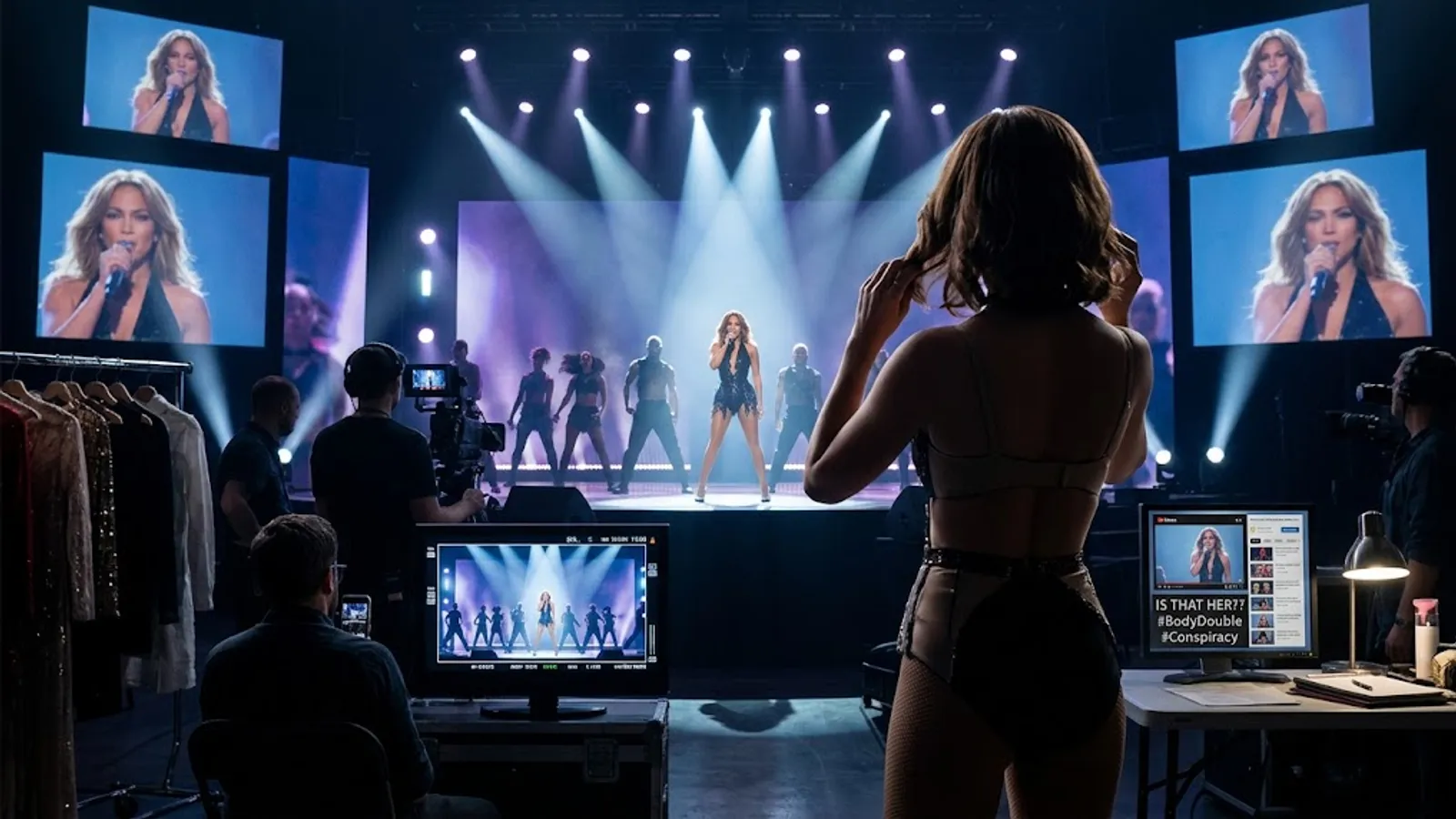
A movie star walks away from the camera. You see the back of their head, their body and the way they move, but never quite get a clear look at their face. In another scene, someone falls from a roof, dances professionally or appears in a shot where the actor doesn't need to be seen clearly.
Sometimes, that person isn't the actor.
Body doubles are real. Film and television productions have used them for decades, and celebrities have openly talked about using doubles for particular scenes. Julia Stiles recently said she used a body double for many of the complex dance sequences in Save the Last Dance. Gloria Estefan has also described using a body double in her "Turn the Beat Around" music video while she was eight months pregnant.
But that doesn't mean the internet's other claim follows automatically: that celebrities regularly send lookalikes to appear as them at public events.
That's a much bigger claim, and it needs much stronger evidence.
What exactly is a body double?
A body double is a performer who takes an actor's place for particular shots when the actor's face isn't needed or when another performer is better suited to what the scene requires.
The reason can be practical.
Maybe the shot shows the actor from behind. Maybe the production needs someone with a particular physical skill. Maybe the actor doesn't want to perform a particular scene. Maybe the shot only shows a hand, a leg or another part of the body.
The double is selected to resemble the actor closely enough for the camera to maintain the illusion.
That doesn't necessarily mean the person looks identical to the celebrity.
Camera position, lighting, clothing, wigs, editing and the way a scene is framed all help hide the differences.
The audience isn't supposed to study the double's face. In many shots, there isn't a reason to show it.
Body doubles, stunt doubles and stand-ins aren't the same thing
These terms get mixed together online, but they describe different jobs.
A body double generally replaces an actor for specific shots where the actor's body can be used without showing their face clearly.
A stunt double is a trained performer who takes over for dangerous or highly physical action. That can include fights, falls, crashes and other stunts.
A stand-in has a different job again. A stand-in usually helps the production prepare a shot. They can take the actor's place while the camera, lighting and crew are being positioned, without appearing in the finished scene.
So when someone says, "That's the celebrity's body double," it matters what they mean.
A person helping set up a camera isn't secretly pretending to be the celebrity.
A stunt performer taking a dangerous fall isn't secretly replacing the celebrity's entire performance.
And a body double appearing in a shot where the actor's face isn't visible isn't evidence that the actor wasn't involved in the scene.
These are ordinary production techniques.
Why would an actor need a body double?
There are several reasons.
One is physical ability.
An actor may be able to convincingly play a dancer without being capable of performing every demanding dance sequence required by the story. Julia Stiles recently explained that she used a body double for many of the difficult dance sequences in Save the Last Dance. She had trained for the role, but the finished film didn't require every movement on screen to be performed by her.
Another reason is physical appearance.
Gloria Estefan recalled using a body double for wide shots in the 1994 music video for "Turn the Beat Around" because she was eight months pregnant at the time. The close-up shots could still feature Estefan herself, while the wider shots used the double.
There are also scenes involving nudity or simulated sexual activity where a production may use a body double under agreed conditions. Industry agreements specifically address the use of body doubles in these situations, including limits connected to the performer's consent.
Sometimes the reason is simply efficiency.
If the camera needs a shot of someone walking away, there may be little benefit in keeping the principal actor on set for every take.
Body doubles can be used in music videos too
This isn't limited to Hollywood movies.
Music videos often involve unusual locations, physical performances, underwater scenes, elaborate choreography and shots where the singer's face isn't visible.
There are documented examples of musicians using doubles for particular sequences. Gloria Estefan's "Turn the Beat Around" video is one example.
There are even current casting calls specifically looking for body doubles for music videos. One 2026 listing, for example, sought a performer who would mostly be filmed in silhouette.
So if you see a celebrity in a music video and discover later that another performer handled one particular shot, that isn't evidence of a secret identity swap.
It's just filmmaking.
How does the audience avoid noticing the difference?
The simplest answer is that the camera does a lot of the work.
Suppose a scene shows a celebrity walking toward a car.
The actor might be used for the close-up.
A double might handle the wider shot from behind.
The editor cuts between the two.
If the clothing, hair, lighting, movement and camera position match, your brain naturally treats both images as the same person.
A production can also use visual effects to combine performances. In some situations, the actor's face can be digitally placed over another performer's body.
This is one reason a body double doesn't necessarily need to be a perfect physical copy of the actor.
The production only needs the substitution to work for the particular shot.
So do celebrities use body doubles outside movies?
This is where the answer changes.
There is a big difference between using a double for a specific piece of filmed entertainment and sending a double to impersonate a celebrity at a public appearance.
The first is a documented production practice.
The second is a much bigger claim.
If a celebrity appears on a red carpet, accepts an award, gives a live speech or performs in front of thousands of people, saying "they looked different, so it must have been a body double" doesn't establish that a replacement actually happened.
There would need to be evidence showing that the person who appeared wasn't the celebrity.
That distinction became particularly clear in several viral stories during 2026.
What happened with the Shakira body-double claim?
After Shakira performed at the 2026 World Cup opening ceremony in Mexico City, social media users began claiming that the singer had been replaced by a body double.
People pointed to differences in her appearance, including her hair and the way she looked during the performance.
Euronews investigated the claim and compared images of Shakira from before the event with footage from the ceremony.
One useful detail stood out: a small scar on Shakira's forehead was visible in photographs taken before the World Cup and was also visible during the performance.
That doesn't mathematically prove someone's identity, but it is very different from simply saying, "She looks different."
Euronews found no evidence establishing that a body double had performed in her place.
Jim Carrey had a similar problem in 2026
Jim Carrey's appearance at the César Awards in Paris in February 2026 produced another wave of body-double and clone speculation.
The reason was familiar.
People thought he looked different.
His hair was different. His appearance had changed. He had not been making constant public appearances, so viewers were comparing the person they saw with an older mental picture of him.
Online speculation quickly turned those differences into claims that someone else had appeared at the ceremony.
But the available evidence went in the other direction. The César organization said Carrey's appearance had been planned for months, and later fact-checking reported that he personally attended the ceremony.
Again, the interesting part isn't whether someone thinks he looked different.
People can look different.
The question is whether there is evidence that another person actually replaced them.
Why can a celebrity suddenly look like a different person?
There are plenty of ordinary reasons.
Age changes the face.
Hair changes the face.
Weight changes the face.
Makeup can change the apparent shape of the nose, jaw, cheeks and eyes.
Facial hair can make someone look dramatically different.
Different lighting can alter shadows around the eyes and cheekbones.
Camera lenses also change how faces appear. A close phone camera and a professionally shot portrait aren't necessarily going to produce the same proportions.
Then there are clothes, posture, expressions and even the angle at which someone holds their head.
Put several of those changes together and a familiar person can look surprisingly unfamiliar.
That doesn't require an impostor.
What would actually count as evidence of a body double?
This is the part that gets lost in viral videos.
A person looking different is not strong evidence by itself.
A blurry video isn't strong evidence either.
A screenshot showing a slightly different facial feature isn't enough.
A much stronger case would involve something independently verifiable.
For example, there could be:
- A production credit identifying a double.
- A performer publicly confirming that they doubled for the celebrity.
- The celebrity or production company confirming the substitution.
- Behind-the-scenes footage showing the double performing the relevant shot.
- Contract or production documentation that establishes the use of a double.
- Multiple independent sources confirming the same event.
- Evidence showing that the person physically present could not have been the celebrity.
The standard should depend on the claim.
If the claim is simply that a movie used a stunt double, that's easy to establish because stunt performers are part of normal production.
If the claim is that a celebrity secretly sent an impostor to accept an award, that's a very different allegation.
"Something looks off" isn't enough.
Why do body-double theories spread so easily?
Part of the problem is that the real thing already exists.
People know that actors have stunt doubles. They know movies use body doubles. They have seen behind-the-scenes footage of performers who look remarkably similar to famous actors.
So when a celebrity appears to look different, it's easy to connect two unrelated facts:
Actors use doubles.
This celebrity looks different.
Therefore:
That must be the double.
But the conclusion doesn't automatically follow.
The same thing happens with edited video. A short clip can remove all of the context that would normally make an appearance easy to understand. Add unusual lighting, a different hairstyle and a dramatic caption, and an ordinary event can suddenly look like evidence of something extraordinary.
The more familiar the celebrity, the easier this can become.
People have a strong mental image of someone they've watched for years. When the real person changes, the difference can feel more significant than it actually is.
Can you ever spot a body double?
Sometimes.
If the production deliberately shows the double's face, the difference may be obvious.
In other cases, the camera gives you clues. You might notice that a person's face is never shown during a physically demanding shot, or that an apparently continuous action has been constructed from several different angles.
But spotting a possible double isn't the same as identifying one.
Film editing is built around hiding the joins.
A viewer may watch a scene and assume one performer did everything from beginning to end when the finished sequence actually combines the principal actor, a stunt performer, a body double, visual effects and several different takes.
That's normal filmmaking.
TRUE? Do celebrities really use body doubles?
True, but with a big qualification.
Celebrities and actors really do use doubles.
They are used for stunts, physically demanding scenes, particular body shots, dance sequences, music videos, nudity and other situations where using the principal performer isn't necessary, practical or appropriate. There are documented examples from both films and music videos, and industry agreements explicitly account for body doubling.
What isn't established by that fact is the much larger idea that celebrities routinely send body doubles to secretly impersonate them at public appearances.
A celebrity looking different from an older photograph isn't proof.
A strange-looking video isn't proof.
A viral post isn't proof.
The useful question is always the same: what evidence shows that a different person actually appeared?
Body doubles are real.
The conspiracy attached to them is a separate claim.