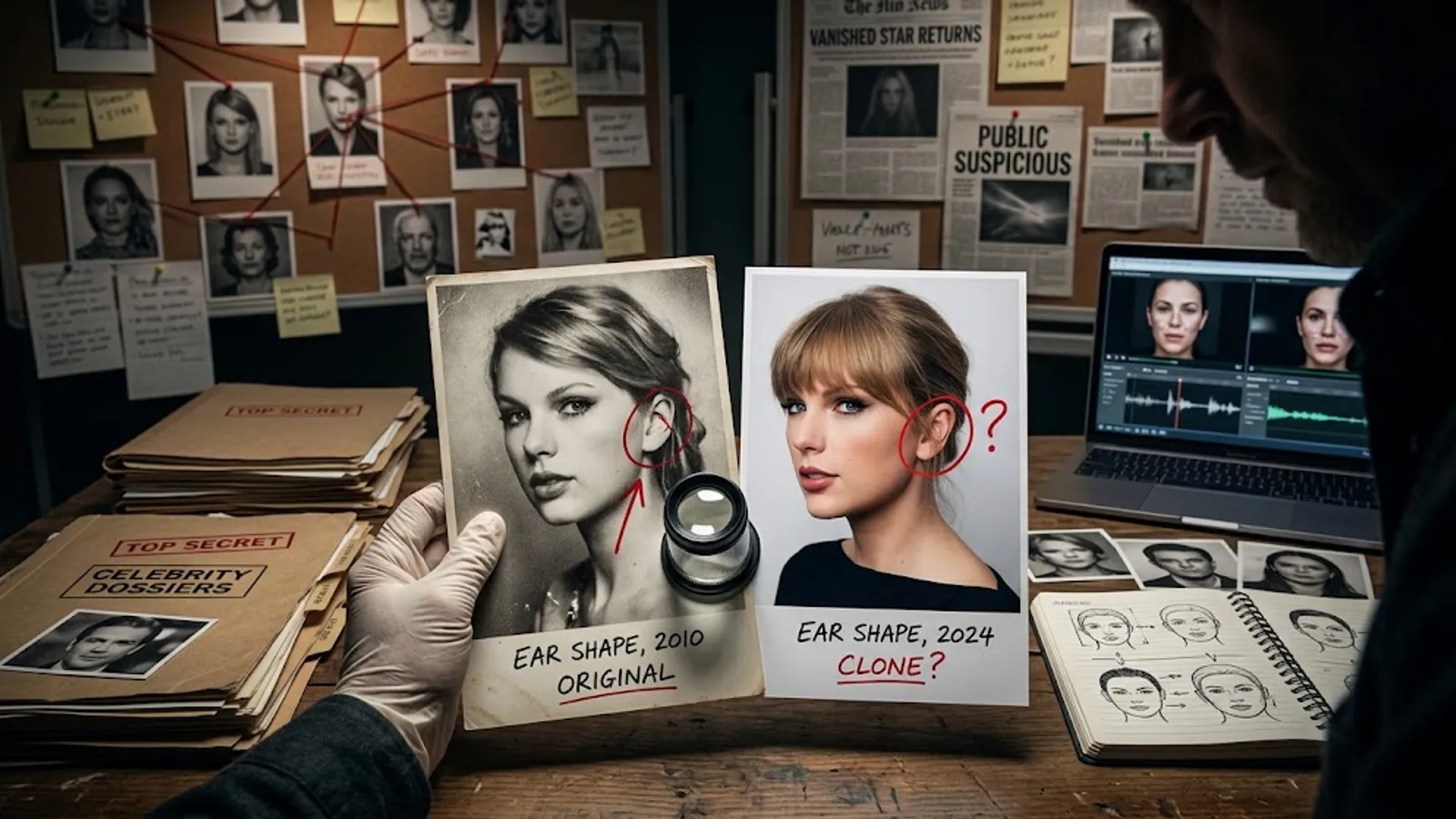
A celebrity can disappear from the public eye for a few years, return with a different hairstyle, a little more or less weight, a different face shape and a different way of dressing, and suddenly the internet has a theory.
Maybe they had plastic surgery.
Maybe they're aging.
Maybe the photograph was taken from an odd angle.
Or, according to one of the internet's favorite explanations, the person isn't the person at all.
They've been replaced.
The story has appeared around celebrities including Paul McCartney and Avril Lavigne, and it resurfaced again in 2026 after Jim Carrey appeared at the César Awards in Paris. Online posts questioned whether the man on the red carpet was really Carrey, with some claiming he had been replaced by a clone or body double. The rumor spread even though coverage of the event identified Carrey as the person attending the ceremony, and both the César organizers and representatives for Carrey publicly confirmed his attendance.
So, are celebrities actually being replaced by clones?
There is no credible evidence that celebrities are secretly being cloned and swapped for replacements. There is also no solid scientific evidence that a human has ever been successfully cloned. The U.S. National Human Genome Research Institute says claims of human cloning remain unproven and have not held up under scientific scrutiny.
But that doesn't explain why the photographs can sometimes look so convincing.
For that, you have to look at how cloning actually works, how faces change, how photographs distort appearance, and how our brains deal with a familiar face that suddenly looks unfamiliar.
A clone wouldn't be a ready-made replacement adult
The word "clone" creates a misleading picture.
People often imagine that scientists could take someone's DNA, produce another version of that person and somehow end up with an adult who looks exactly the same and can immediately step into their life.
That's not what cloning does.
A clone is a genetically copied organism. In the best-known animal cloning technique, scientists use genetic material from an existing animal to create an embryo, which then develops through pregnancy. It isn't an instant duplication machine.
Even naturally occurring identical twins show why identical DNA doesn't mean identical lives or perfectly identical appearances. Identical twins share essentially the same genome, but development, environment and gene expression can produce differences between them.
The National Human Genome Research Institute also says that there is no solid scientific evidence that anyone has cloned a human. Earlier claims of human cloning have not held up under scientific scrutiny.
So the basic premise already runs into a problem.
There is no demonstrated technology producing secret adult human clones that can simply be substituted for living celebrities.
What about body doubles?
This part is real, which is one reason the conspiracy can sound less strange than it first appears.
Body doubles exist.
Film productions use them when another person can perform a particular shot instead of the main actor. A double may be used for nudity, physical skills, dangerous work or shots where the actor's face isn't clearly visible.
That is very different from secretly replacing somebody in ordinary life.
A body double isn't a biological copy. It is another person hired for a particular purpose.
A stunt double might perform a dangerous action. A body double might provide a body for a particular shot. A stand-in may take an actor's place while lighting and cameras are being prepared.
None of that means the actor has been permanently replaced.
The distinction matters because online discussions often move from a true statement, "body doubles are used in entertainment," to a completely different claim, "therefore this person appearing in public must be a body double."
The second claim needs evidence of its own.
Why can a celebrity's face look so different?
This is where the story gets more interesting.
Faces aren't fixed photographs.
They change with age, weight, hairstyle, facial hair, makeup, cosmetic procedures, dental work, illness, sleep, expression and countless smaller factors.
Even before any physical change happens, the photograph itself can make a major difference.
Researchers studying face recognition have found that changes in lighting and viewpoint can substantially affect how faces are perceived and matched. A face photographed from one angle under one lighting setup can look dramatically different from the same face under another.
That matters enormously with celebrities because most people don't encounter them in person.
They encounter them through photographs.
And photographs aren't neutral records of appearance.
A camera captures one particular angle, one particular moment, one particular expression and one particular lighting arrangement.
Change all four and the same person's face can suddenly feel unfamiliar.
Lighting can change the face you're seeing
Look at a familiar person's face under a bright light directly in front of them.
Then look at them under a strong light from above.
Then from below.
The features haven't moved, but the shadows have.
Research on facial perception has repeatedly found that lighting direction affects how people recognize and interpret faces. Shadows change the apparent shape of facial surfaces, which changes the visual information the brain uses when identifying someone.
This becomes particularly noticeable with celebrities because red-carpet photography, television cameras, paparazzi photographs and old promotional pictures can all produce very different lighting conditions.
A comparison between two badly matched photographs can therefore create an illusion of a much bigger physical difference than actually exists.
Makeup can change perceived age
Makeup is another surprisingly powerful variable.
Research published in the British Journal of Psychology found that makeup changed perceived age in photographs. In the study, women in their 40s and especially their 50s were judged to look significantly younger when wearing makeup.
That doesn't mean makeup can turn one person into another.
It means relatively ordinary changes in contrast, skin appearance and facial emphasis can alter the way we judge a face.
Celebrities also have access to professional makeup artists, hairstylists, lighting crews and photography teams.
A photograph from a magazine shoot and a photograph taken unexpectedly outside a building aren't necessarily going to resemble each other very closely.
Yet people often compare them as if they were controlled scientific measurements.
They aren't.
Aging is even harder to account for when you're comparing old photographs
There is another problem with many celebrity clone theories.
The comparison is often between photographs separated by ten, twenty or thirty years.
People age.
Facial shape and skin texture change. Hairlines change. Hair color changes. Facial hair appears or disappears. Body weight changes. Muscles and soft tissue change. Cosmetic procedures can alter features.
Researchers working on automatic face recognition have long treated aging as a major source of variation because changes in facial shape and texture can make recognition more difficult.
Yet our mental image of a celebrity often gets stuck in the period when we first became familiar with them.
Someone who became famous at 25 may remain "25" in a fan's mental picture even when they're 45 or 55.
Then a new photograph arrives.
The person looks older.
The brain has to reconcile the new image with the old one.
"That's the same person, but older" is one possible explanation.
"This must be somebody else" is another.
The second explanation is much more dramatic.
Why does seeing two different photos feel like evidence?
Because the photographs really can be different.
That's the trap.
A person doesn't have to imagine a difference that isn't there. The difference can be completely genuine.
The mistake is what comes next.
Someone notices that a celebrity's nose looks different in two photographs. Someone else notices the eyes. Another person points out the ears, jawline, handwriting or smile.
Those observations are then collected together as though they all prove the same thing.
But noticing differences doesn't establish their cause.
A photograph can establish that two images look different.
It cannot, by itself, establish that two different people are responsible for those images.
That's a much bigger claim.
And the more unusual the explanation, the more evidence it needs.
The Avril Lavigne theory shows how this works
Avril Lavigne's supposed replacement is one of the best-known examples.
The theory claimed that Lavigne died in the early 2000s and was replaced by a look-alike named Melissa Vandella. The story circulated online for years and became one of the standard examples of celebrity replacement conspiracies. Recent coverage in 2026 shows that the rumor is still being discussed.
The supposed evidence includes differences in her appearance, handwriting and style.
But these are all things that can change without a person's identity changing.
More importantly, the existence of a collection of unusual-looking photographs isn't proof of a replacement.
A theory can take dozens of ordinary details and connect them into one extraordinary story.
Once that story exists, every new photograph can become another piece of "evidence."
That's how a rumor can become difficult to kill.
Jim Carrey shows how quickly the cycle can restart
In February 2026, Jim Carrey appeared at the César Awards in Paris.
His appearance prompted a new wave of online speculation that he had been replaced by a clone or body double. The discussion focused heavily on how different he appeared from the version of Carrey many people remembered from earlier in his career. Contemporary coverage described the same pattern seen in older celebrity clone stories: an unexpected appearance, visual differences and rapid online speculation.
This is a useful example because nothing about the basic situation requires cloning to explain it.
Carrey is older than he was when many of his most famous films were released.
He had also spent periods away from the center of Hollywood publicity.
Then he appeared at a major event and was photographed under professional red-carpet lighting.
That creates a large gap between someone's stored mental image and the new photograph.
A conspiracy fills that gap with a story.
Why do people keep finding "proof"?
Psychologists have studied conspiracy beliefs for years, and one recurring theme is our tendency to detect patterns and connections, particularly when an explanation gives confusing events a coherent story. The American Psychological Association describes pattern perception and the desire for security and belonging as factors that can contribute to belief in conspiracy theories.
Celebrity replacement theories have another advantage.
They are visually easy to investigate.
You can put two photographs beside each other.
Circle the ears.
Draw lines around the eyes.
Compare the jaw.
Zoom in on the hands.
Look at the handwriting.
Suddenly you have the appearance of an investigation.
But a collection of screenshots isn't automatically forensic evidence.
The comparison may not control for age, lighting, camera angle, lens characteristics, facial expression, makeup or image quality.
The person making the comparison may also begin with the assumption that a replacement happened and then look for details that support it.
That makes the investigation run backward.
Instead of asking, "What explanation best fits the evidence?" it becomes, "What evidence can I find for the explanation I already believe?"
Social media makes the pattern even stronger
A celebrity looking slightly different isn't particularly newsworthy.
A post saying, "This isn't the real Jim Carrey" is.
The second version gives people something to investigate, argue about and share.
That doesn't prove every person who discusses a celebrity conspiracy believes it literally. Some people share these theories as jokes, memes or entertainment. The Avril Lavigne story itself has complicated origins and has been described as an internet rumor that escaped the context in which it was created.
But once a claim spreads widely, later viewers may encounter it without knowing where it came from.
A joke becomes a rumor.
The rumor becomes a theory.
The theory gets presented as a discovery.
Then somebody makes a video comparing photographs, and the whole cycle starts again.
What evidence would actually prove a celebrity had been replaced?
This is probably the most useful question to ask.
If someone claims a celebrity has been secretly replaced, what would we expect to see if the claim were true?
Not just a different hairstyle.
Not a strange photograph.
Not a different expression.
Not a video where the person appears unfamiliar.
A serious claim of identity replacement would require evidence capable of distinguishing the person from a look-alike or unrelated individual.
That could include independently verified biological or forensic evidence, reliable records showing a genuine identity discontinuity, or credible documentation from people with direct knowledge.
And even then, "body double" and "clone" would be separate claims.
A body double is another human being.
A clone would involve a completely different biological claim.
Those shouldn't be treated as interchangeable.
Could a human clone look like the celebrity?
A hypothetical human clone would share the donor's nuclear DNA, but that still wouldn't make the clone an identical copy in the science-fiction sense.
Natural identical twins already demonstrate the distinction.
They share essentially the same genome, yet they can have distinguishable fingerprints and other differences.
A clone would also have to develop from an embryo and go through childhood.
It wouldn't emerge as a 45-year-old version of the celebrity with the same memories, experiences, scars, habits and learned behavior.
That alone makes the idea of secretly replacing an adult celebrity with a newly created clone very different from the way cloning is usually imagined.
So why does the theory feel believable?
Because it starts with something real.
The celebrity really does look different.
The photographs really are different.
Body doubles really exist.
People really can resemble one another.
Human cloning is a real scientific concept.
Social media really does spread strange claims.
And our brains really are capable of finding patterns in ambiguous information.
The problem comes when all of those separate facts are assembled into one explanation without evidence connecting them.
That's how a collection of ordinary observations can end up looking like extraordinary proof.
The verdict
False, based on the evidence available.
There is no credible evidence that celebrities are being secretly cloned and replaced.
There is also no solid scientific evidence that a human has ever been successfully cloned. The National Human Genome Research Institute says claims of human cloning have not been substantiated.
Celebrities can, of course, use body doubles for particular film or performance situations. That's an ordinary part of entertainment production, not evidence of a secret replacement system.
And a person's appearance can change dramatically without their identity changing at all.
Age, weight, makeup, hair, cosmetic procedures, expression, lighting, camera angle and image quality can all alter what a familiar face looks like. Research on face perception shows that lighting and viewpoint alone can have substantial effects on facial recognition.
The more interesting question, then, isn't why celebrities would need clones.
It's why a perfectly ordinary change in someone's appearance can sometimes feel like evidence that we're looking at an entirely different person.
And once you understand how easily photographs, aging and our own pattern-seeking minds can combine, the "proof" starts to look quite different.