
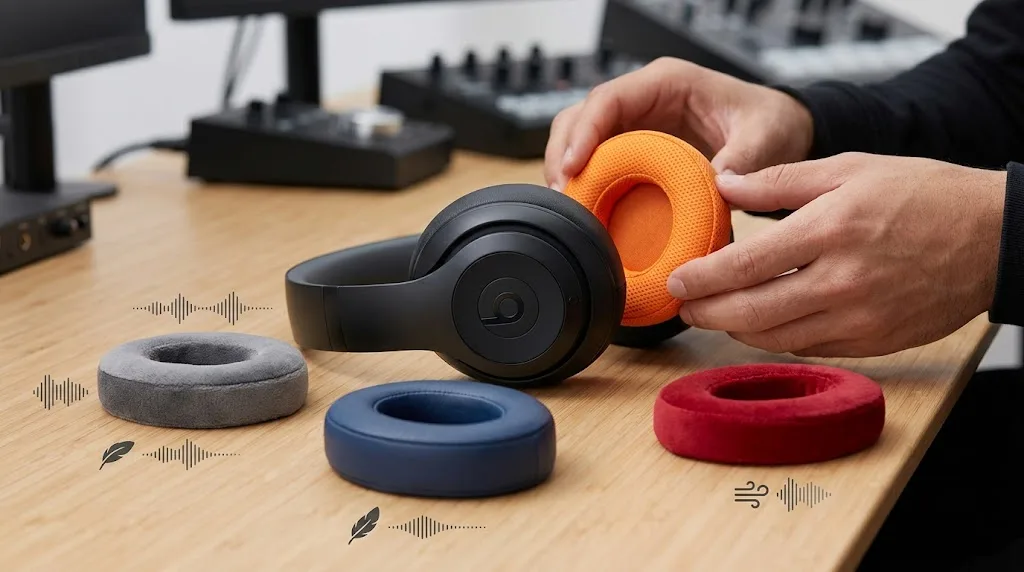
A pair of headphones normally comes with one set of ear cushions. When they wear out, you replace them. That's about as much thought as most people ever have to give them.
The Beats 360 is different. The ear cushions and the cushion on the headband can be removed and replaced, and Beats sells them in two different materials: Performance Knit and UltraPlush. The idea isn't only to let you change the color of the headphones. The two materials are designed around different kinds of use. (beatsbydre.com)
Performance Knit is the breathable option that comes with the headphones and is aimed at workouts and active use. UltraPlush has a smooth engineered-leather surface and is intended to feel more like a traditional premium headphone cushion during everyday listening. (beatsbydre.com)
So what actually changes when you swap them?
Quite a bit, although not in the way you might expect.
The biggest differences are how the cushions feel against your head, how they deal with moisture, how they seal around your ears, and how that seal affects the listening experience.
The two cushion materials are designed for different jobs
The Beats 360 comes with Performance Knit cushions. Beats describes them as plush memory foam wrapped in a breathable knit, with the material designed to provide a soft, airy feel and withstand active use. The alternative, UltraPlush, uses a smooth engineered-leather material around the memory foam. (beatsbydre.com)
That gives the two versions a fairly simple division of labor.
Performance Knit is the workout-oriented cushion.
The knit material is designed to let more air move around the surface and to handle moisture better. Independent testing has found that it feels more breathable and is better at moving moisture away from the skin during exercise. (SoundGuys)
UltraPlush is the everyday-oriented cushion.
Its smooth surface feels more like the leather-style pads found on many other premium over-ear headphones. Reviewers have generally found it softer and more comfortable for ordinary listening over longer periods. (WIRED)
So the first difference is fairly straightforward: you are changing the material that your head and ears are actually touching.
But that's only the beginning.
The ear cushions are part of the sound system
It is easy to think of an ear cushion as nothing more than padding.
It isn't.
An over-ear headphone works partly by creating a seal around your ear. The cushion presses against your head and closes off much of the space between the earcup and the outside world.
That seal affects what you hear.
Apple's own Beats 360 support information says the ear cushions should fit snugly around your ears because the seal affects the overall listening experience, Active Noise Cancellation and Transparency mode. (Apple Support)
This is why changing an ear cushion can make a headphone feel or sound different even though you haven't changed the speaker inside it.
The driver is still producing the same audio signal. But the space between the driver and your ear has changed.
A poor seal can let outside sound in and allow some of the headphone's sound to escape. A good seal gives the headphone a more controlled acoustic environment.
That's also why the fit of the headphones matters so much.
Can changing the cushions change the sound?
It can change how the headphones sound to you, but Beats has designed the system to keep the overall listening experience consistent between cushion types.
This is an important distinction.
The physical materials are different. They don't interact with your head in exactly the same way, and they can produce different seals. Independent testing has found noticeable differences between the two cushion types, particularly in sealing, comfort and moisture handling. SoundGuys, for example, found that UltraPlush created a tighter seal while Performance Knit was more comfortable and better at wicking moisture. (SoundGuys)
At the same time, Beats says the cushions are acoustically engineered and designed to form an optimal seal, while reporting on the product indicates that the headphones can identify which cushion material is attached and adjust acoustic processing accordingly. (beatsbydre.com)
That means Beats isn't simply saying, "Put whichever pad you want on there and hope the sound stays the same."
The headphone has been designed around the fact that the cushion is part of the acoustic system.
So if you notice a difference between Performance Knit and UltraPlush, that doesn't necessarily mean one cushion is objectively "better sounding." The physical seal, the material against your skin and the headphone's acoustic processing are all involved.
What about noise cancellation?
The same basic principle applies to ANC.
Active Noise Cancellation uses microphones and electronic processing to reduce unwanted external sound. But the headphone still benefits from physical isolation. The cushion helps close the gap around your ears before the electronics have to deal with the remaining noise.
That's why Apple specifically tells Beats 360 owners that a snug cushion seal helps provide the best ANC and Transparency performance. (Apple Support)
This is one reason the UltraPlush cushion can feel different from Performance Knit even if you aren't thinking about the material itself.
A cushion that seals differently changes the acoustic environment around your ear.
SoundGuys found the UltraPlush cushions produced a tighter seal and considered that useful for active noise cancellation, while Performance Knit was more comfortable and better suited to moisture-heavy situations. (SoundGuys)
So the cushion isn't simply sitting there between your skin and the plastic.
It is part of the headphone's interface with your ear.
Performance Knit makes more sense when you're sweating
This is probably the easiest difference to understand.
Over-ear headphones have always had a problem during exercise. A closed cushion sits against warm skin for a long time, and once you start sweating, the area around your ears can become hot and damp.
Performance Knit is designed specifically around that problem.
Beats describes it as breathable and suitable for fitness, while independent reviewers have reported that it feels more breathable during workouts and handles moisture better. (beatsbydre.com)
Tom's Guide's running test also found the Performance Knit cushions became damp during a long run and took several hours to dry, which is a useful reminder that breathable does not mean sweat-proof or permanently dry. (Tom's Guide)
The Beats 360 itself is IPX4 rated for sweat and water resistance, but that does not mean the headphones are waterproof. Apple specifically says they aren't designed for swimming, showering or other water sports. (Apple Support)
The removable cushion therefore solves a very ordinary problem.
You can take the cushion off after a sweaty workout instead of leaving the same damp material pressed against your head for the rest of the day.
UltraPlush is more suited to ordinary listening
UltraPlush goes in the opposite direction.
Instead of a breathable textile surface, it uses a smooth engineered-leather material. Beats describes it as being designed for extended listening, and reviewers have generally found it softer and more comfortable for everyday use. (beatsbydre.com)
That makes the modular system more practical than simply offering different colors.
You can have one cushion setup that makes sense for exercise and another that makes sense for sitting at a desk, travelling or listening at home.
WIRED's reviewer described switching to UltraPlush outside workouts and called Performance Knit the more suitable "sport mode." (WIRED)
The difference won't be identical for every person. Head shape, glasses, hair, skin contact and personal sensitivity all affect how an over-ear cushion feels.
But the basic design idea is clear.
One headphone can have two different physical interfaces.
The headband cushion is different
There are actually two kinds of cushions you can replace on the Beats 360: the ear cushions and the headband cushion.
They shouldn't be treated as though they do the same job.
The ear cushions sit around the ears and help create the acoustic seal.
The headband cushion sits against the top of your head. Its main job is comfort, pressure distribution, stability and appearance.
Changing the headband cushion isn't going to suddenly give the headphones more bass or stronger ANC.
Changing the ear cushions can matter acoustically because those cushions sit directly around the earcups and affect the seal.
Beats designed the two pieces to be removable in different ways. The ear cushions twist off and lock back into place, while the headband cushion pulls down and snaps back into the frame. (Apple Support)
That makes the system relatively easy to maintain.
Why make the cushions removable in the first place?
There are really four reasons.
First, workouts.
You can use the more breathable Performance Knit material when you're exercising.
Second, comfort.
You can switch to UltraPlush when you're sitting around listening for hours.
Third, cleaning and replacement.
A cushion that gets sweaty or worn doesn't have to remain permanently attached to a $350 pair of headphones. The removable design makes it easier to replace the part that receives the most physical contact. (WIRED)
Fourth, customization.
The cushion kits come in different colors and materials, so you can change the appearance of the headphones without buying another pair. Beats launched additional Performance Knit colors and UltraPlush options separately from the headphones themselves. (beatsbydre.com)
That last part is the most obvious feature, but arguably the least interesting one.
The useful part is that the same headphone can be adapted to different situations.
And if you're considering the headphones themselves, the variant with the pink Performance Knit cushions is the one this article's cushion discussion centers on:
Beats 360 — Cloud Over-Ear Headphones with Pink Performance Knit Cushions (Amazon)
Are the cushions difficult to change?
No.
The ear cushions rotate off and back on.
Apple's instructions say to rotate an ear cushion counterclockwise to remove it, then rotate it clockwise until it snaps into place when reinstalling it. The headband cushion simply pulls down to remove and snaps back into place. (Apple Support)
The headphones also give an audible tone when an ear cushion has been successfully attached while the headphones are powered on. (Apple Support)
That is a useful detail because the cushion isn't supposed to be treated like a loose piece of padding.
It needs to be properly attached.
Can you replace the cushions when they wear out?
Yes.
That's one of the more practical parts of the design.
Beats sells replacement Cushion Kits separately, and the kits contain the ear cushions and headband cushion. At launch, the standard U.S. price was $49.99, although Beats offered a limited introductory price of $9.99 in selected markets. (beatsbydre.com)
That means the modular design isn't necessarily something you use every week.
You can simply keep the original cushions until they become worn, dirty or unsuitable for the way you're using the headphones.
Then replace them instead of replacing the entire headphone.
So which Beats 360 cushion makes more sense?
It depends on what you're doing with the headphones.
| Situation | More suitable cushion |
|---|---|
| Running or gym workouts | Performance Knit |
| Heavy sweating | Performance Knit |
| Hot conditions | Performance Knit |
| Everyday listening | UltraPlush |
| Long desk sessions | UltraPlush |
| Softer traditional headphone feel | UltraPlush |
| Want easier replacement after wear | Either |
| Want to change the appearance | Either |
This isn't a case where one cushion makes the other obsolete.
They're solving different problems.
Performance Knit prioritizes breathability and active use. UltraPlush prioritizes a smoother, softer everyday feel. The ear cushion also affects the seal around your ears, which is why the choice can have consequences for isolation and ANC as well as comfort. (SoundGuys)
Are the swappable cushions actually useful?
Yes, but the useful part isn't really the ability to change colors.
The more interesting idea is that the same headphone can be physically adapted to the situation.
A normal pair of over-ear headphones asks you to accept one cushion material all the time. If that material gets hot during exercise, that's just part of owning the headphones.
The Beats 360 separates the two jobs.
You can have a breathable cushion for a workout, remove it afterward, and use a different material for the rest of the day.
That also gives the headphones a maintenance advantage. Ear cushions are one of the parts of an over-ear headphone that physically wear against your skin, hair and sweat. Being able to replace them means that deterioration of the cushion doesn't automatically mean deterioration of the entire headphone.
The design is therefore less about making the Beats 360 look customizable and more about making the part that touches your head replaceable.
That's a more useful feature.
The bottom line
The swappable cushions on the Beats 360 aren't just decorative accessories.
Performance Knit changes the physical experience of wearing the headphones, particularly during exercise, by using a more breathable textile surface designed to handle moisture. UltraPlush gives you a smoother, softer surface that's better suited to ordinary listening.
The ear cushions also form the seal around your ears, so changing them can affect the way the headphones isolate outside sound and how ANC performs. Beats has designed the system around that fact rather than treating the cushions as ordinary padding. (Apple Support)
The headband cushion is mainly about comfort and fit.
And because all of these pieces can be removed, cleaned or replaced, the Beats 360's unusual modular design has a practical purpose beyond letting you change the color.
That's what the cushion system actually changes: not the headphones themselves, but the way the headphones interact with you.