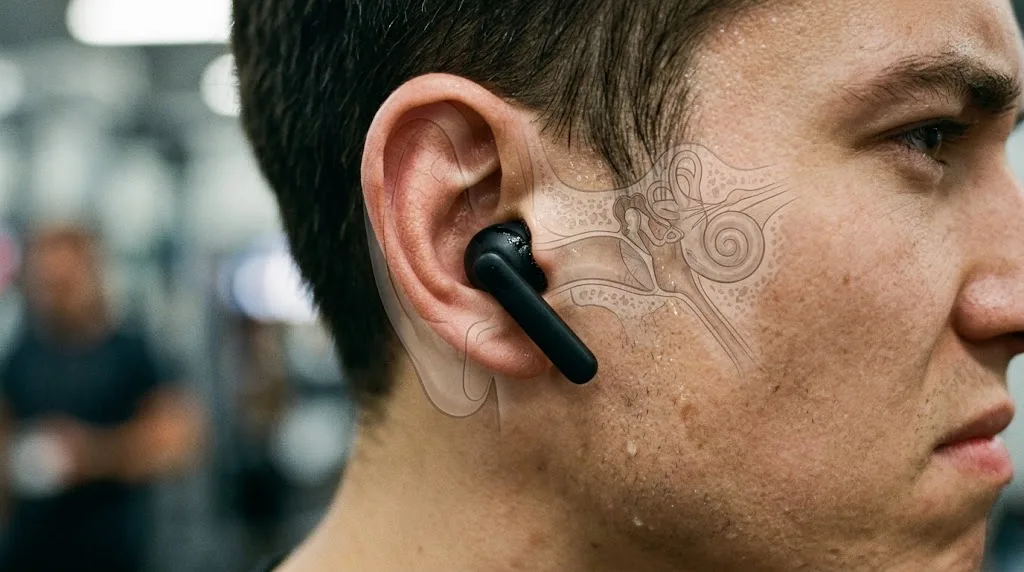
One earbud stays put all morning. The other starts working its way loose as soon as you walk outside. Then you adjust it, push it back in, keep listening, and a few minutes later it has started moving again.
It can feel as though the earbuds are badly designed. Sometimes they are. But often the problem is the fit between the earbud and your particular ear.
Your ears aren't identical, and they aren't shaped like neat little cylinders. The ear canal has bends, changes in width and an irregular three-dimensional shape that varies considerably from person to person. Research using medical imaging has found substantial differences in ear-canal geometry between individuals, and even the two sides of the same person don't have to behave exactly the same way.
That's why the same earbuds can feel completely secure in one person's ears and hopeless in someone else's.
An earbud stays in place through a combination of contact with the ear, friction, pressure, the shape of the earbud itself and, with some designs, support from the outer ear. When one part of that system doesn't match your anatomy, the earbud starts to move.
What actually keeps an earbud in your ear?
A silicone-tipped earbud usually relies on more than simply being pushed into the ear canal.
The tip makes contact with the canal walls. That contact creates friction and helps hold the earbud in position. A good fit can also create a seal, which matters for sound quality and active noise cancellation.
The outer part of the earbud can provide another source of support. Depending on the design, the housing may rest against parts of the outer ear, while wings or hooks can brace against the ear and stop the earbud from rotating or moving outward.
So there isn't one universal mechanism that keeps earbuds in.
A useful way to think about it is:
The earbud has to match the shape of the ear well enough that normal movement doesn't overcome the forces holding it there.
That explains why changing the tip can fix one person while another person needs a completely different earbud design.
Why one earbud can fit better than the other
This is one of the most frustrating parts of the problem.
You can put the same size tip on both earbuds and find that the left side feels perfect while the right side keeps slipping.
That's not necessarily unusual.
Studies of the external auditory canal show considerable variation in its size and shape. The canal also curves rather than running straight into the head.
The difference doesn't have to be dramatic. A small change in the angle, width or shape of the canal can change where an ear tip makes contact.
That's also why you shouldn't assume both ears need the same tip size.
Apple's own AirPods Pro guidance specifically says that different tip sizes may be needed for the left and right ears. Its fit testing is designed to check whether the tips are producing an appropriate seal, rather than assuming the same size works equally well on both sides.
So if one earbud keeps falling out, don't automatically blame the entire pair.
The problem may be on that side only.
Why the wrong ear-tip size can make earbuds fall out
People often assume that a loose earbud needs a bigger tip.
Not always.
A tip that's too small may not make enough contact with the ear canal. It can move around because there isn't enough grip.
But a tip that's too large can also cause trouble.
If the tip is pressing too hard against the canal, it can feel uncomfortable and may not seat properly. The earbud can also be pushed outward rather than settling into a stable position.
That's why “go bigger” isn't a universal solution.
The goal is not the largest tip you can tolerate. It's the size that gives you a stable, comfortable fit.
Apple's fitting instructions similarly recommend changing sizes when the seal isn't right, but also say to use a smaller tip if the larger one feels uncomfortable.
There is another clue you can use.
If the earbud stays in place but the sound becomes thin, especially in the bass, the problem may be the seal rather than the entire physical fit. If the earbud is actually rotating, creeping outward or dropping, you're dealing with a retention problem.
Those two problems can happen together, but they're not the same thing.
Why twisting an earbud can make it stay in
Some earbuds aren't designed to be pushed straight into the ear and left there.
Their shape works better when the earbud is inserted and then rotated slightly into a position where the housing and ear tip sit against the ear more securely.
That small rotation can change the contact points between the earbud and your ear.
It can also help the ear tip settle into the shape of the canal instead of sitting loosely at the entrance.
This is why two people can use the same earbuds and insert them in slightly different ways, with one person getting a much more stable fit.
The important part is not to force the earbud deeper than is comfortable. A stable fit should come from the geometry of the earbud and ear, not from pushing it as far into the canal as possible.
Why earbuds fall out when you walk or run
An earbud that feels perfectly secure while you're sitting at a desk is being tested very little.
Walking introduces repeated movement. Running adds much more.
Every step moves your head and body. Your jaw also moves while you talk, breathe heavily or eat. Those movements can slightly change the position of the earbud, and a tiny shift can become a gradual slide.
If the fit is already marginal, exercise exposes the problem.
Sweat makes this worse for some people.
Moisture can change the friction between the ear and the earbud, making a surface that was reasonably secure when dry become much easier to slide. Current earbud fit guides from Shokz and other manufacturers identify moisture and movement as common reasons a previously stable fit becomes unreliable during exercise.
That's why an earbud can survive an hour of sitting still but start slipping ten minutes into a workout.
The ear hasn't suddenly changed shape. The conditions around the fit have changed.
Why silicone tips and foam tips feel so different
Silicone and foam don't behave the same way inside the ear.
Silicone tips are flexible and spring back toward their original shape. Their performance depends heavily on their size, shape and how well they sit against the ear canal.
Memory-foam tips behave differently. They can compress during insertion and then expand to conform more closely to the surrounding space.
Shure, for example, describes its memory-foam sleeves as ear-conforming and offers them in multiple sizes.
That doesn't mean foam is automatically better.
A person who finds silicone slippery may prefer foam. Someone else may prefer the feel, durability or easier cleaning of silicone.
Foam can also change the overall feel of an earbud because it creates a different kind of contact with the ear.
The useful question isn't “Which material is best?”
It's “Which material gives this particular ear a stable and comfortable fit?”
Why some earbuds hurt even though they won't stay in
Pain and instability can seem like opposite problems.
You might expect an earbud that feels too tight to be impossible to lose.
But an earbud can press against one part of the ear while failing to make stable contact somewhere else.
The tip may be too large for the canal while the outer housing presses against the cartilage. Or the housing may simply be the wrong shape for the contours of your outer ear.
This is one reason repeatedly pushing an uncomfortable earbud farther in isn't a good solution.
The problem may not be a lack of pressure. It may be the wrong pressure in the wrong places.
Why some earbuds need wings or ear hooks
This is where the design of the earbud starts to matter as much as the tip.
A conventional in-ear earbud often relies heavily on the ear canal and ear tip for retention.
Wings and fins add another contact point. They can press against a part of the outer ear and help prevent the earbud from rotating or moving outward.
Ear hooks go a step further by physically wrapping around the ear.
That changes the retention system.
Instead of asking the ear tip to do almost all of the work, the earbud gets support from the outside of the ear as well.
This is particularly useful for running and other activities where movement repeatedly challenges the fit. Current running-focused guides commonly recommend hooks, wings or other external support when ordinary tips aren't enough.
If you've tried several tip sizes and insertion methods and the earbuds still keep falling out during exercise, that can be a sign that the design itself isn't a good match for your ears.
What about open-ear earbuds?
Open-ear earbuds take a completely different approach.
Instead of sitting inside the ear canal and relying on an ear-tip seal, they sit around or beside the ear and direct sound toward the ear.
Clip-style models use the outer ear as part of the support system.
That's why they can be useful for people who simply don't get along with conventional in-ear earbuds.
The trade-off is that open-ear designs don't give you the same kind of sealed fit as an in-ear earbud. Sound isolation and bass response can be different, and sound leakage may be more noticeable.
But if your main problem is that nothing you put inside your ear stays comfortable and secure, changing the design can make more sense than buying another pair of conventional earbuds and hoping the fit will somehow improve.
Why one pair works perfectly for someone else
This is probably the most useful thing to understand about earbud fit.
A review that says “these earbuds fit perfectly” tells you something about that person's experience.
It doesn't tell you that the same earbuds will fit your ears.
Ear-canal dimensions vary substantially across people. One study of adult ear-canal geometry found that measured areas could differ by factors of two to three at some locations.
The outer ear also differs in shape.
So when somebody says, “These never fall out of my ears,” and yours keep hitting the floor, neither of you necessarily has the wrong earbuds.
The physical match is different.
That's also why earbud fit is difficult to solve with a single “best size.”
There isn't one universal ear.
If your earbuds keep falling out, look at the pattern
The way the earbud fails can tell you quite a lot.
It falls out almost immediately: The tip size, insertion angle or overall earbud shape may not be giving you enough stable contact.
It slowly works its way loose: Friction, moisture, movement or a marginal seal may be allowing the earbud to rotate and creep outward.
Only one side falls out: The two ears may need different tip sizes or slightly different positioning.
It becomes worse when you sweat: Moisture may be reducing friction or changing the seal.
It stays in but sounds worse: The ear tip may have lost its seal even though the earbud hasn't completely fallen out.
It hurts and still feels unstable: The housing or tip may simply be a poor match for the shape of that ear.
Nothing seems to work: The retention system itself may be wrong for you. A wing, hook, clip or open-ear design may solve a problem that another silicone tip can't.
So what should you try first?
Start with the earbuds you already have.
Try the available tip sizes rather than assuming the one installed at the factory is the right one. Test each ear separately because your left and right ears may not need identical sizes. Apple explicitly recognizes this possibility in its AirPods Pro fitting guidance.
Make sure the tips and the parts of your ears they contact are clean and dry.
Then pay attention to how the earbud sits. If the design calls for a slight rotation, use it. Don't force it deeper just to make it feel secure.
If the problem appears mainly during exercise, test the fit under the conditions that actually matter. A pair that works at your desk but fails during a run isn't really solving your running problem.
And if you've tried different tips and positioning without success, stop assuming another size will magically fix it.
The earbud may simply be the wrong shape for your ear.
That's where wings, fins, ear hooks and open-ear clip designs become useful. They're not just accessories. They change how the earbud is physically supported.
A product example: the TOZO OpenEarRing
This is where the product question becomes relevant without turning the article into a generic buying guide.
The TOZO OpenEarRing uses a clip-on open-ear design rather than relying on a silicone tip sitting inside the ear canal. TOZO lists the earbuds at about 5.1 grams each and describes the design as an open-ear clip style, with up to 40 hours of total playback including the charging case. The manufacturer also lists IPX5 water resistance.
TOZO OpenEarRing Open Ear Earbuds
That doesn't mean it will fit every ear perfectly. A clip still has to match the shape and size of the outer ear.
But mechanically, it's solving a different problem.
If your conventional earbuds keep falling out because the ear tip cannot maintain a stable relationship with your ear canal, an open-ear clip removes much of that dependence on the canal altogether.
That's the interesting part of products like this.
The answer to “Which earbud stays in my ears?” isn't always a better ear tip.
Sometimes it's a different way of holding the earbud in place.
The full product page for the TOZO OpenEarRing gathers the specs, the buying link and the fit trade-offs in one place.
The bigger reason earbuds fall out
Earbuds don't stay in your ears because they're simply “the right size.”
They stay because several physical factors happen to work together: the shape of your ear canal, the shape of the earbud, the size and material of the tip, the contact pressure, friction, the seal, the support from the outer ear and the amount of movement you're putting the system through.
Change any of those and the result can change.
That's why an earbud can be perfect for one person, uncomfortable for another, and completely unusable for a third.
If yours keep falling out, the useful question isn't simply whether the earbuds are good or bad.
It's which part of the fit is failing.
Once you know that, the solution becomes much less mysterious.