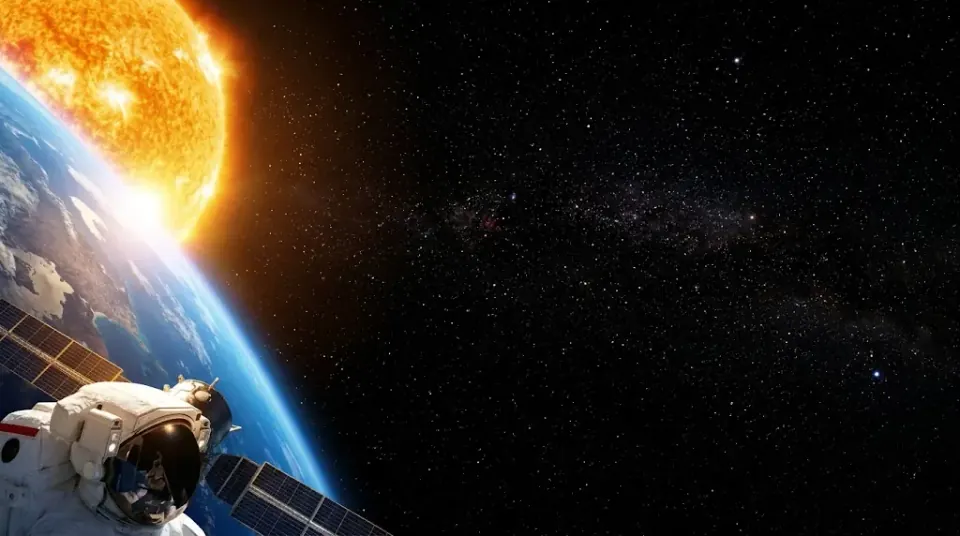
Look at almost any photograph taken from space and you'll notice the same strange contrast: the Sun can be shining directly into the scene, spacecraft and astronauts can be brightly lit, and yet the sky behind them is almost completely black.
It seems as though sunlight should fill everything around it.
It doesn't.
Space looks black because sunlight can travel through the vacuum without scattering much light toward your eyes. On Earth, the atmosphere scatters sunlight in many directions, which is what turns the daytime sky bright blue. In space, there is almost no atmosphere to do that. (NASA Science)
That explains the basic effect. But there's another question hiding behind it.
If the universe contains stars and galaxies in almost every direction, why doesn't all of that light add up to make the sky bright?
That's a different part of the answer.
Sunlight can travel through space without lighting up the space around it
Light doesn't need air to travel.
Sunlight crosses the roughly 150 million kilometers between the Sun and Earth through space, and most of that journey happens through an extremely thin vacuum. The photons don't need molecules of air to carry them along.
What matters is what happens when those photons reach something.
A photon travelling from the Sun toward an astronaut can enter the astronaut's eye directly. The astronaut sees the Sun.
Another photon can hit the astronaut's suit and be reflected into the astronaut's eyes. The suit looks bright.
But imagine looking at a point halfway between the Sun and the astronaut, away from the Sun itself.
There may be very little there to send sunlight toward your eyes.
So there is no glowing blue or white background.
The sunlight is still there. You're simply not seeing a large amount of it coming from that direction.
This is one of the easiest parts of space to misunderstand. We tend to think of light as something that fills the air around a source, but the brightness of the daytime sky on Earth comes largely from light being redirected by the atmosphere.
Without that scattering, the background remains dark.
Earth's atmosphere turns sunlight into a bright sky
Stand outside on a clear afternoon and look away from the Sun.
You're still seeing sunlight.
But you're not looking directly at the Sun.
So how does sunlight reach your eyes?
The answer is Earth's atmosphere.
Sunlight enters the atmosphere and interacts with molecules of gas. Some of the light is scattered away from its original path and sent in other directions. Blue light is scattered more strongly than longer-wavelength red light, which is why the daytime sky appears blue. This is called Rayleigh scattering. (NASA Space Place)
That scattered light reaches your eyes from across the sky.
The result is a sky that appears to be glowing.
It's not that the air itself has suddenly become a giant lamp. The atmosphere is redirecting some of the Sun's light so that you can see it even when you're looking away from the Sun.
Take most of that atmosphere away and the effect largely disappears.
That's what an astronaut sees.
Why is the Sun still blindingly bright in space?
Because the Sun is a direct source of light.
An astronaut looking toward the Sun is receiving sunlight straight from the source. There is no need for atmospheric scattering.
That's why space can contain two apparently contradictory things at once:
The Sun can be extremely bright.
The surrounding sky can be black.
NASA has photographed this exact situation during spacewalks. Astronauts and spacecraft surfaces are strongly illuminated by direct sunlight, while the background sky remains dark because there isn't enough atmosphere around them to scatter sunlight across the field of view. (NASA)
The same thing happens on the Moon.
The lunar surface can be brightly lit by the Sun while the sky above it remains black.
The Moon has essentially no atmosphere capable of producing Earth's familiar blue sky.
Does sunlight need air?
No.
This is another common misunderstanding.
Sunlight is electromagnetic radiation. It can travel through a vacuum.
In fact, if light needed air to move, sunlight could never reach Earth because the space between Earth and the Sun is almost empty.
Sound is different. Sound is a mechanical wave that needs material, such as air, water or a solid, to transmit vibrations.
Light doesn't work that way.
So the absence of air in space doesn't stop sunlight.
It stops the scattering that makes sunlight visible from many different directions.
That's the distinction.
Why can astronauts see stars if space is black?
Stars are light sources themselves.
Their light travels through space and can enter an astronaut's eyes directly, just as sunlight from our own Sun can.
So astronauts can see stars.
The difficulty is that stars are much fainter than the Sun, and nearby objects in direct sunlight can be extremely bright. Your eyes and cameras have to deal with that enormous difference in brightness.
This is also why a photograph taken in space doesn't always look like the image you might expect.
If a camera exposure is set to capture a brightly sunlit spacecraft, astronaut or lunar surface, faint stars may not show up. The camera isn't proving that the stars aren't there. They're simply too dim to register at that exposure.
Change the exposure and faint stars become visible.
The same basic problem happens when you photograph someone standing outside on a sunny day with the Moon in the background. You can expose for the person or for the much fainter Moon, but getting both perfectly exposed in one ordinary photograph is difficult.
Space has an even larger range of brightness.
Why doesn't sunlight make the whole solar system glow?
Because empty space doesn't behave like a foggy room.
Imagine walking through a room filled with smoke while someone shines a flashlight across it. You can see the beam because smoke particles scatter some of the light toward your eyes.
Now remove the smoke.
The flashlight can still shine from one end of the room to the other, but the beam itself becomes much harder to see from the side.
The vacuum of space is much closer to the second situation.
There are still particles of dust, gas and other material in space, so it isn't a perfect vacuum everywhere. But much of interplanetary and interstellar space is extremely sparse compared with Earth's atmosphere.
There simply isn't enough material along most lines of sight to scatter sunlight into a bright background.
That is why photographs from orbit can show an intensely bright Sunlit object surrounded by deep black.
Why is the Moon's sky black during the daytime?
The Moon is a particularly good demonstration of the same physics.
On the lunar surface, the Sun can be above the horizon and shining directly onto the ground. An astronaut standing there is in full sunlight.
Yet the sky is black.
The Moon doesn't have the thick atmosphere Earth has, so there is no widespread scattering of sunlight to fill the sky with blue light. NASA notes that Apollo photographs show this contrast clearly: brightly illuminated lunar surfaces against a black sky. (NASA StarChild)
The Sun doesn't become less powerful just because the sky is black.
The environment around the astronaut simply isn't scattering the light the way Earth's atmosphere does.
Is space completely black?
Not quite.
This is where the simple explanation needs a little qualification.
If you look into a region of space without a bright object in your field of view, it can appear extremely dark, but the universe does contain faint background light.
NASA's New Horizons spacecraft made observations from far beyond the brighter environment around Earth and found evidence of a faint diffuse optical glow from sources throughout the universe. In other words, space is not a mathematically perfect black void with absolutely no visible light anywhere. (NASA Science)
There is also radiation throughout the universe that human eyes cannot see.
The cosmic microwave background, for example, fills the universe but is in the microwave part of the electromagnetic spectrum rather than visible light. Other radiation exists at infrared, ultraviolet, X-ray and gamma-ray wavelengths.
Your eyes only respond to a small part of the electromagnetic spectrum.
So when we say space looks black, we're talking about how it appears to human vision under ordinary viewing conditions, not claiming that there is literally no radiation there.
Then why doesn't the light from billions of stars make the sky bright?
This is the deeper version of the question.
If there are enormous numbers of stars and galaxies, it seems reasonable to ask why their combined light doesn't make every direction in the sky bright.
This problem is known as Olbers' paradox.
In a hypothetical universe that was infinite, unchanging and infinitely old, you could expect every line of sight to eventually end at a star. If that were the case, the entire sky would be filled with starlight rather than mostly darkness. (NASA StarChild)
Our universe doesn't fit those conditions.
It has a finite age, so light from sufficiently distant objects hasn't had unlimited time to reach us. And the universe is expanding, which stretches the wavelengths of light from distant sources. Some light that began at shorter wavelengths can arrive at wavelengths outside the visible range.
So there are really two different reasons the sky looks dark.
On the local scale: there isn't enough atmosphere or other material around you to scatter sunlight into your line of sight.
On the cosmic scale: the universe has a finite history, is expanding, and much of the radiation produced throughout cosmic history isn't arriving at your eyes as visible light.
The first explains why an astronaut can stand in full sunlight beneath a black sky.
The second explains why the universe doesn't appear to be one enormous glowing surface of stars.
Why is Earth's sky blue but space black?
The difference comes down to what the light encounters.
On Earth:
Sunlight enters the atmosphere → gas molecules scatter the light → scattered light reaches your eyes from many directions → the sky looks bright and blue.
In space:
Sunlight travels through a very thin vacuum → there is little material to scatter it → most light continues along its original path → the background remains dark.
The sunlight itself hasn't changed.
The environment around the observer has.
That is why the Sun can be shining just as fiercely above an astronaut as it is above someone standing on Earth, while the two observers see completely different skies.
So why does space look black when the Sun is shining?
Because sunlight doesn't automatically make the space around it glow.
The light can travel through the vacuum in a straight path without being scattered toward an observer. An astronaut looking at the Sun sees its direct light, and an astronaut looking at a sunlit spacecraft sees light reflected from the spacecraft.
But looking away from those objects, there is very little material available to redirect sunlight into the astronaut's eyes.
Earth's atmosphere changes that. It scatters sunlight across the sky, producing the bright blue dome we see during the day. (NASA Space Place)
So the blackness of space isn't evidence that sunlight isn't there.
It's almost the opposite.
It shows how little there is between the light source and the observer to scatter that light around.