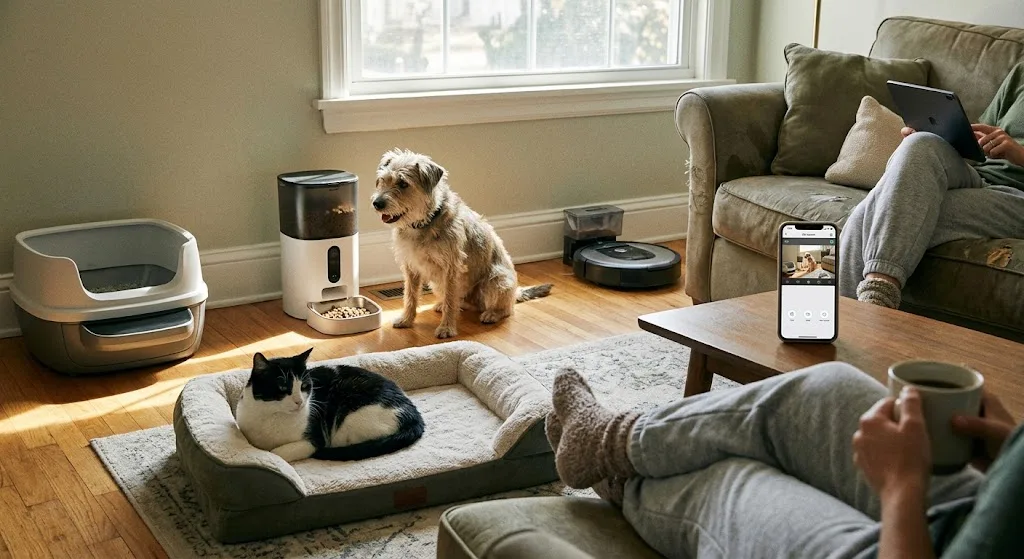
Living with a dog or cat comes with a surprising number of small jobs. Food has to be put out at the right time. Water needs replacing. Paws get dirty. Dogs get bored. Cats eventually turn the litter box into somebody else's problem.
Some pet products are mostly decoration. Others earn their place because they solve one of those recurring jobs and make it easier to handle.
That distinction matters more than ever. Pet owners are still spending heavily on their animals, but recent industry research shows they're becoming more selective about where that money goes. The products holding up best tend to be connected to everyday care, prevention, convenience, enrichment or safety.
The eight products below fit that pattern. They aren't all necessary for every dog or cat, and some are useful only in particular situations. But each one addresses a real problem that pet owners regularly deal with — and each has its own HIAW Products explainer if you want to go deeper on how it works.
1. A gravity feeder and water dispenser
A bowl works perfectly well for many pets. The problem is remembering to refill it.
A gravity feeder solves that particular problem without any electronics at all. Food sits in a reservoir above the bowl, and as your pet eats, more dry food falls down into the feeding area. The same basic principle works with a gravity water dispenser.
The Amazon Basics feeder and water dispenser set we looked at uses this simple system. Its food reservoir holds 152 fluid ounces and the water reservoir holds 135.3 fluid ounces. Transparent containers also make it easy to see when supplies are getting low.
This isn't a smart feeder. It doesn't know what time it is, measure individual meals, recognize your dog or send a notification to your phone.
That's actually part of the appeal.
There is less technology to fail.
For someone who simply wants to make sure a pet has a reserve of dry food and water available during the day, a gravity system can be much simpler than a Wi-Fi feeder.
There is one limitation worth understanding. A gravity feeder doesn't control how much your pet eats. If your dog or cat tends to keep eating as long as food is available, putting a large reservoir in front of them may not solve the feeding problem at all.
It's best thought of as a convenience product, not a portion-control device.
Best for: pets that eat dry food sensibly, busy households and owners who want fewer daily refills.
How a gravity feeder actually works →
2. A treat-dispensing pet camera
A normal pet camera lets you look at your dog or cat while you're away.
A treat-dispensing camera adds another part to the equation: interaction.
The TKENPRO 2K camera we looked at combines a 2K camera with a remotely controlled treat dispenser, two-way audio, night vision, motion alerts and automatic tracking. Its manual recommends dry treats between 7 and 15 millimeters and warns against crumbly treats that could jam the dispenser.
That makes the device more than a surveillance camera.
You can check what's happening, speak through the device and send a small reward without being physically there.
The category is also showing a strong commercial signal. Recent NielsenIQ data reported by GlobalPETS found sales of treat-dispensing cameras increased 32% year over year, while ordinary pet cameras didn't see the same growth.
There is a practical reason for that difference. A camera answers the question, "What is my pet doing?"
A treat dispenser adds, "Can I interact with them?"
That can be useful when you're working late, traveling for a short period or trying to give a pet something engaging during a period when you can't be there.
It shouldn't replace proper care or regular human interaction, though. A camera can tell you that your dog is pacing around the room. It can't take the dog outside.
Best for: owners who spend part of the day away from home and want both monitoring and interaction.
Inside the treat-dispensing camera →
3. A puzzle toy for mental enrichment
A dog can have plenty of physical exercise and still have very little to do with its brain.
Puzzle toys change the way a dog gets food or treats. Instead of simply eating what is placed in front of it, the dog has to investigate the toy, move pieces, sniff, paw or work out where the reward is hidden.
That makes the meal or treat take longer and turns eating into an activity.
The DR CATCH puzzle we looked at is a simple sliding puzzle designed around this idea. Current Amazon-market tracking places this particular product among the leading dog puzzle products, with estimates of roughly 8,000 to 10,000 monthly sales during 2026. Those figures are third-party estimates, not Amazon's published sales numbers, so they should be treated as market indicators rather than exact figures.
The broader category has a stronger story behind it. GlobalPETS reports that pet owners are increasingly looking for toys that provide mental stimulation and enrichment rather than simple entertainment, while recent NielsenIQ data showed electronic toys up 27% and treat-dispensing toys up 15% year over year.
A puzzle toy isn't magic, and not every dog will understand one immediately.
Start with something simple. If the dog can't figure it out, the toy can become frustrating instead of enriching.
The goal isn't to make the puzzle as difficult as possible. It's to give the dog something worth figuring out.
Best for: dogs that eat quickly, seem bored indoors or enjoy food-based games.
How puzzle toys provide enrichment →
4. A dog dental-care product
Dog dental care is easy to overlook because problems develop gradually.
Plaque begins accumulating within hours after eating, and dental disease can progress underneath the gumline where you can't see it simply by looking at the teeth. The American Animal Hospital Association recommends regular at-home dental care, with daily brushing considered the best way to reduce plaque.
That's why dental products can be useful.
The product we looked at, Pup Labs ProDenta, is a powder intended to be added to a dog's food as part of an oral-care routine. It may be convenient for owners whose dogs resist toothbrushes, but it shouldn't be treated as a substitute for brushing or veterinary dental care.
That's an important distinction because "supports dental health" and "removes established dental disease" are very different claims.
Veterinary guidance also recommends looking for dental chews and other products that have evidence behind them. AAHA specifically points owners toward products carrying the Veterinary Oral Health Council seal when choosing dental treats and chews.
If a dog already has heavy tartar, red or bleeding gums, bad breath, drooling or difficulty eating, a powder isn't the point at which the problem should end. Those can be signs that a veterinary dental examination is needed.
Best for: owners building a regular oral-care routine, alongside brushing and appropriate veterinary care.
What dental powders can and can't do →
5. Pet wipes for the mess between baths
There is a large gap between "completely clean" and "needs a full bath."
A dog can come back from outside with muddy paws, pick up dirt around its rear end or simply need a quick clean after a walk. Giving the dog a full bath every time isn't practical.
That's where pet wipes make sense.
The Earth Rated wipes we looked at are designed for paws, body and rear-end cleaning and are unscented. The product is also sold for cats, although any cleaning product should be used according to its intended area and your veterinarian's advice if your pet has a skin condition.
The category isn't just sitting around quietly either.
APPA's 2026 Dog Report says ownership of dog wipes more than doubled year over year, increasing 108%. APPA connects that growth with owners looking for quick, convenient ways to maintain pets between baths and grooming appointments.
That's a good example of a product that sounds almost too ordinary to matter until you think about how often the problem occurs.
A wipe doesn't replace bathing when a dog actually needs a bath. It simply handles the smaller messes that happen in between.
And unlike some heavily marketed pet products, its usefulness is easy to understand.
Best for: muddy paws, quick cleanups, post-walk messes and keeping a dog cleaner between baths.
Why pet wipes earn their place →
6. A GPS pet tracker
A collar tells you where your dog is when you're looking at the dog.
A GPS tracker is for the much less pleasant situation where you're not.
Pet tracking technology has become an established part of the wider pet-tech market, with tracking and wearable devices representing a major segment of the category.
The basic idea is straightforward. The tracker determines its location using positioning technology and communicates that information so the owner can see where the pet is.
The exact technology varies between products. Some rely on cellular networks, some use Bluetooth or nearby devices, and some combine several technologies. That's why two products that both say "pet tracker" on the box can behave very differently.
The tracker we looked at is marketed around real-time location tracking without a monthly fee. That sounds attractive, but "no monthly fee" doesn't automatically mean unlimited tracking with no other requirements. Coverage, battery life, network technology and the product's own service model still matter.
This is one of those products where the right choice depends heavily on the animal.
A cat that never leaves the house may have little use for a GPS tracker.
A dog that regularly escapes the yard is a different story.
Best for: outdoor dogs, escape-prone pets and owners who want an additional layer of location security.
How GPS pet trackers actually find your pet →
7. An automatic litter box
Anyone who has cleaned a litter box knows why people keep inventing ways to make the job less unpleasant.
Automatic litter boxes work by separating waste from usable litter after the cat has finished using the box. The exact mechanism varies, but many systems use a rotating drum, rake or other moving mechanism to collect waste while leaving most of the clean litter behind.
The PetPivot model we looked at is an open-top automatic litter box designed for multiple cats. Its product information describes infrared and Hall sensors that detect a cat's presence and stop the cleaning cycle if the animal enters during operation. It is designed for cats weighing roughly 3 to 22 pounds.
That safety system matters.
An automatic litter box isn't simply a motor attached to a toilet. The machine has to know when the cat is inside, when it is safe to operate and how to move the waste without interfering with the animal.
There is another reason these systems are becoming more interesting.
Cat ownership reached 53 million U.S. households in 2025, according to APPA, and multi-cat households are also increasing. APPA reports that ownership of two cats rose 7% year over year while households with three or more cats rose 7%.
The more cats there are in a household, the more often the litter box gets used.
That doesn't mean an automatic box is right for every cat. Some cats dislike changes to their litter setup, and every automatic system still needs cleaning, maintenance and monitoring.
But for the right household, removing some of the daily scooping can make a genuine difference.
Best for: multi-cat households and owners who want to reduce daily litter-box maintenance.
Inside the self-cleaning litter box →
8. A pet water fountain
Cats have a reputation for being fussy about water, and sometimes that reputation is deserved.
Some cats prefer moving water. Others don't care. A fountain can't force a cat to drink, but it can provide a continuously moving water source that some cats find more appealing.
Cornell's Feline Health Center says some cats increase their water intake when given a fountain, although individual preferences vary. It also recommends keeping fresh water available and making sure cats can reach their water without conflict from other animals in the household.
That's the important part.
A fountain isn't a magical hydration device. It's another way of presenting water.
The Veken 95-ounce fountain we looked at has a 2.8-liter capacity and uses filtration and circulating water. Product information also lists a water-level window and replaceable filtration components.
For a cat that likes drinking from a running tap, a fountain may make more sense than constantly turning the bathroom faucet on.
It also gives owners a larger reservoir to work with, although the water still needs regular changing and the fountain itself needs cleaning. A dirty fountain defeats much of the point.
And if a cat suddenly starts drinking much more or much less than usual, that's not a shopping problem. Changes in drinking can be associated with medical conditions and deserve attention from a veterinarian.
Best for: cats that prefer moving water, multi-pet households and owners who want a convenient way to provide circulating water.
How pet water fountains work →
What makes these eight different from ordinary pet gadgets?
The useful part isn't that they're new.
It's that each one addresses a recurring problem.
A gravity feeder reduces refilling.
A treat camera lets you interact with a pet from a distance.
A puzzle toy turns eating into an activity.
Dental products support an ongoing care routine.
Wipes handle the mess between baths.
A tracker adds another layer of protection when a pet gets loose.
An automatic litter box reduces scooping.
A fountain gives some pets a more appealing way to drink.
That lines up with what current pet-industry research is showing. Owners are becoming more deliberate about spending, and products connected to everyday care, prevention, convenience and enrichment are holding up better than products that are simply nice to have.
There is also a broader shift toward products that do more than one job. APPA found that 65% of dog owners purchased chews in 2025, with chews gaining traction partly because they can reward, entertain, engage and support dental health at the same time.
That's probably the most useful way to think about modern pet products.
Don't ask whether something is technically a "pet gadget."
Ask what problem it removes.
Which ones are actually necessary?
Not all eight.
A dog that eats normally may have no reason to use a gravity feeder. An indoor cat may have little need for a GPS tracker. A cat that happily drinks from a normal bowl doesn't necessarily need a fountain. And an owner who enjoys scooping a litter box every day has no obligation to automate it.
The better approach is to match the product to the problem.
If feeding is the problem, look at a feeder.
If boredom is the problem, look at enrichment.
If cleaning between baths is the problem, wipes make sense.
If dental care is being neglected, establish an actual dental routine.
If a pet escapes, tracking becomes much more useful.
If litter maintenance is taking too much time, an automatic box may earn its space.
And if a cat doesn't drink enough, a fountain is one possible way to make water more appealing.
The best pet product isn't necessarily the smartest one or the most expensive one. It's the one that solves a problem that actually exists in your home.
That is why some of the simplest products on this list can be just as useful as the expensive gadgets.