
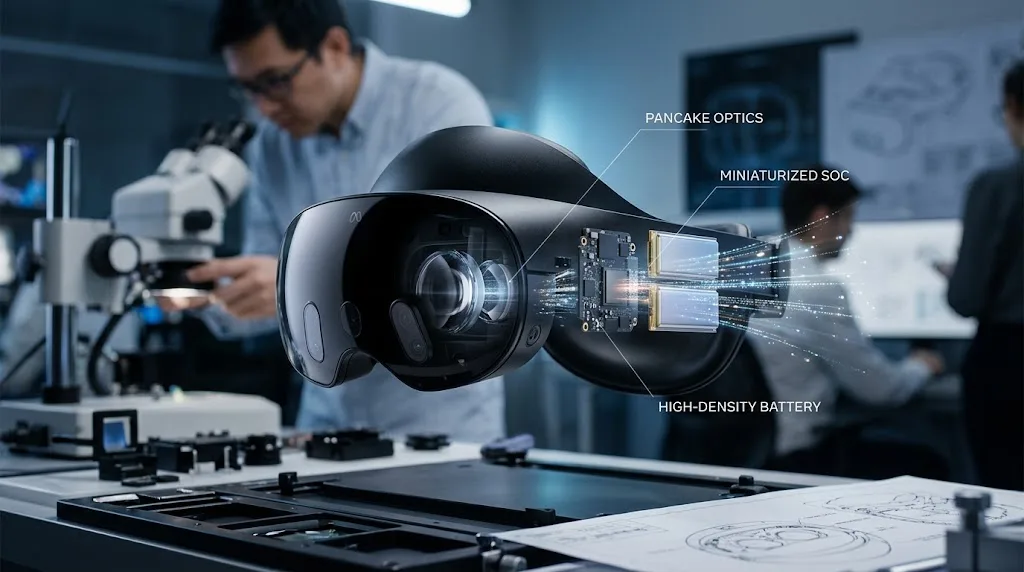
A normal VR headset puts almost everything on your head. The screens are there. The lenses are there. The processor is there. The battery is there. The cameras and sensors are there. All of it has to sit in front of your face while you move around.
Meta's new VR Glasses take a different approach.
The glasses themselves weigh about 100 grams, roughly one fifth the weight of a Meta Quest 3. They still have high-resolution displays, cameras, eye tracking, hand tracking, speakers and the sensors needed to understand where you are and what you're doing.
The part that makes the weight possible is sitting somewhere else.
A cable connects the glasses to a small compute puck that you can keep in your pocket or attach to clothing. The puck contains the processor, battery and storage, while the glasses concentrate on the things that actually need to be close to your eyes.
That split is the basic reason Meta can make a VR system that looks more like a pair of glasses than a traditional headset.
The trick is moving the heavy parts away from your face
Think about the components inside a conventional VR headset.
A processor needs power and cooling. A battery needs physical space. Storage needs space too. Then there are displays, lenses, cameras, tracking hardware, speakers and all the electronics connecting everything together.
None of those parts are especially useful because they're sitting on your forehead.
They are there because a traditional VR headset has to be an all-in-one computer.
Meta's VR Glasses separate those jobs.
The glasses contain the display and sensors. The compute puck handles the processor, battery and storage. An optical tether connects the two.
So when Meta says the glasses weigh about 100 grams, that doesn't mean the entire VR system weighs 100 grams.
It means about 100 grams is sitting on your face.
The rest is somewhere else.
What's actually inside the glasses?
There is still quite a lot packed into that small frame.
The most obvious component is the display system. Meta calls it a 5K Infinite Display, built from micro-OLED panels. The developer specifications list 2,412 × 2,288 pixels for each eye and 37 pixels per degree.
That is a lot of display detail for something small enough to sit inside glasses.
The panels also run at up to 120 Hz, which matters because VR has to update the image quickly as your head and eyes move.
In front of those displays are compact pancake lenses.
Pancake optics are useful here because they can fold the optical path inside a much thinner package than older lens arrangements. Light effectively travels through the optics in a more compact arrangement instead of requiring a long, bulky space between the display and your eyes.
That's one of the reasons modern VR hardware can get thinner without simply giving up the display.
The glasses also have cameras and tracking sensors.
Meta's system uses eye tracking, hand tracking and head tracking, so the device has to understand both the position of the headset and what you're looking at.
There are also speakers built into the frames.
So the glasses aren't empty shells with screens in them.
They're doing quite a bit.
They just aren't doing everything.
The processor lives in your pocket
This is the biggest difference.
The compute puck contains the main processing hardware, along with the battery and storage.
That matters because processors aren't just little chips that can be dropped anywhere without consequences. A powerful processor needs electrical power, and the more work it performs, the more heat it can produce.
Putting that hardware beside your eyes creates several problems at once.
It adds weight.
It takes up space.
It produces heat close to your face.
And it requires a larger battery to power the system.
Move those parts into a pocket and suddenly the glasses have a much easier job.
The puck can be larger without making your head heavier.
It can also deal with heat in a different place. Meta's own developer documentation describes separate thermal management for the glasses and the compute puck, which reflects the fact that the two pieces have different thermal loads.
This is one of those engineering decisions that looks simple after someone has made it.
Move the heavy stuff.
But that decision changes the whole shape of the product.
Why does the system need the puck at all?
VR needs a surprising amount of computing power.
The system has to generate two slightly different images, one for each eye. It has to keep those images aligned with the movement of your head. It has to process camera information. It has to track your eyes and hands. It has to run the operating system and applications.
And it has to do all of that while maintaining a high frame rate.
The Meta VR Glasses use the same Horizon OS platform and software ecosystem as Meta's Quest devices. The developer specifications list a Snapdragon XR2 Gen 3 class processor for the glasses system, along with 12 GB of memory.
That is not the sort of computing hardware you normally associate with lightweight eyewear.
So Meta doesn't try to squeeze the entire computer into the frame.
The puck becomes the computer.
The glasses become the display and sensing system attached to it.
What does the cable actually do?
The cable is the physical connection between the two halves.
Meta describes it as an optical tether.
That lets the glasses receive the information they need from the computer without requiring the main processor to sit inside the frames.
It's a trade.
A completely wireless VR headset is convenient because everything is contained in one device. Meta's approach gives up some of that freedom in exchange for dramatically reducing the weight on your face.
You don't get rid of the hardware.
You relocate it.
That distinction is easy to miss when looking at photographs of the glasses because the puck can disappear into a pocket.
But it's doing a lot of the work.
The battery moved too
The battery is another major reason conventional VR headsets become bulky.
A battery capable of powering a processor, displays, cameras, wireless radios and sensors for an extended period needs physical volume.
There isn't much room for that inside a pair of glasses.
So Meta puts the battery in the puck as well.
The result is a slightly unusual arrangement. The thing touching your face is relatively light, while the larger battery is carried somewhere else on your body.
It's similar to the way some older electronic devices used an external battery pack, except here the external unit is also the computer and storage system.
That makes the weight easier to carry because your face and neck are much more sensitive to weight than your pocket is.
A few hundred grams in a pocket is mostly an inconvenience.
A few hundred extra grams hanging several centimeters in front of your face can become uncomfortable surprisingly quickly.
How can the glasses track your eyes?
Eye tracking requires sensors inside the glasses that can observe the user's eyes.
Those sensors don't need the full computing system beside them.
They collect information about where the eyes are looking, and the larger computer can process that information.
Eye tracking also has another useful job.
It can help the system decide where it needs to spend its rendering power.
This is called eye-tracked foveated rendering.
The basic idea is straightforward. Your eyes see the center of your vision in much greater detail than the far edges. The computer can therefore devote more rendering effort to the area you're actually looking at instead of treating every pixel as equally important.
Meta's developer documentation says foveated rendering can reduce GPU work and power consumption in suitable workloads.
That matters in a small system because every bit of saved processing can mean less heat and less battery consumption.
So eye tracking isn't only about controlling menus with your gaze.
It can also help the computer decide where to spend its resources.
What about hand tracking?
The glasses also use cameras to watch your hands.
That allows you to interact with virtual objects without necessarily holding controllers.
Meta's design for the device uses your eyes and hands as the primary input. You can look at something and use a hand gesture, such as a pinch, to select or manipulate it.
The system doesn't need a separate pair of handheld controllers for every interaction.
That's another piece of hardware Meta can leave out of the default experience.
Controllers are still supported, but they aren't required for the basic eyes-and-hands interface.
This is particularly useful for a device designed to look and feel less like gaming equipment.
How does it see the real world?
The cameras on the glasses are also used for passthrough.
Passthrough means the cameras capture the physical environment and the system displays that view while placing digital objects over it.
That is how mixed reality works.
The computer isn't making the room disappear completely. It's taking camera information about the room and combining it with computer-generated graphics.
Meta's developer documentation describes full-color passthrough and depth information on the VR Glasses.
So if you're working with a virtual screen while sitting at a real desk, the system can maintain an understanding of that physical environment while showing the digital content.
Again, much of the processing happens away from your face.
The lenses are doing some of the work too
The display isn't simply a tiny television sitting directly in front of your eyes.
The optical system matters just as much as the panel.
The glasses use pancake lenses designed to keep the optical assembly compact while producing a large virtual image from the small micro-OLED displays.
This is part of why the device can create the impression of a huge cinema screen without actually having a huge screen.
You're looking at a small display through an optical system that makes the image appear much larger.
It's the same basic trick that allows other modern VR headsets to create large virtual environments from relatively small physical panels.
The difference here is that Meta has to fit the whole optical system into something much closer to ordinary eyewear.
So why aren't normal VR headsets this light?
Because they are solving a slightly different problem.
A Meta Quest 3 is an all-in-one wireless computer. Its processor, battery, storage and other electronics are all attached to the headset.
It also has a wider field of view.
The Meta VR Glasses have a nominal field of view of about 70 degrees horizontally by 66 degrees vertically, compared with about 110 by 96 degrees for the Quest 3.
That's a meaningful difference.
The lighter design doesn't come entirely for free.
Meta has changed the balance between weight, field of view, computing location and physical design.
The result is a device that is much lighter on your face, but it isn't simply a Quest 3 shrunk down without compromise.
The glasses are lighter because the system isn't all in one place
This is the part that can get lost in the headline number.
The Meta VR Glasses don't contain an entire high-powered VR computer inside 100 grams of eyewear.
Instead, Meta divided the machine into two pieces.
On your face:
- Micro-OLED displays
- Pancake lenses
- Eye-tracking hardware
- Cameras and tracking sensors
- Speakers
- Other electronics needed to operate the glasses
In the pocket or on your clothing:
- Main processor
- Battery
- Storage
- Much of the computing hardware
Between them:
- An optical tether carrying the connection between the glasses and the compute puck
That is the engineering trick.
Nothing has disappeared.
The weight has simply been moved to a place where it is easier to carry.
And that may be the more interesting part of Meta's new VR Glasses. The company isn't making the computer dramatically smaller in every respect. It's changing where the computer lives.
For years, making VR more comfortable largely meant making the headset itself lighter.
Meta's approach asks a different question: what if the headset doesn't have to carry the whole computer in the first place?
That leaves you with a pair of glasses on your face and a small computer in your pocket.
It's still VR.
It's just no longer all hanging from your head.