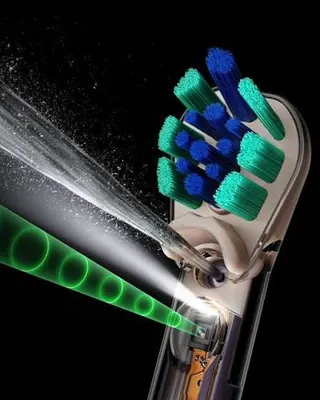
Most toothbrushes have a fairly simple job. The bristles move across your teeth, you guide the handle around your mouth, and you try not to miss the places where plaque tends to collect.
The Dyson CameraJet takes a very different approach.
There is a tiny camera built into the brush head. While you brush, it looks inside your mouth and captures images of your teeth. Dyson's Gap Optical Targeting system then uses those images, together with a machine-learning system, to identify, track, and predict the spaces between your teeth. When the system detects a target, the toothbrush fires a small burst of mouth rinse toward it.
So the short answer is that the CameraJet doesn't somehow measure the gaps mechanically. It sees them.
The interesting part is what happens between seeing a gap and firing the jet.
The short answer
Dyson says the CameraJet's 100,000-pixel macro camera captures 28 images per second. Those images are processed by a machine-learning system trained on more than 470,000 dental images. The system identifies and tracks interdental gaps and predicts their position well enough for the toothbrush to fire a targeted jet — and Dyson says this can happen within 100 milliseconds of the camera seeing a gap.
That sounds simple when it's compressed into one sentence. It isn't.
Between the camera and the jet there are three separate problems to solve: making a usable image inside a moving mouth, recognizing a gap in that image, and predicting where the gap will be by the time the liquid arrives. Each one is its own piece of engineering.
What the tiny camera actually sees
The camera in the CameraJet is extremely small. Dyson describes it as a 100,000-pixel macro camera about 1 mm in size, paired with a dome-shaped target lens and stroboscopic lighting designed to keep the scene visible.
Its job isn't to take a nice photograph of your teeth.
It needs to produce an image that's good enough for the software to work out where one tooth ends and the space between two teeth begins.
That's harder than it sounds. Inside your mouth, the camera is looking at curved tooth surfaces, gums, bristles, saliva, and toothpaste. The brush itself is moving, too — Dyson says the brush head moves nearly 1,000 times per second while the camera analyzes 28 images each second.
The lighting is therefore part of the system, not a cosmetic feature. Dyson says the stroboscopic light and dome-shaped lens are there to improve visibility and the camera's field of view. In other words, the hardware exists to keep the scene readable for the software, not for your eyes.
The result is a rapid stream of small images showing the area immediately around the brush head.
The computer then has to make sense of them.
How the system recognizes a gap
This is where Dyson's Gap Optical Targeting comes in.
Dyson says its machine-learning algorithm identifies, tracks, and predicts the spaces between teeth, and that the system was trained using more than 470,000 dental images collected during development. That tells us something useful about the system — although Dyson has not published the detailed architecture of the model or exactly which computer-vision techniques it uses.
In practical terms, the software has been trained to recognize the visual characteristics of interdental spaces.
A gap isn't just an empty black line in an image. Its appearance changes depending on the angle of the camera, the shape of the teeth, the position of the brush, and the lighting.
That's why the machine-learning system is doing something closer to visual classification and tracking than simply searching for a particular color or shape. It receives an image and determines which part of that image corresponds to the target area.
Then it has another problem to solve.
The toothbrush is moving.
Why the toothbrush has to predict where the gap will be
If you point a camera at a stationary object, you can take your time deciding where that object is.
The CameraJet doesn't have that luxury.
The brush head is moving around your mouth, and the hand holding it is moving at the same time. By the time the camera has seen a gap, the brush head may already be in a slightly different position.
This is why Dyson says Gap Optical Targeting doesn't just identify gaps. It tracks and predicts them. That distinction matters.
Imagine the camera sees the space between two teeth at one instant. The toothbrush then continues moving. The system needs to estimate where that target will be relative to the jet when the liquid is actually released.
Dyson says the system can detect and jet a gap within 100 milliseconds of seeing it. So the process isn't simply "see gap, spray." It's closer to:
See gap → identify it → track its position → predict where it will be → trigger the jet.
Dyson hasn't publicly explained the exact mathematical model used for that prediction, so it would be wrong to claim the toothbrush uses any particular tracking algorithm or neural-network architecture. But the engineering problem is clear from the way the company describes the system: the target is moving, and the cleaning action has to follow it.
How the jet actually fires
Once the software has identified the target, another part of the system takes over.
The CameraJet contains a small fluid system designed to produce a targeted burst of liquid. Dyson calls this the Conical Jet. The company says it can deliver up to 0.15 milliliters of liquid between the teeth, and that a diaphragm pump generates the pressure needed to deliver the burst quickly — in as little as a tenth of a second.
The nozzle is designed to produce a cone-shaped spray rather than a single needle-like stream.
That makes sense for the target. The device isn't trying to drill a microscopic hole between two teeth. It's trying to move liquid through an interdental space and disturb the material sitting there.
The timing is what makes the whole arrangement unusual. The camera and the machine-learning system determine where the target is. The fluid system determines how to send liquid there. The two have to work together quickly enough that the jet arrives at the intended area while the toothbrush is still moving.
Why the CameraJet needs its own liquid
The CameraJet isn't an ordinary toothbrush that happens to have a camera attached. Dyson sells it as a system that includes its own toothpaste and mouth rinse — and the reasons are optical, not just commercial.
Dyson describes its toothpaste as non-foaming and says the formulations are engineered to work with the camera system. From the camera's point of view, that's logical: foam, bubbles, and a thick layer of paste would make a tiny optical target much harder to identify. If the software needs to recognize a small space between two teeth, keeping the scene optically clear matters.
The rinse, meanwhile, is designed for the jet — a liquid that has to behave predictably when it's pushed through a tiny nozzle in a fast burst.
This is one reason the CameraJet is more complicated than putting a miniature camera on an electric toothbrush. It's an optical system, a computer-vision system, a toothbrush, and a fluid-delivery system operating together.
What happens when the camera can't see clearly
This is one area where the public information is limited.
Dyson explains the camera, the lighting, the lens, and the machine-learning system, but it doesn't publish a complete list of the conditions under which Gap Optical Targeting will refuse to fire or lose a target.
The company does say the camera is optimized for short-range detection and only operates when needed for features such as auto-jetting and live viewing.
So it would be a mistake to describe the CameraJet as having perfect vision inside your mouth. Like any camera-based system, its performance depends on the quality of the visual information available to it. Dyson has built the hardware around that problem, using a dedicated lens and stroboscopic illumination, but the company hasn't publicly provided enough detail to say exactly how the software handles every possible obstruction, angle, or loss of visibility.
That's one of the unanswered engineering questions around the product.
Does the CameraJet store what it sees?
According to Dyson, no.
The company says images used by the CameraJet are processed on the device or through the MyDyson app and are not stored or shared. Dyson also says neither it nor third parties can access the live camera view. The camera can show you a live view in the MyDyson app, but only when you choose to use that feature.
That makes the CameraJet a little different from the way people normally think about an AI camera.
The camera isn't there primarily to collect photographs. It's there because the toothbrush needs visual information to perform a physical task.
See the target. Locate it. Follow it. Then tell the jet where to go.
What the AI actually knows about your teeth
Not as much as the word "AI" might suggest.
The system doesn't need to understand your mouth the way a dentist does. It doesn't need to know your name, identify every tooth in your mouth, or make any kind of medical diagnosis.
Its job is much narrower: find the visual pattern that corresponds to a gap between teeth, and keep track of that target well enough to direct the cleaning system toward it.
The training on more than 470,000 dental images gives the software examples from which it learned what those visual structures look like. The exact model and processing pipeline are proprietary, though.
So when a description says the CameraJet's AI "recognizes your teeth," that's a useful simplification — but it isn't a complete account of what Dyson has documented. The more accurate description is that the system uses machine learning to identify, track, and predict interdental gaps for the purpose of controlling the jet.
What happened with the early CameraJet failures
No explanation of this product is complete without acknowledging the reports that followed its launch.
WIRED reported failures and leakage complaints from some early users, and says Dyson acknowledged a component issue affecting some early batches. Dyson maintains that the wider supply shortage reflects strong demand and production scaling, and disputes the implication that it amounts to a recall.
For the mechanism story, none of that changes how the targeting chain is designed to work — but it's a reminder that a brand-new product category usually arrives with rough edges, and that Dyson's engineering claims and the product's real-world reliability are two separate questions.
The whole process in one sequence
Put the pieces together and the full chain looks like this:
- 1The camera seesA 1 mm macro camera captures the area around the teeth 28 times per second.
- 2The image is illuminated and capturedStroboscopic light and the dome-shaped lens keep the tiny scene readable.
- 3Machine learning identifies the gapGap Optical Targeting finds the part of the image that is an interdental space.
- 4The system tracks and predicts its positionAs the brush moves, it estimates where the gap will be when the jet fires.
- 5The pump prepares the liquid burstThe diaphragm pump pressurizes up to 0.15 ml of rinse.
- 6The conical jet fires into the targetThe cone-shaped spray is released toward the predicted position.
The bristles are still doing the ordinary brushing the whole time. The camera adds a targeting system on top of that — and the software is what turns the camera's images into a physical action.
So how does it actually know where to spray?
It doesn't "know" in the human sense. It sees a visual target and uses software to track and predict its position.
Dyson says the camera analyzes 28 images every second and that the system can detect and jet a gap within 100 milliseconds. The camera isn't there so you can look at your teeth — it's part of a control system. It gives the toothbrush information about where the target is, and the software uses that information to decide where the liquid should go.
There's still plenty Dyson hasn't disclosed, including the precise computer-vision architecture and the details of how its prediction model works. But the basic mechanism is clear enough: the CameraJet turns a live image of your mouth into a moving target, then uses that target to control a physical jet.
And that's why a toothbrush suddenly needs a camera.
We also keep a dedicated CameraJet product explainer in HIAW Products — the mechanism at a glance, what's happening inside, and what to know before buying.
This explainer reflects Dyson's public documentation and third-party reporting as of September 2026. The CameraJet is a brand-new product, and if Dyson publishes more technical detail — about the camera, the targeting model, or the fluid system — this article will be updated.
If your question is more practical than mechanical — whether the CameraJet can actually replace flossing — we looked at that separately, at what the evidence actually says.