
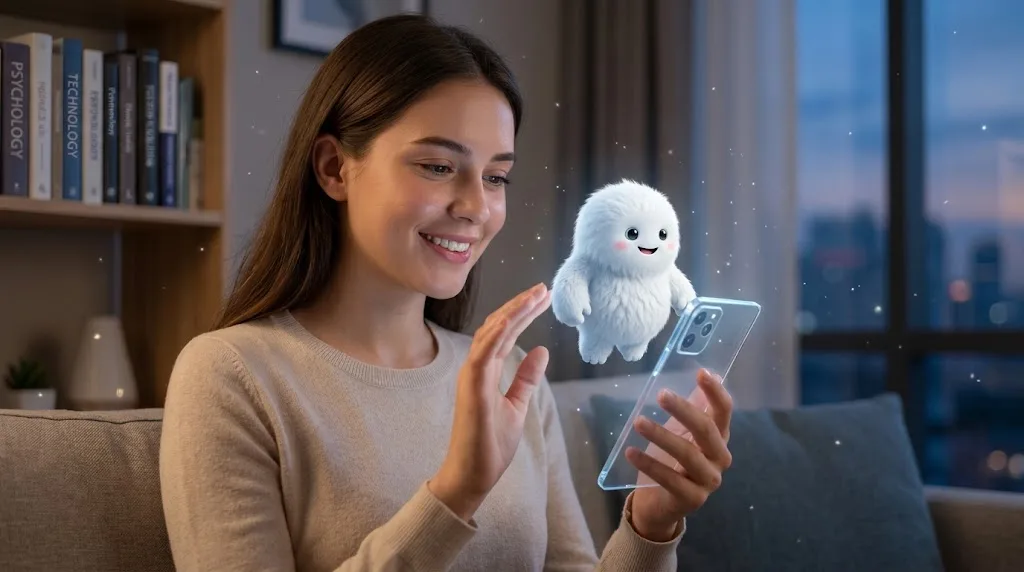
If you open an ordinary AI chatbot, you usually get a text box, a logo and a blinking cursor.
Meta's Muse is different. It has a name, a voice, a personality and an animated character called Jolly. Meta has even put that character into the design of Muse Charm, its small physical device for interacting with Muse.
That might seem like a cosmetic choice. It isn't entirely one.
Giving an AI a face changes the way people perceive the thing they're talking to. Research into human-computer interaction has found that human-like voices, appearances and communication styles can increase social presence and affect trust, attraction and willingness to keep using an AI system. Some newer research has also linked anthropomorphic design with emotional attachment to AI. (ScienceDirect)
That doesn't mean Meta created Jolly simply to make people trust Muse. We can't know the company's private reasoning unless Meta says so.
But we can explain why a character is useful in an AI interface, why cute design can have an effect on people, and why the choice becomes more significant when the AI is supposed to handle personal information and tasks.
What is Jolly supposed to be?
Jolly is the visual character associated with Meta's Muse AI.
Muse itself is more than a chatbot. Meta describes it as a personal AI agent that can take actions for the user, including tasks such as sending email and booking travel. It can also remember relevant information and work through a dedicated virtual computer environment called Muse Secure VM. (Facebook)
The character sits on top of all of that.
Instead of interacting with an invisible software system, the user sees and hears something with a recognizable identity.
That distinction matters because software doesn't naturally have a face or a physical presence. A traditional app can show a button, an icon or a notification, but none of those necessarily suggests that another entity is participating in the conversation.
A character does.
The effect is similar to what has happened with virtual assistants, animated customer-service agents, game characters and virtual pets. The computer is still doing the computing, but the interface gives the interaction a social shape.
Why give an AI a personality?
People naturally assign human characteristics to things that aren't human.
We give names to cars. We talk about computers being stubborn. People apologize to voice assistants when they accidentally interrupt them. Children can become attached to virtual pets even though the animal on the screen obviously isn't alive.
Psychologists call the broader tendency anthropomorphism, which means attributing human characteristics, intentions or emotions to non-human things.
AI makes this tendency particularly easy to trigger because the software talks back.
A search engine gives you results.
A conversational AI answers you.
Once something responds in natural language, remembers parts of a conversation and uses a recognizable voice, the interaction starts to resemble ordinary social communication.
Adding a face or character pushes that effect further.
Research on intelligent personal assistants has found that anthropomorphic design can increase social and task attraction, which can then influence trust. In other words, the effect isn't necessarily as simple as "make it human and people trust it." The human-like qualities can make the system feel more socially engaging, and that can influence how people judge it. (ScienceDirect)
Why make the character cute?
This is where Jolly's design becomes more interesting.
A neutral corporate avatar could have represented Muse perfectly well. Meta could have used a geometric logo, a glowing orb or a simple animated icon.
Instead, it chose a soft, cartoon-like character.
Current coverage of Muse has repeatedly described Jolly in terms associated with toys, virtual pets and childlike character design. The Guardian has specifically examined the use of cuteness around Muse, while Wired has questioned why an adults-only AI product has been given a mascot that resembles a children's character. (WIRED)
Cuteness has a useful property in interface design: it can make something unfamiliar feel less threatening and more approachable.
That doesn't mean every cute object becomes trustworthy. It means the visual design can change the emotional starting point of an interaction.
A machine with a stern-looking face sends one set of signals.
A small, expressive character sends another.
That matters when the technology is complicated.
Muse is asking people to interact with an AI agent that can remember information, access connected services and perform actions on their behalf. Meta is trying to turn something technically complicated into something that feels understandable enough to talk to.
A character helps with that.
Does making AI look human actually make people trust it?
Sometimes, but the research is more complicated than the popular explanation suggests.
A 2025 study examining anthropomorphism in virtual agents found that human-like appearance and behavior could increase trust through perceptions of warmth and competence. The researchers also found that excessive anthropomorphism could have the opposite effect under some circumstances. (ScienceDirect)
Another study published in 2026 found that anthropomorphic language increased trust in an AI system. But it also found something more uncomfortable: people could assign more responsibility for the AI's actions to the AI itself and less responsibility to the company that created it. (University of California Press)
That distinction matters.
If an AI assistant makes a mistake, a user should still understand that the system was designed and deployed by a company. Giving the software a personality can make that boundary less obvious.
A friendly character doesn't become responsible for the system simply because it looks like one.
Why an AI face can change the conversation
There is another effect worth considering.
When an AI has a face, voice and personality, people may stop treating the interaction purely as an exchange with software.
Research into conversational assistants has found that anthropomorphic cues can increase perceived social presence. Social presence is basically the feeling that another social entity is present during an interaction. (ScienceDirect)
That can be useful.
A person may find a voice assistant easier to talk to than a complicated menu system. A character can make an unfamiliar feature easier to understand. A consistent personality can make an assistant easier to remember and recognize.
But there is a tradeoff.
The more socially present a system feels, the easier it may become to forget what it actually is.
Muse isn't a friend sitting on the other side of the conversation. It is an AI system operating through Meta's software and infrastructure.
That distinction becomes more important as the system gains access to more of someone's life.
This is where privacy gets interesting
Muse isn't being designed merely to answer trivia.
Meta says Muse can connect to services, work with email, handle tasks and remember information that matters to the user. The company says users control which services Muse can access and that the system asks for approval before sensitive actions such as sending an email or making a purchase. (Facebook)
That's useful functionality.
It also means the relationship between the user and the AI matters more than it would with a simple question-and-answer chatbot.
If the interface feels cold and mechanical, a person may naturally maintain some distance.
If the interface feels warm, familiar and personal, that distance can shrink.
A 2026 study specifically examining human-AI attachment found that anthropomorphism was the strongest predictor of the attachment orientations it measured. The researchers developed a scale for measuring emotional support, separation distress and the sense of AI as a secure base. (PubMed)
That doesn't mean everyone who uses Muse will become attached to Jolly.
It means the possibility of emotional attachment is no longer a purely science-fiction question. Researchers are now measuring it.
So is Jolly basically a virtual pet?
Not exactly.
But the comparison makes sense.
Virtual pets work partly because they turn software into something that feels like an entity with a continuing identity. The character remains recognizable from one interaction to the next.
Muse is doing something similar at a more sophisticated level.
Instead of feeding a digital animal or keeping it alive, you're talking to an AI agent that can perform tasks, remember information and interact with services.
The character gives those capabilities a visible identity.
That's also why the Muse Charm is significant.
Meta describes the Charm as a small device designed specifically for talking and interacting with Muse, with a real-time voice model built into the experience. Reports about the device describe a small display showing the Muse character. (Facebook)
The character therefore isn't confined to an app.
It can become part of the physical interface.
Why put the character on a physical device?
A chatbot on a phone already has a screen.
A dedicated AI device has to justify its existence somehow.
A character helps give the hardware an identity.
Without one, a tiny AI device can feel like a miniature computer with a screen. With one, it starts to resemble something you interact with rather than something you operate.
That's a subtle difference, but it's important to the direction Meta is taking.
The company isn't only building an AI model. It's building several ways to encounter that AI, including phones, AI glasses and the Muse Charm. Meta has described these as different ways of connecting with a personal agent throughout the day. (Facebook)
The character gives all of those interfaces something in common.
Whether Muse is speaking through glasses, appearing on a phone or sitting on a little screen in your pocket, the user is still interacting with the same recognizable entity.
Is Meta trying to make Muse feel like a companion?
The design certainly moves in that direction, but "companion" is stronger than what Meta officially promises.
Meta describes Muse as a personal AI agent that can help with goals and tasks. It emphasizes usefulness, memory, conversation and action rather than presenting Muse as a replacement for human relationships. (Facebook)
Still, the design makes the interaction feel more personal than a conventional productivity tool.
A name does that.
A voice does it.
Memory does it.
A recognizable character does it even more.
Put all four together and the software becomes easier to perceive as a continuing presence rather than a tool you open and close.
That may be exactly why the design has attracted so much attention.
There is a downside to making AI feel friendly
The same qualities that make an AI approachable can also make it easier to overestimate.
A character can be charming without being accurate.
A friendly voice can sound confident when the underlying answer is wrong.
An expressive avatar can make a response feel thoughtful even when the system is simply generating a plausible answer.
That distinction is especially important for an agent like Muse because it isn't limited to producing text. Meta wants it to perform actions.
The better the interface becomes at making the AI feel socially competent, the more important it becomes for users to judge the actual capability of the system separately from its personality.
A cute face doesn't make an AI more intelligent.
A pleasant voice doesn't make an answer more accurate.
And a character isn't evidence that the system understands a person in the same way another human being does.
Why Meta chose a character instead of a simple logo
We can't see inside Meta's design meetings, so there isn't a factual answer to the company's private motivation.
But the broader technology and psychology make the design choice understandable.
A character can:
- give an invisible AI a recognizable identity
- make voice interaction feel less mechanical
- create continuity between different devices
- increase social presence
- make an unfamiliar technology feel more approachable
- give users something visually recognizable to associate with the assistant
- encourage a more personal style of interaction
Research suggests that some of those effects can influence trust, engagement and attachment. (ScienceDirect)
That doesn't make Jolly inherently manipulative, and it doesn't prove that Meta designed it specifically to lower people's defenses.
It does mean the character is doing more than decorating the screen.
The bigger change is happening underneath
The interesting part of Muse isn't really the cartoon.
It's the direction of AI interfaces.
For years, the standard AI interface was a box.
You typed something.
The machine answered.
Then AI became conversational. Now companies are trying to make it persistent, personal, proactive and capable of taking actions.
Once an AI starts behaving more like an ongoing assistant, companies have a design problem: what should that assistant feel like?
A text box makes it feel like software.
A voice makes it feel more present.
A memory makes it feel more personal.
A face makes it feel more social.
A physical device makes it feel like something that exists in the user's everyday environment.
Muse is moving through several of those layers at once.
That's why Jolly matters.
The character isn't the intelligence inside Muse. It is the interface people use to understand and relate to that intelligence.
And humans are very good at relating to things that appear to have a recognizable identity.
So why does Meta's Muse have a cute character?
Because a character changes the relationship between a person and an otherwise invisible piece of software.
Meta has built Muse as a personal AI agent rather than a conventional chatbot, and the company is putting that agent into phones, glasses and eventually dedicated hardware. A recognizable character gives that agent continuity across those experiences. (Facebook)
Psychology helps explain why that matters.
Human-like voices, appearances and behavior can increase social presence. Under some conditions, anthropomorphic design can influence trust and engagement. Research is also beginning to show that people can form genuine emotional attachments to AI systems. (ScienceDirect)
The cute design therefore isn't just about making Muse look nicer.
It changes how the technology is perceived.
The important part is remembering that perception and capability aren't the same thing. Jolly may look friendly, familiar and expressive, but underneath the character is still an AI system that can make mistakes, handle personal information and act within the permissions it has been given.
The more human an AI feels, the more useful it becomes to remember that it isn't one.